New, Dedicated Archaeology Lab Unearths Opportunities
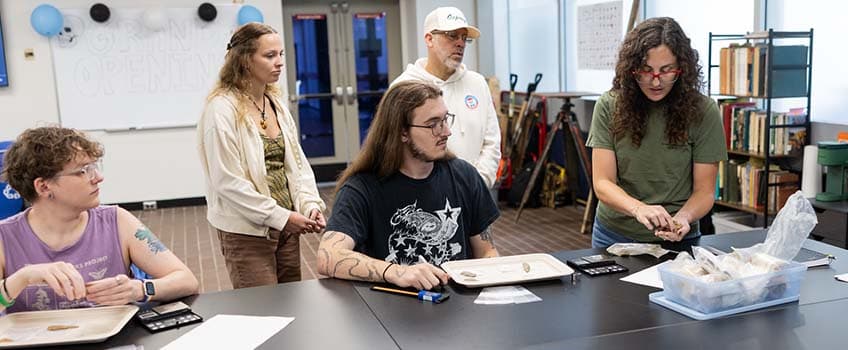
From left, Archaeology students Rain Bohrer, Chelsea Farrell, Marshall Skelton (sitting) and Julio Ruiz watch Associate Professor of Archaeology Bobbi Hornbeck handle some artifacts from a recently donated collection of Native American stone tools by South Jersey archaeologist Dick Regensubrg '76.
Galloway, N.J. — Bobbi Hornbeck wants to put Stockton University’s Archaeology program “on the map in South Jersey.”
A new dedicated lab space and storage room that opened in September will go a long way toward doing just that, said the Assistant Professor of Archaeology.
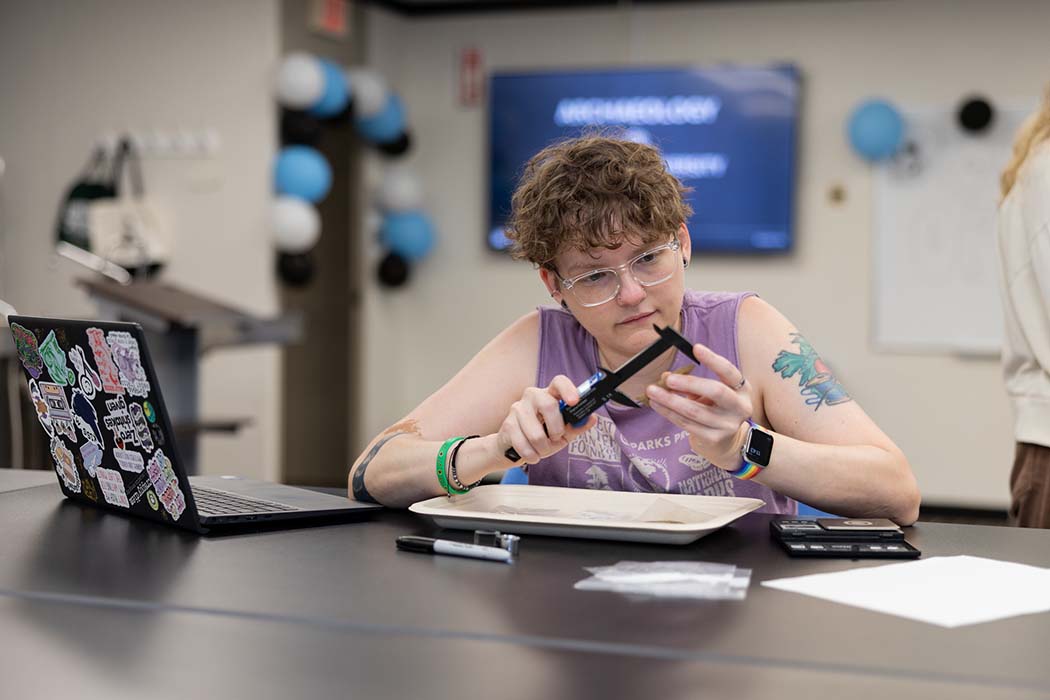
Rain Bohrer, a senior Anthropology major from Egg Harbor Township, takes measurements of some of the artifacts from the collection of Dick Regensburg. Regensburg’s collection of more than 100 items contains mostly Native American stone tools that are 4,000 to 5,000 years old, some reference books and field gear from his career.
“Private donors and collection holders are much more likely and willing to collaborate with places like Stockton now when they know they have a safe, secure and respectable place to give or loan those materials to,” Hornbeck said. “I want to encourage people in South Jersey to start to identify Stockton as an archaeological space that can be called upon.”
The new lab includes a sink large enough for flotation and washing, a more than 2-meter-long soil table, a dedicated computer with proper archaeology software for mapping and data analysis, photography and microscope stations, 10 student workstations and a separate room for storing artifact collections.
For senior Rain Bohrer, the new lab is a dramatic improvement over the spaces where she previously examined collections.
“Bobbi’s office was our lab. She had a tiny cupboard where she would store the artifacts in little boxes on the shelves,” said the Egg Harbor Township Anthropology major. “We would set up in a room with a light that was on a timer that would shut off constantly as we tried to identify what the items were. It was not the best situation.”
Stockton Provost Michael Palladino agreed, adding that creating the lab was one of the first projects he talked about doing when he came to campus two years ago.
“When you have a faculty member working on National Science Foundation-funded research projects at different locations around the world, giving students experiential opportunities, it was very clear she didn’t have lab space to do this,” he said. “For some students this could be the hook that may inspire them to do a graduate degree or follow-up research.”
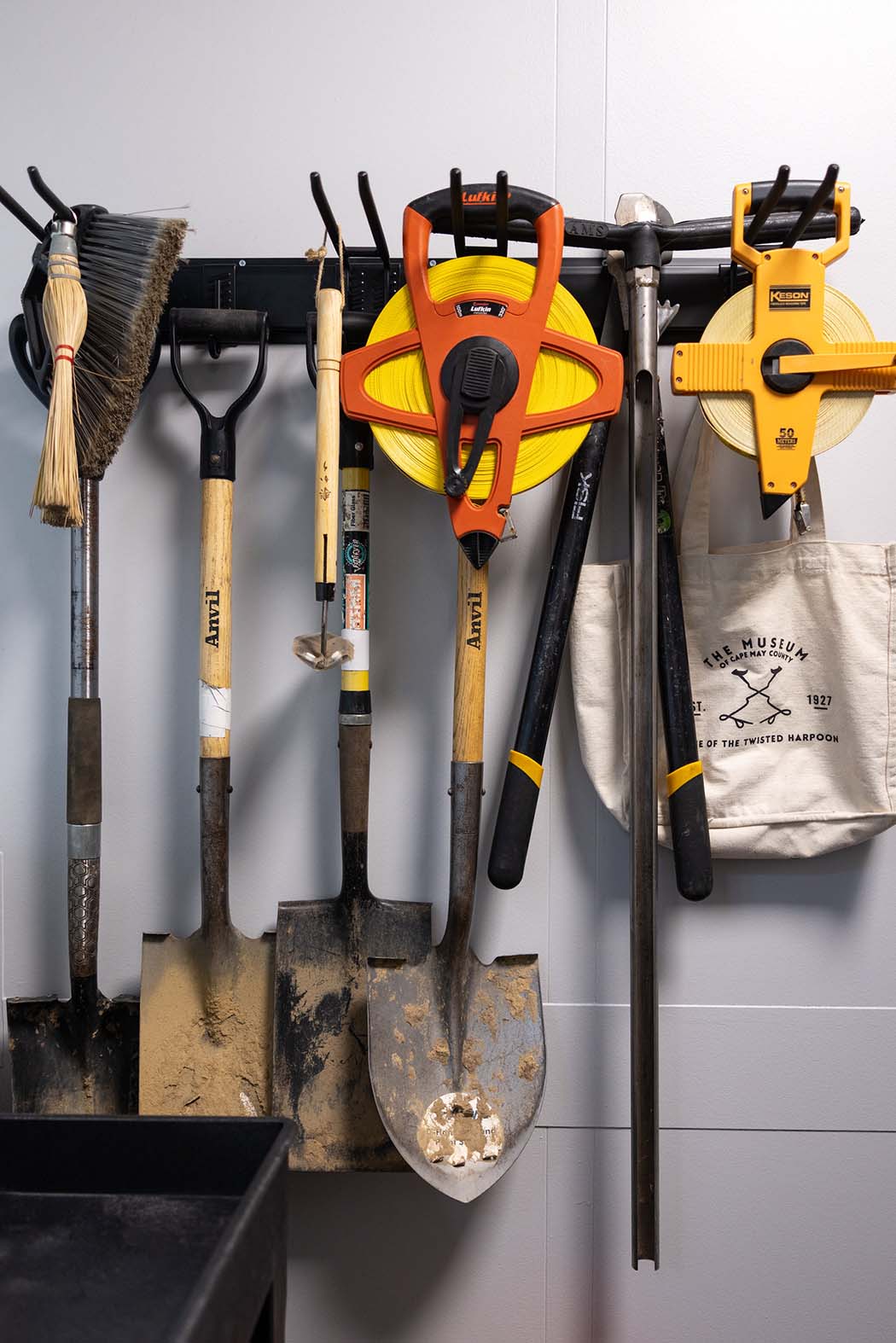
In addition to a separate room for storing tools and artifact collections, the lab includes a sink large enough for flotation and washing, a more than 2-meter-long soil table, a dedicated computer with proper archaeology software for mapping and data analysis, photography and microscope stations and 10 student workstations.
One of Hornbeck’s main objectives is to attract more donations of collections. The university recently received a large one from the Nature Center of Cape May and well-known South Jersey archaeologist Dick Regensburg, a 1976 alum and former Stockton faculty member who lives in Cape May County.
Before becoming an archaeologist, Regensburg worked for NASA and helped design the spacesuits worn by the first astronauts. After graduating from Stockton, he became known for his work studying Indigenous peoples in South Jersey. His collection of more than 100 items contains mostly Native American stone tools that are 4,000 to 5,000 years old, some reference books and field gear from his career.
Hornbeck wants to use the collection to help students understand how to do basic stone tool analysis in a laboratory setting — measure the artifacts, photograph them, determine how old they are — and then document that information in a database. She also wants to show students that stone tools were sometimes made using lower-quality rocks and often are found broken.
“As an archaeologist, you don’t always find the beautiful, looks-like-it-was-dropped-yesterday stone tools that you would see in a museum,” she said. “Students have to learn how to be able to discern cultural materials, even when they aren’t perfect and whole. Collections like this are great for that because it introduces students to what the majority of cultural material looks like.”
Hornbeck is also looking forward to students using the lab to examine other collections, including soil samples and materials from her research work on the remote Aleutian Islands of Alaska and the Richard Cook Collection, which includes nearly 3,000 Native American stone tools from Cape May County.
“I’m hoping these collections will become an active educational and research resource for the region,” she said. “By making the collections accessible to students and researchers, they can provide hands-on opportunities to develop technical skills in archaeological identification, analysis, documentation and collections-based research, while also supporting new questions about the Indigenous history of our region.”
Senior Sage Rosenberg can’t wait to get started.
“We have been working on a few projects over the years and prior to this we were in kind of the dark corners of the universe on campus,” said the Atlantic City Anthropology major. “I think it will be great for incoming students to have a dedicated space that is completely devoted to archaeology. Hopefully, it will encourage even more students to look into it.”
— Story by Mark Melhorn, photos by Susan Allen
Read more about Archaeology at Stockton
-

New, Dedicated Archaeology Lab Unearths Opportunities
Thursday, October 15th, 2026 -

Picture Stockton... digging for clues to the past
Wednesday, May 28th, 2025 -

Hands-on Research a Focal Point of New Archaeology Minor
Friday, November 1st, 2024 -

New Class Gets Students' Hands Dirty Digging into Archaeology
Monday, May 1st, 2023 -

Marine Scientists Use Sonar to Tell NJ's Revolutionary War History
Tuesday, August 21st, 2018