Stockton Poll: Most N.J. Voters Would Support Local Data Center Bans
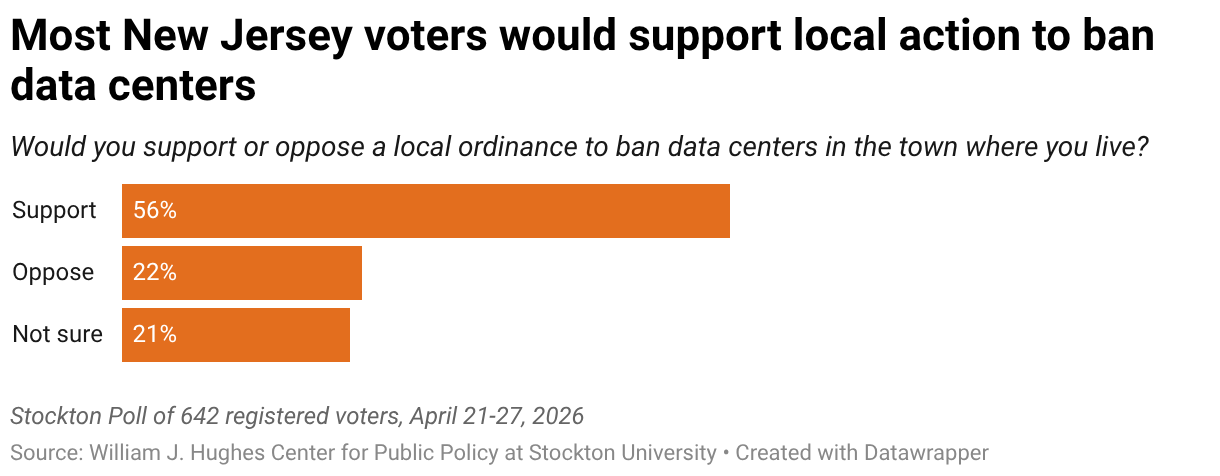
Galloway, N.J. — A majority of New Jersey voters are concerned about the growth of artificial intelligence data centers and 56% would support banning them in their own communities, according to a Stockton poll released today by the William J. Hughes Center for Public Policy at Stockton University.
New Jersey voters remain wary of growing reliance on AI and expect labor market disruptions as the AI boom accelerates. Nearly 3 in 4 voters (74%) think AI will eliminate more jobs than it will create, while just 7% believe it will create more jobs than it eliminates, and 13% think it will have little to no impact either way.
A plurality of 41% of voters believe society’s increased use of AI will make their lives worse. That rate was 36% in a 2024 Stockton poll of New Jersey residents. More than one-fourth (27%) think the increased use of AI will make their lives better, while 18% think it will have little to no impact.
Data Center Development
Despite voter apprehension around AI, growing demand for it has fueled a surge in data centers, facilities that house the computing infrastructure needed to power cloud services and digital technologies like AI. A majority of 54% of voters said they have heard at least a little about the growth of AI data centers throughout the state.
Under the Murphy administration, New Jersey aimed to position itself as an AI hub, offering tax incentives to attract data center development. As data center projects materialized, including a hyperscale facility in Vineland, public pushback emerged. Pemberton Township became the first municipality to pass a local ban on the construction and operation of data centers in February, and several towns have since followed with their own restrictions.
According to the poll, 56% of voters would support a ban on data centers in the town where they live, compared to 22% who would oppose and 21% who are unsure. Higher rates of Democrats (64%) were supportive of a local ban than Republicans (46%) or Independents (54%).
Just 8% of voters believe data centers benefit the communities in which they are located, while nearly half (49%) say they do more harm than good, 22% think they have little impact either way, and about the same rate (21%) are not sure.
Energy Use
A majority of voters are very (54%) or somewhat concerned (27%) about the impact of data centers on electricity costs in New Jersey. About the same rate are very (50%) or somewhat concerned (26%) about environmental impacts, including energy and water use.
The surge in energy demand stemming from AI-driven data centers comes at a time when New Jerseyans are already struggling with rising utility costs. A Stockton poll released last year found that nearly half of residents had to adjust everyday spending to afford utility bills.
Because New Jersey is part of the 13-state PJM Interconnection grid, rising energy demand from data centers across the region can increase electricity prices, even when new development occurs outside the state.
“New Jersey is home to many energy-intensive industries, from pharmaceuticals to advanced manufacturing to technology, and the growth of data centers anywhere in the region will only add to existing demand pressures,” said Hughes Center assistant director Alyssa Maurice.
Regulatory Landscape
Regulatory responses to data center development have begun to emerge in states across the country. One proposed strategy has been to impose “bring your own power” policies, requiring data centers to develop on-site, behind-the-meter generation.
According to the poll, 84% of New Jersey voters would support requiring data centers to supply their own new sources of power rather than relying on the existing electric grid, and 9% oppose. Support was consistent across the political spectrum.
More than 8 in 10 voters (81%) support requiring data centers to meet stricter environmental and energy efficiency standards, while 11% oppose.
Public support is low for state incentives designed to attract data centers. Nearly three-fourths of voters (72%) oppose offering tax breaks or subsidies to technology companies for data center development, while 18% support such measures.
“The policy debate around data centers is just beginning, as questions remain over appropriate zoning, how energy is sourced, and who pays for much-needed grid upgrades,” Maurice said. “At the same time, New Jersey leaders are sure to face continued pressure to reduce energy costs for residents.”
When asked about the state’s overall approach to data center development, a plurality of voters (46%) favor encouraging development with strict regulations on energy usage and environmental impacts.
Still, more than one-third (35%) say the state should discourage data center development entirely, while only 12% support encouraging development with fewer regulations to promote economic growth.
“The findings highlight the challenge facing policymakers as they try to balance economic growth tied to AI infrastructure with growing public concern about costs, environmental sustainability, and local community impact,” Maurice said.
The poll of 642 registered voters was sponsored and conducted by the Hughes Center for Public Policy from April 21-27. The poll’s margin of error is +/- 3.9 percentage points.
View the full poll results here.
Methodology
The poll of New Jersey residents was sponsored and conducted by the Stockton Polling Institute of the William J. Hughes Center for Public Policy at Stockton University. Data collection took place from April 21-27, 2026 using NJ voter list sample. A total of 642 New Jersey registered voters were interviewed. Responses were recorded via telephone or online in English. Overall, 87% of interviews were conducted on cell phones and 13% on landline phones. In terms of mode, 78% were reached via dialing with the survey administered by a live interviewer and 22% were reached via text-to-web. The live calls were conducted by Opinion Services. The text messages were sent by Stockton Polling Institute staff from the university’s Galloway campus and included a single-use link to take the survey online. The data were weighted to balance the sample demographics using iterative proportional fitting. Weights were based on the voting eligible population in New Jersey on variables of age, race/ethnicity, education level, region, and sex. The poll's margin of error is +/- 3.9 percentage points at a 95% confidence level. The margin of sampling error is higher for subsets. Sampling error does not account for other potential sources of bias in polls such as measurement error or non-response. The poll has a design effect of 1.26. The design effect reflects the increase in sampling variance introduced by weighting adjustments.
About the Hughes Center
The William J. Hughes Center for Public Policy at Stockton University serves as a catalyst for research, analysis and innovative policy solutions on the economic, social and cultural issues facing New Jersey, and promotes civic life through engagement, education and research. The nonpartisan center is named for the late William J. Hughes, whose distinguished career includes service in the U.S. House of Representatives, Ambassador to Panama, and as a Distinguished Visiting Professor at Stockton. The Hughes Public Policy Center can be found on YouTube @StocktonPublicPolicyCenter, and can be followed on Instagram @hughespublicpolicycenter, Facebook @StocktonHughesCenter and X @HughesCenter.
More stories on the Hughes Center

Constitution Day Speaker Explores Rights of Immigrants

Stockton Poll: Most N.J. Voters Would Support Local Data Center Bans
Poll: Large Majority of N.J. Voters Support Social Media Regulations

Higher Education Conference Highlights AI, Workforce Challenges

Series Brings Local Government to the Classroom