Higher Education Conference Highlights AI, Workforce Challenges
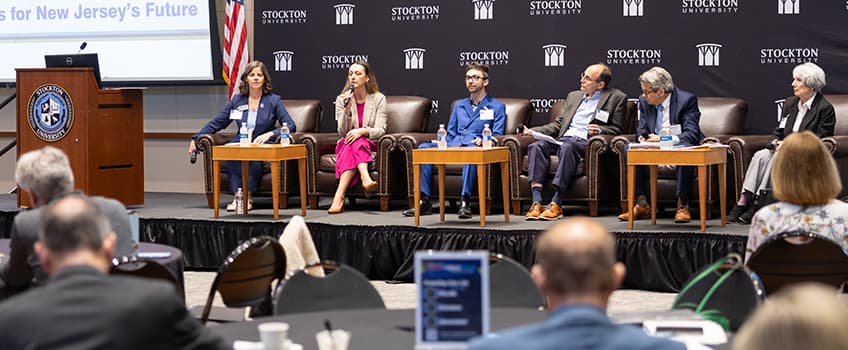
About 100 people gathered at Stockton University on Monday, April 13 for the second annual ‘The Power of Public Colleges and Universities’ higher education conference.
Galloway, N.J. — The use of artificial intelligence and preparing students for careers to meet evolving workforce demands are two of the most pivotal issues facing higher education in New Jersey.
Fortunately, the state’s public colleges and universities are uniquely positioned to address those issues, according to several of the speakers at a conference held April 13 at Stockton University.
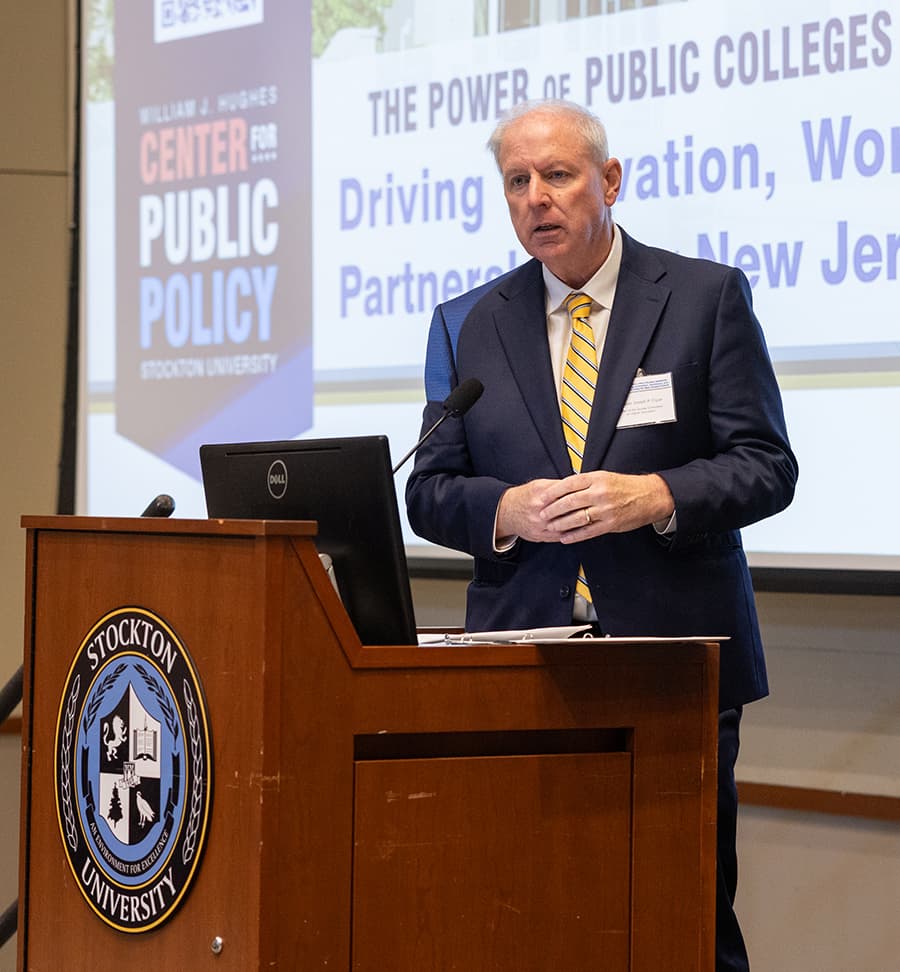
New Jersey State Sen. Joseph Cryan was the keynote speaker at the conference.
“Folks are looking at different ways that higher education can contribute to make a difference in a community, and I think we need to focus in and realize that innovation happens here,” said State Sen. Joseph P. Cryan, chair of the Senate Committee on Higher Education. “In New Jersey, you provide the most highly educated workforce in the United States. So, we are deeply well positioned and able to adjust accordingly to what we can do. But how we do it, those are the debates that we need to have.”
Cryan was the keynote speaker for “The Power of Public Colleges and Universities: Driving Innovation, Workforce and Partnerships for New Jersey’s Future.” The William J. Hughes Center for Public Policy hosted the conference along with Stockton’s Office of Government Relations and university President Joe Bertolino.
“The challenges facing higher education are real and they require us to stay steady, to stay focused, and more importantly, to work together,” Bertolino said in introductory remarks to about 100 state legislators and community and higher education leaders. “And that’s why meetings such as these are important.”
In addition to Cryan’s speech, the conference also included panel discussions on artificial intelligence in higher education and workforce development and public-private partnerships. It ended with a Q&A session with Margo Chaly, the acting State Secretary of Higher Education.
The first panel on AI featured a diverse mix of viewpoints and included Marie Pryor, of the NJ AI Hub; Gavin Rozzi ’18, ’20, the founding director of the Division of Housing and Community Resources Data Center at the New Jersey Department of Community Affairs; Kevin Michels, the founding director of The College of New Jersey’s School of Business Center for Innovation and Ethics; Jo-Renee Formicola, a professor emeritus of Political Science and Public Affairs at Seton Hall University; and Gregory Williams, the education director of the New Jersey AFL-CIO.
Formicola, who recently published a book titled “Academia’s Dilemma: What to do about Artificial Intelligence," encouraged students to use AI to do research and seek out data, but emphasized that humans must still be the ones to determine what it all means.
“We have the obligation to teach analysis, synthesis, extrapolation so that we arrive at critical thinking,” she said. “Students have got to learn critical thinking so they can make decisions that are beneficial not only to themselves and their professions, but to society as well.”
Rozzi, who earned a Bachelor of Arts in Political Science and a Master of Science in Data Science and Strategic Analysis at Stockton, agreed that having humans “in the loop” is essential to decision making with AI.
“But I think we need to have a human in the loop in a thoughtful sense where they’re actually meaningfully contributing to the decision,” he said. “If you’re just auto approving everything that an AI is sending you, it’s very easy to be misled.”
Michels also cautioned on the possible overuse of AI and what the results of that may be.
“An interesting AI paradox is that reliance on AI may destroy the very critical thinking skills we need to be good partners with AI, to use it well,” he said. “Don’t rely on it to develop critical thinking skills.”
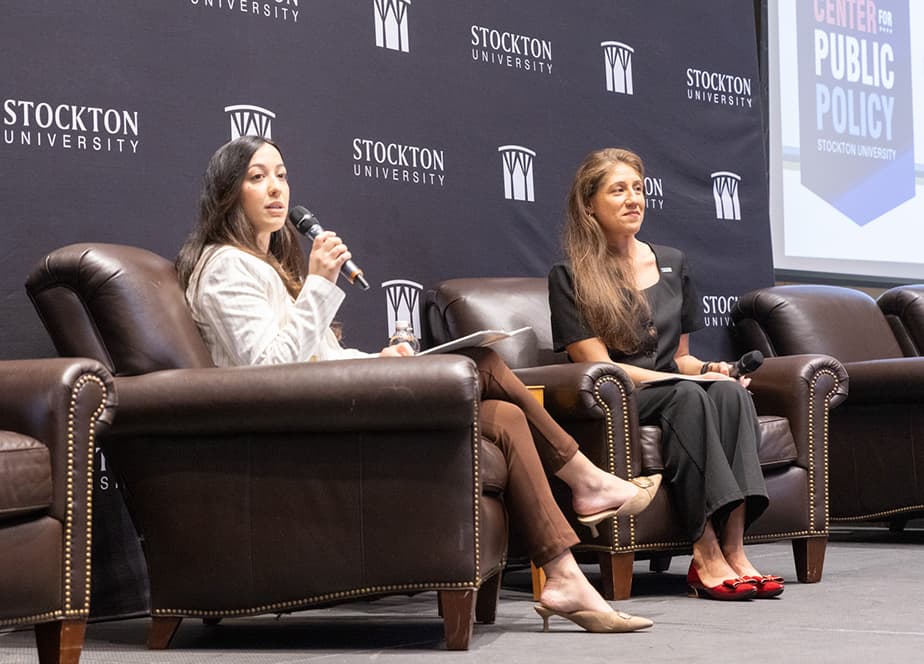
From left, Alyssa Maurice, the assistant director of the William J. Hughes Center for Public Policy at Stockton University, hosts a Q&A session with Margo Chaly, the acting New Jersey Secretary of Higher Education.
A second panel on workforce development & public-private partnerships tackled ways higher education can increase student opportunities, build community ties and enhance public services.
Stockton Provost Michael Palladino said the university is taking a leading role in meeting the needs of the growing health care workforce in southern New Jersey, which is badly needed.
“Regionally, the numbers are very sobering. I’m talking about Atlantic, Cumberland and Salem counties, which are among the three lowest in the state for health outcomes. Residents of these three counties have almost a 4-year lower life expectancy than the rest of the state,” Palladino said. “They have higher rates of chronic illnesses, infant and maternal mortality, and a very significant specialist shortage among health care workers. It’s a major opportunity for us to expand our health sciences portfolio, and we are partnering with AtlantiCare, Shore Medical Center, Cooper and Virtua to build pathways.”
In addition to Palladino, the panel included Joseph Youngblood, chancellor of Kean Global, Kean Ocean and Strategic Global Initiatives; Jennifer Keyes-Maloney, executive director of the New Jersey Association of State Colleges and University; Aaron R. Fichtner, president of the New Jersey Council of County Colleges; and Michele Siekerka, president and CEO of New Jersey Business & Industry Association. The panel was moderated by Michael Egenton, executive vice president of Government Relations at the New Jersey Chamber of Commerce.
Chaly ended the conference trying to dispel some myths and talking points about the importance of higher education. She mentioned students with a bachelor’s degree can expect to earn $2 million more over the course of their lifetime compared to students with only a high school degree.
“We cannot lose track of that quantifiable return on investment,” she said. “When there are talking points that say we’ve hit the ceiling on higher education, that it’s no longer worth it, we need to stop that conversation immediately.”
Chaly said New Jersey Gov. Mikie Sherrill’s administration will revisit the state’s plan for higher education over the next few months, which is something she said hasn’t happened since 2019.
“We need to make sure we are producing graduates that are adaptable, that can think critically and find solutions for the complex shifts in industry right now,” she said.'
— Story by Mark Melhorn, photos by Susan Allen and Abbigail Erbacher