Nest Cams Help Stockton Study Declining Osprey Nest Productivity
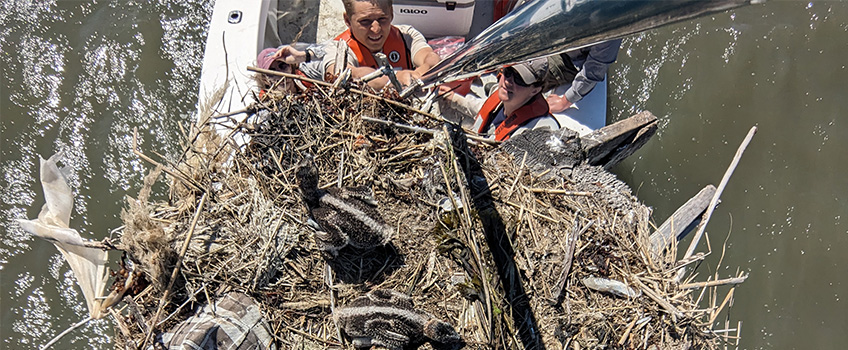
Melanie Schroer, an instructor of Biology at Stockton University, and her students use a smartphone camera attached to a selfie stick to look into osprey nests to survey nest productivity.
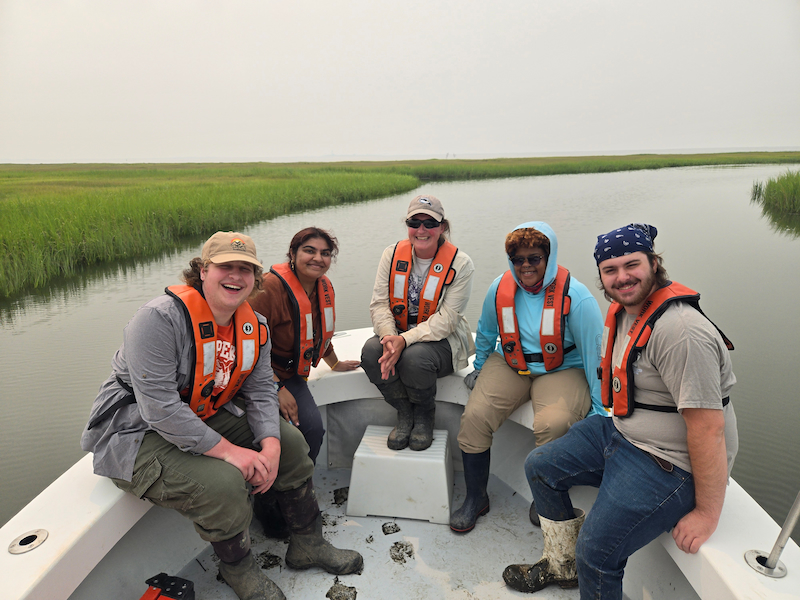
Port Republic, N.J. - Melanie Schroer, an instructor of Biology at Stockton University, monitors 27 osprey nests along the Mullica River and Great Bay and installed wildlife cameras on 10 of the nest platforms. She also works with the Stockton Marine Field Station to bring students to the nesting platforms to monitor with a long selfie stick that can peek into nests to document egg and chick activity.
In May, during the first nest survey, there were 54 eggs and three chicks. By the end of June, there were 25 chicks and one egg that was unlikely to hatch. On July 17, there were 14 chicks. The final survey in August counted nine fledged chicks.
The 85 percent loss of chicks for the nest sites this season is sounding an alarm.
“The broader context here is that osprey nest productivity is declining. Nesting success has taken a huge hit, not only in my little part of the world, but also New Jersey, and much of the East Coast, and so, of course, everyone wants to figure out what's going on. This population has been recovering for 50 years, and it's been doing great, and then just the last handful of years, not so much anymore,” she said.
Adult ospreys are fishing along the coast, but what they are catching and feeding their young is the clue that Schroer is studying to figure out why the chicks are being found dead and emaciated.
A Majestic Raptor
Genovese is pictured holding an Osprey chick while Ben Wurst, of the Conserve Wildlife Foundation, bands the bird so it can be tracked during its lifetime.
The wildlife cameras record 60,000 videos every two weeks. The footage captures predation, when the chicks hatch, when adults bring back food, what they are feeding the chicks and how often they are getting fed.
Schroer noted that over the past few years, wildlife biologists Ben Wurst, of the Conserve Wildlife Foundation of New Jersey, and Bryan Watts, founder of the Center for Conservation Biology in the Chesapeake Bay region, have been pointing to the connection between the food supply and osprey productivity, specifically Atlantic Menhaden or bunker.
The osprey is an indicator species that gives warning when its environment is off balance, so Schroer is looking down the food chain.
Last year during nest monitoring, Schroer noticed a switch in diet. “We saw that in the beginning of the season in May, they were bringing a lot of bunker back to the nests. But then by the end of May, early June, they switched to mostly flounder, which doesn't seem like a big deal, but flounder, when you think of calories per kilogram of fish, is less than half of a bunker. So they're putting in more work and bringing back fewer calories, fewer resources for their young,” she said.
Students are currently analyzing video footage and using software to measure the fish that are delivered to the chicks to determine the fishes’ age class and estimate the calories.
Schroer is also looking at how the chicks interact with each other. “Osprey chicks generally take turns eating, and everything's okay, and they're docile, but when food is limited, generally the aggression increases. This is a way of maintaining a hierarchy within the nest. The oldest, biggest chick gets fed first, and therefore, it's the most likely to survive. We’re trying to look at chick aggression to confirm that not enough calories are being brought to the nest, and, yes, the chicks are actually experiencing stress and hunger. So even if we can't count the number of fish that are in the bay, you can still see the effects,” she said.
Andrew Genovese, a Biology major from Egg Harbor Township, New Jersey, saw the aggression play out in nest cam footage. "Osprey chicks could often be seen pecking and biting at each other," he said.
Genovese partipated in last year's field surveys and recalled, "we'd find dead chicks present in or near a nest. That was usually a rarity, but sometime around halfway through the season we realized that the rate at which we saw them was abnormal."
Going into this year's field season, he felt "unsure, but cautiously optimistic about what to expect in terms of population success" and hoped last year was an outlier.
"By the end of the season, the tragically high 85 percent loss of chicks had completely disheartened me. It was painful to have spent so much time watching over them, noting observations, and seeing them grow only for so many of the nests to fail," he said.
Prior to getting involved in this research, Genovese knew ospreys from the nests he'd pass in the saltmarsh along the Garden State Parkway.
“There are still many adults in the ecosystem, but if the nest productivity declines as it has been in the last couple years, there won't be enough young birds to replace the older ones and sustain the population. In my site as of August 13, nest productivity for active nests is 0.43. This number doesn't account for the six pairs that never laid an egg. If you consider the 27 nests that were active last year, and include the six nests that were active last year and had pairs present but not laying eggs this year, the productivity drops to 0.33. These numbers are below the sustainable threshold of 0.8 young per nest, according to Ben Wurst's 2025 Osprey Project Report or 1.15 according to research in the Chesapeake Bay,” she explained.
In the 1970s, DDT, a pesticide, was the main problem affecting ospreys, but Schroer pointed out that what followed was “an incredible success story, and a testament to the fact that if we recognize the problem and actually do something about it quickly, we can have these incredible results.”
Reported by Susan Allen