$2.44M Grant to Expand Access, Research at Marine Facilities
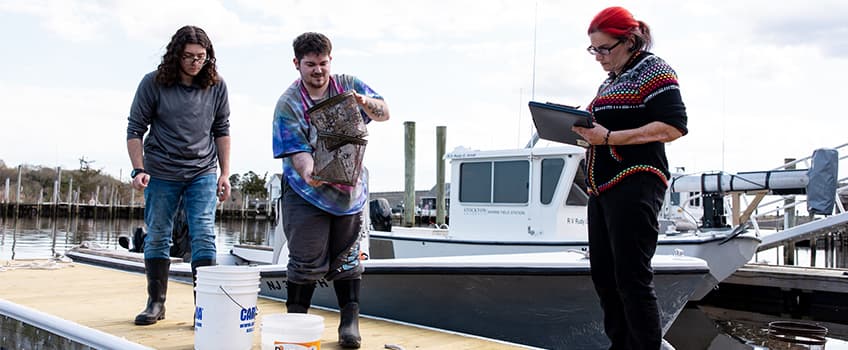
From left, Marine Science majors Alexander Wroblewski, a senior from Drexel Hill, Pennsylvania, River Hammell, a senior from Wenonah, and Jess Taylor, a senior from Whiting, record fish monitoring data at the dock at the Marine Field Station in Port Republic. A new grant will allow the university to make improvements to the dock area.
Port Republic, N.J. — Stockton University has received a $2.44 million grant to make critical infrastructure improvements to its Marine Field Station and Coastal Research Center, expanding research and educational programming, while improving accessibility for those with disabilities.
“This project will create a strategically located working waterfront to support coastal science in Atlantic and Ocean counties by providing improved and accessible facilities for use by Stockton University and its many state, federal and educational partners,” said Steve Evert, director of the Marine Field Station.
The Marine Field Station is the university’s hub for connecting and supporting faculty from Marine Science, Environmental Science, Geology, Biology, Chemistry and Coastal Zone Management programs.
The improvements, funded by a $2,440,760 grant from the Pro-NJ Trust, will focus on the field station’s marina area along Nacote Creek. The station currently has a habitat-degraded lagoon, shoreline erosion issues and a boat ramp that can no longer be used, Evert said.
Stockton’s project would reduce bulkhead coverage along the creek by more than 60% from about 300 feet to about 100 feet by reclaiming the habitat-degraded lagoon with dredged material and installing 100 feet of living shoreline. A new boat ramp and additional dockage will also be added. The improvements will decrease nuisance flooding, increase shoreline protection and decrease the likelihood of damage from a potential storm threat.
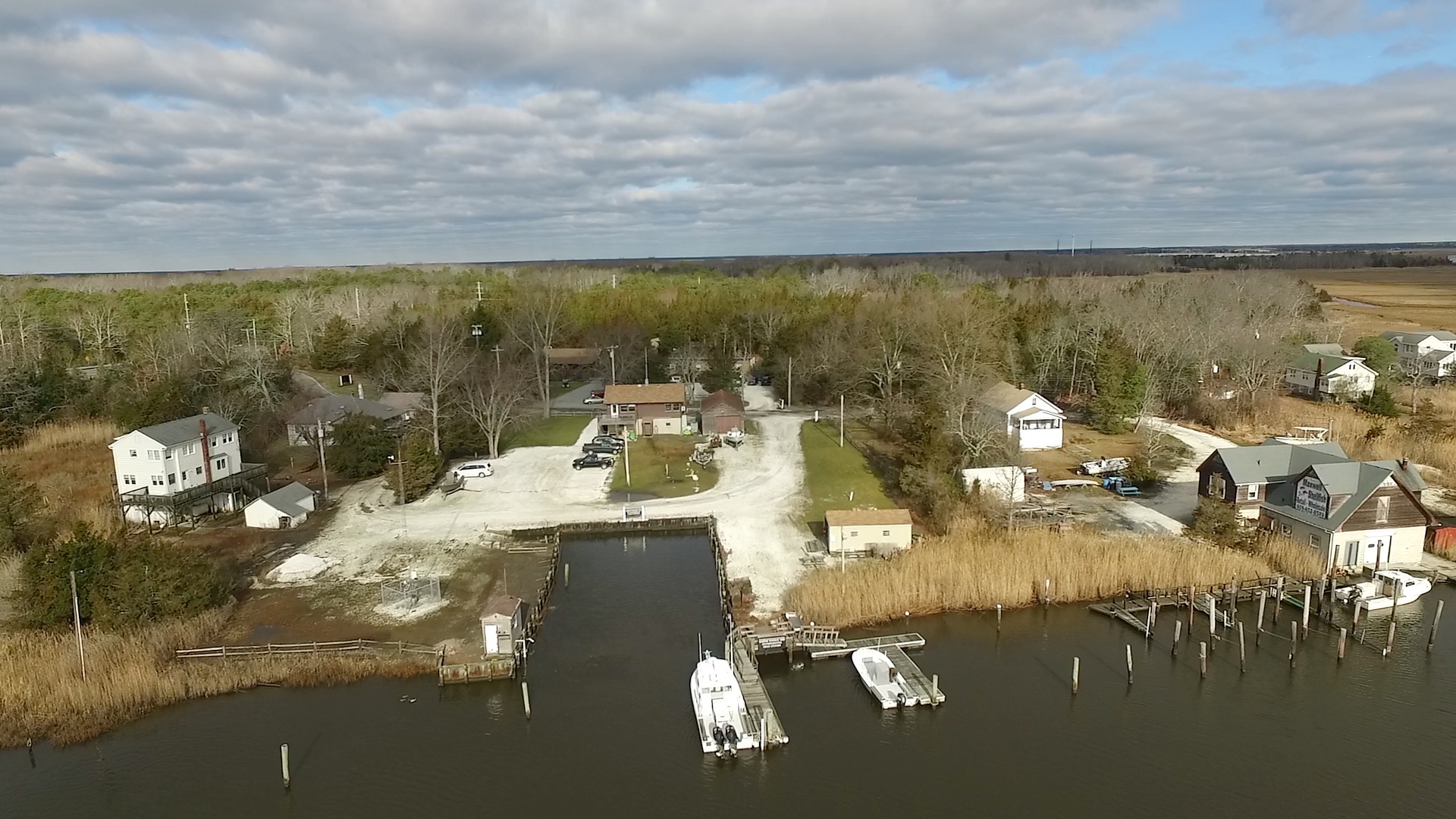
The Stockton Marine Field Station is located along the Nacote Creek in Port Republic. The $2.44 million grant from the Pro-NJ Trust will focus on improvements to the field station's marina area.
“In addition to the needed site improvements and increased capacity to welcome regional partners, I am particularly excited that this project will increase access to our Dockside Science Program for students with disabilities by building an accessible science pier,” Evert said.
The Dockside Science Program introduces high school and college students to coastal science and monitoring efforts without requiring them to board a vessel, he said. The science pier will have long-term monitoring stations installed to collect data on water quality, tide levels and other future data needs.
The site also hosts a meteorological station for the Jacques Cousteau National Estuarine Research Reserve, which is one of 30 areas in the National Estuarine Research Reserve System that is protected for long-term research, water-quality monitoring, education and coastal stewardship.
“These improvements will put us on a good path to increase our public programming, and it is my hope that additional funding will be secured in the future to create a dockside science pavilion,” Evert said. “Stockton has been increasing its emphasis on teaching the broader aspects of coastal science that include marine operations, resiliency, mapping and monitoring of the coastal zone. These program advancements are benefiting students by providing a broader base from which to carve out their career paths and contribute to the blue economy.”
Evert estimates the Marine Field Station serves more than 200 Stockton undergraduate and graduate students annually, along with students and researchers from other institutions, state and federal agencies and K-12 students in Atlantic, Cape May and Ocean counties. The improvements would allow Stockton to develop additional opportunities for school groups to visit.
Through this investment, Stockton will strengthen a vital hub for coastal science, student learning and regional collaboration."Amanda Norvell, dean of the School of Natural Sciences and Mathematics.
Beyond the educational benefits, Evert said the improvements will also increase public safety by providing science and emergency response vessel access to the areas surrounding the Mullica River. New Jersey’s Bureau of Marine Water Monitoring, which monitors the state’s tidal waters for swimming safety and supports the multimillion-dollar shellfish industry, has occasionally used the station’s docks since 2015 and hopes to continue the partnership, Evert said.
Also, the Galloway Township Office of Emergency Management identified the station as an emergency-response location for the surrounding waters. The improvements will allow Stockton to welcome other agencies and institutions working in Ocean and Atlantic counties, Evert said.
Evert said design and engineering leading to the permitting necessary to complete the project will occur over the next 6 to 18 months, with construction scheduled to begin thereafter.
The Pro-NJ Trust is a $15 million fund started by Ocean Wind to fund over seven years municipal infrastructure projects, educational research and nonprofit initiatives supporting coastal resiliency in Atlantic, Cape May and Ocean counties.
-- Story by Mark Melhorn, photos by Susan Allen and Kent Green