Stockton’s Maple Project Yields More Than Syrup
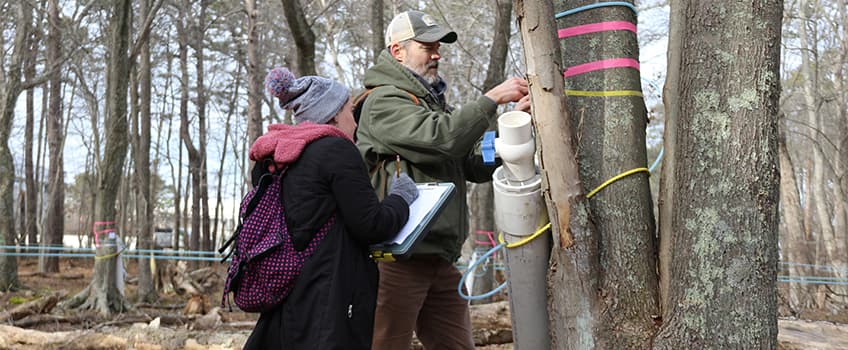
Senior Environmental Studies major Kayla Mathes, from Bucks County, Pennsylvania, takes notes as Matthew Olson, associate professor of Environmental Studies, takes a measurement of one of the red maple trees in Stockton's maple grove.
Galloway, N.J. — Now in its sixth year, the Stockton Maple Project continues to grow, not just in how much maple syrup it produces, but in how it involves Stockton University students in the process.
The project recently received a $273,000 grant from the United States Department of Agriculture’s Acer Access and Development program, and a portion of that funding strengthens student research and involvement.
“The program supports projects that strengthen the domestic maple syrup industry through research, education, natural resource sustainability, marketing and maple-sugaring activities,” said Mariam Majd, Stockton associate professor of Economics, who explained that Acer is the Latin name for the maple tree genus.
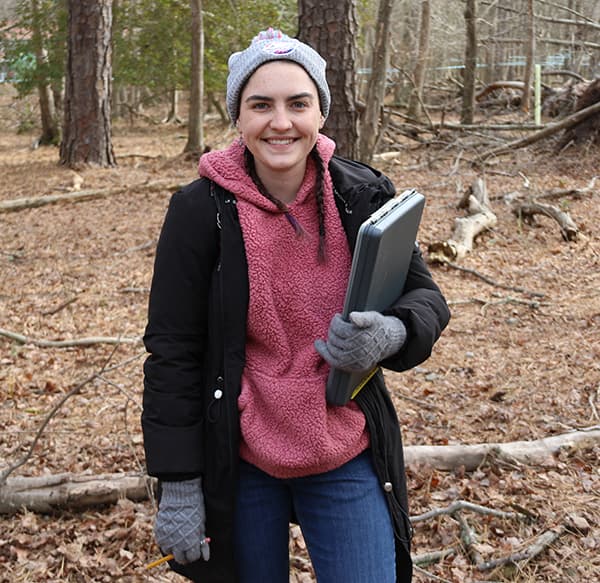
I didn’t know that red maples were so abundant to where you could tap them in your own backyard. I love the sugar bush. I think everything about the Maple Project is really cool.Senior Kayla Mathes
Majd said each year the project has at least 10 students working in Stockton’s maple grove — just off Vera King Farris Drive on campus — to tap trees, collect sap, and help bottle and label the syrup. Students have also been hired through the grant to promote the project and help with educational and community engagement efforts. There are also several active student research projects that the grant helps fund.
“The research components of our grants are especially important because they allow us not only to advance the maple industry but also to mentor Stockton students in the research process,” Majd said.
Senior Kayla Mathes has been fascinated with the Maple Project since her first year at Stockton, but she hasn’t had an opportunity to take part in it until this year when she needed a senior project for her Environmental Studies major.
“I’m not from New Jersey and I knew nothing about the Jersey forests prior to all this,” said the Bucks County, Pennsylvania, native. “I didn’t know that red maples were so abundant to where you could tap them in your own backyard. I love the sugar bush. I think everything about the Maple Project is really cool.”
Mathes approached Matthew Olson, a Stockton associate professor of Environmental Studies, to see if there were any research opportunities tied to the Maple Project. Olson was just about to begin a new study comparing maple trees in the grove and those that aren’t.
“We are trying to learn how tapping vs. not tapping affects tree growth,” Mathes said.
Mathes and Olson identified and marked 15 trees in the current Maple Grove, making sure they are of varying size, growing in similar topography and spaced out. Then they did the same thing in another part of the maple forest surrounding Stockton that has not been tapped for sap to create a control group.
On a recent visit to the grove, Mathes measured the diameter of the marked trees using DBH (diameter at breast height) tape and also plotted their locations using GPS equipment.
“The trees in the grove have been on vacuum for six years now. Hopefully we can see what it did, if anything, to the growth of the trees,” she said, explaining how the vacuum process draws the sap out of the tree so it can be collected in one place through a series of tubes.
Later this spring, Olson and Mathes will take pencil-sized cores of each of the trees and compare the size of the rings. Olson said some grant money was used to upgrade and buy new equipment so the university can do full-fledged tree ring analysis.
“We also want to get an estimate on how much sap individual trees are producing,” Olson said. “We don’t have a lot of data on the sap yield of individual trees, and how much that varies based on their size and condition. We plan to track sap yields of at least 12 trees to understand year to year variation.”
In the future, Olson said he would also like to compare the difference in sap production between bucket collection and the vacuum system and how that affects the trees. He’d also like to replicate the tree ring analysis on trees growing on some of the Maple Project’s partners off campus.
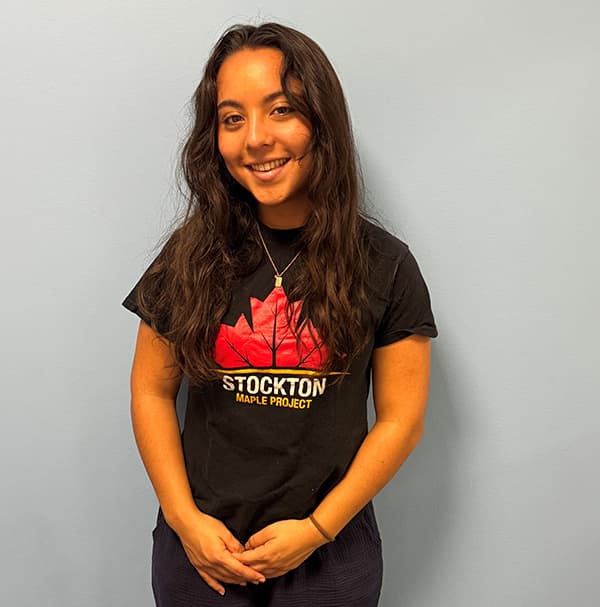
I think it’s something unique. It’s so cool when people come here and have a taste of our syrup to see what we make right here at Stockton."Junior Kiera Liu
“The Stockton Maple Project has served as a sweet platform for teaching and student research,” Olson said. “We really are breaking new ground here because nobody’s really studied this in a red maple swamp in New Jersey. Every little thing we do, every little discovery is kind of pushing the envelope and expanding our understanding of these systems.”
Olson also integrates some of this data into the classroom, adding that students in his statistics class work with several datasets collected from Stockton’s Maple Grove.
For Mathes, becoming part of the project has given her the opportunity to get college credit for an independent study that fits right in with her minor in Sustainability.
“I really love the hands-on aspect of everything, so I just truly enjoy being a part of helping achieve that sustainability,” she said.
That aspect of the project is what attracted junior Kiera Liu to the project. She’s helped promote Stockton’s maple syrup since before her first year and the latest grant has allowed the project to hire her as a social media coordinator. She’s created several videos and posts on Instagram promoting the project and coordinated events for the community, such as the Maple Syrup Workshop and Tree Tapping on Saturday, Jan. 17, on campus.
“I think it’s something unique. It’s so cool when people come here and have a taste of our syrup to see what we make right here at Stockton,” said the Galloway resident and Sustainability major with a concentration in policy. "Sustainability is that perfect blend of business and science. It’s not just about buying green products — it’s about taking what you already have and turning it into something meaningful. That’s exactly what the Stockton Maple Project does by using trees right on campus to make maple syrup.”
— Story and photos by Mark Melhorn
Read more stories about the Stockton Maple Project
-

Stockton's Maple Project Yields More Than Syrup
Thursday, January 15th, 2026 -

Maple Syrup Project Continues to Grow Thanks to New Federal Grant
Tuesday, February 18th, 2025 -

Cold has Maple Syrup Project Primed for Strong Season
Friday, January 19th, 2024 -

Maple Project Expands Outreach to Local Schools
Tuesday, January 31st, 2023