New State Grant Supports Climate Change Education
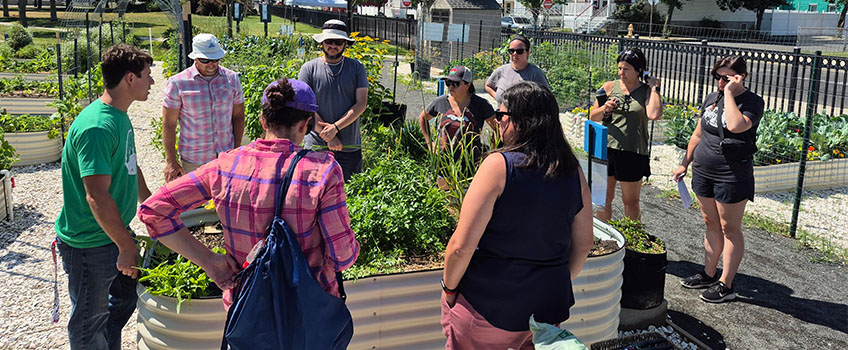
In June, K-12 teachers participated in several hands-on programs, including a day at the Community Garden at Fishermen’s Park in Atlantic City to learn about growing food on a barrier island and responding to coastal flooding.
Galloway, N.J. — Stockton University will continue to provide K-12 teachers free climate change instruction thanks to a $650,000 grant from the New Jersey Department of Education.
This is the third year the university’s Southern Regional Institute and Educational Technology Training Center (SRI & ETTC) received funding from the state to support climate change education for a total award of $1.9 million.
The project, which led to the creation of the Climate Change Learning Collaborative, provides access to resources and professional learning opportunities to help instructors in eight southern counties address New Jersey’s student learning standards for climate change education.
“We use this foundation to help K-12 educators learn to create, assess and teach project-based learning units of study focused upon climate change causes, effects and responses,” said Patty Weeks, director of the SRI&ETTC and co-director of the collaborative.
 The Stockton collaborative serves Atlantic, Burlington, Camden, Cape May, Cumberland,
Gloucester, Ocean and Salem counties. Ramapo College, Rutgers and Monmouth University
provide similar services in other parts of the state.
The Stockton collaborative serves Atlantic, Burlington, Camden, Cape May, Cumberland,
Gloucester, Ocean and Salem counties. Ramapo College, Rutgers and Monmouth University
provide similar services in other parts of the state.
Weeks said Stockton is perfectly situated to help K-12 teachers implement climate change education standards.
“Stockton’s location is unique to study the many effects of climate change thanks to its proximity to both the Atlantic coastline as well as being located within the 1,600 acres of the Pinelands National Reserve,” she said. “The university’s long history of environmental education has helped its students become stewards of the amazing natural resources of the region.”
The Climate Change Learning Collaborative utilizes Stockton faculty from the School of Education, School of Natural Sciences and Mathematics and the School of Arts and Humanities to assist teachers. Kimberly Lebak, professor of Education and co-director for the CCLC project, designed a unique professional development program that provides K-12 educators with strong content knowledge on how climate change directly impacts South Jersey.
Hands-on, experiential learning experiences with community-based organizations — including the Wetlands Institute, Save Barnegat Bay, NJ Audubon, the Center for Aquatic Sciences, Sustainable NJ, Communities Revolutionizing Open Public Spaces (C.R.O.P.S.), and Stockton’s Marine Field Station — provide connections to the knowledge introduced by Stockton faculty.
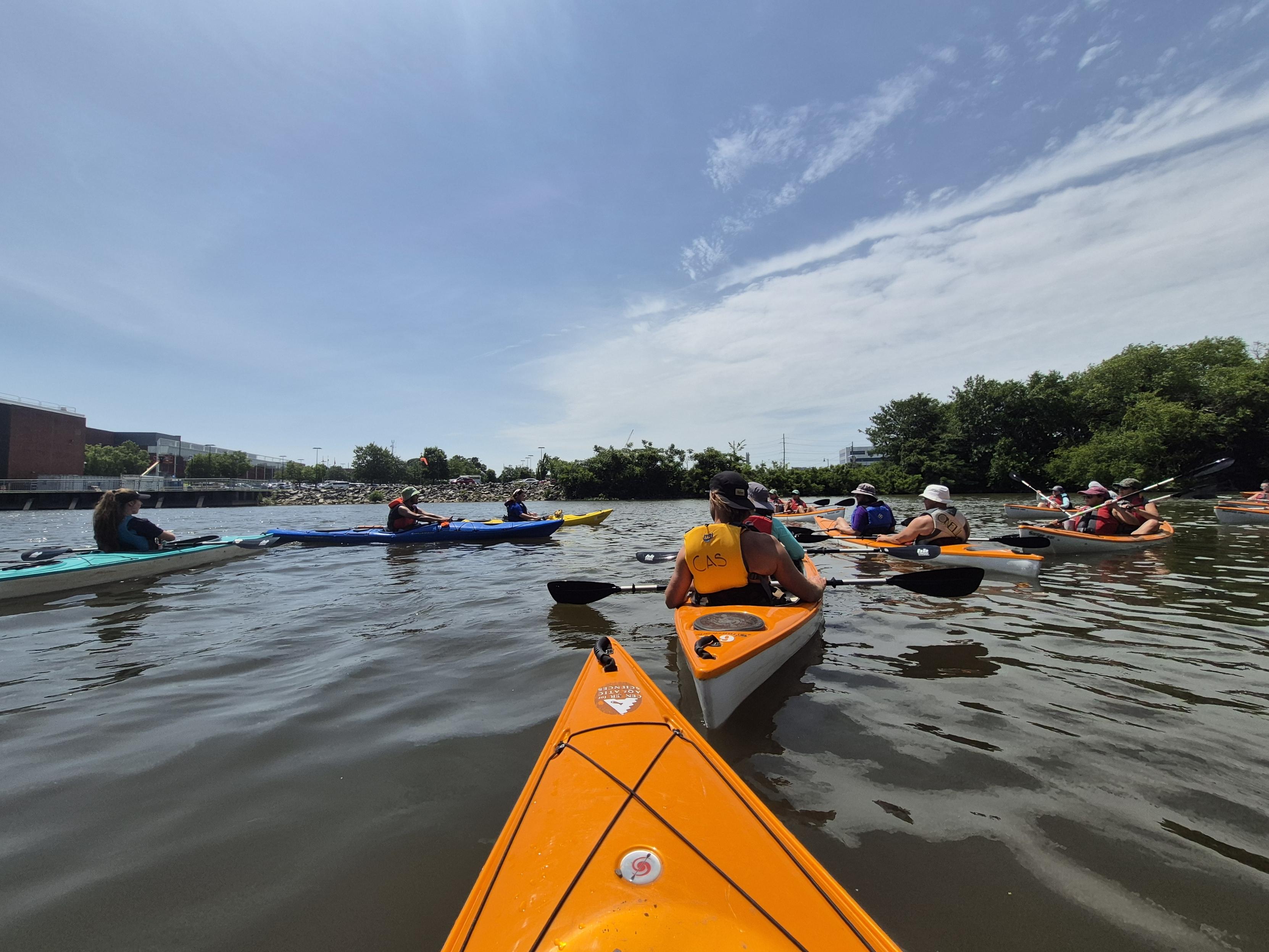
In June, K-12 teachers participated in several hands-on programs, including a day at the Community Garden at Fishermen’s Park in Atlantic City to learn about growing food on a barrier island and responding to coastal flooding. Teachers also joined the Center for Aquatic Sciences for a guided kayak paddle along the Delaware River’s Back Channel and Cooper River where they learned about the impact of climate change on the Camden and the Delaware Watershed.
In July, Education Specialist Debby Sommers led a group of 12 teachers through a tour of Mr. B’s Outdoor Classroom between Reeds Road Elementary School and Galloway Township Middle School. Teachers were encouraged to think about how they could alter their curriculum to find ways for students to interact with the outdoors. Sommers talked about the benefits of bringing students outside and how students with attention issues might find it easier to focus outdoors.
Workshops are available now through April 2027. Sign up through the collaborative’s website, and for questions email climatelearning@stockton.edu.