Arts Garage Exhibit Highlights Transformation into ‘Camp Boardwalk’
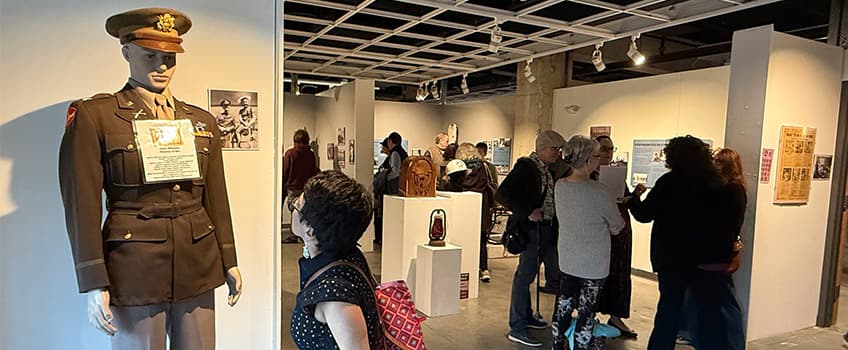
The 'Camp Boardwalk' exhibit at the Noyes Arts Garage of Stockton University will be on display until March 29.
Atlantic City, N.J. — A new exhibit at the Noyes Arts Garage of Stockton University examines Atlantic City’s transformation during World War II into “Camp Boardwalk.”
From June 1942 to November 1945, major city hotels were converted into military barracks, ballrooms into drill halls and Boardwalk Hall into a training facility as Atlantic City became a pivotal part of the World War II homefront.
For curator Patty Chappine, the exhibit, which runs through March 29, grew out of both her research and her teaching. The adjunct faculty member teaches a general education course on women during World War II, and she said her academic work and classroom discussions continually inform each other. Camp Boardwalk has appeared in her work and classes before, but the exhibit allowed her to expand that focus into a public history project.
“For a while now, much of my research has focused on New Jersey women during World War II,” said Chappine, who’s also a Rudnick Fellow for the Alliance Heritage Center. “In that work, Camp Boardwalk has always been an intriguing part of the story.”
In developing the exhibition, Chappine sifted through oral histories, testimonies and archival records documenting the wide range of people connected to Camp Boardwalk. Volunteers with the USO and Red Cross, military nurses, civilian clerical workers, and injured soldiers recovering in Atlantic City all shaped the wartime community she wants visitors to see.
“I came across so many testimonies and oral histories from people who were involved with Camp Boardwalk in some way,” Chappine said. “Editing the information down to make it concise and manageable for a public exhibit was difficult.”
Chappine said she designed the exhibition to make complex wartime history accessible by centering personal stories. Among the narratives that shaped the exhibit are accounts of Red Cross “Grey Ladies,” volunteers who assisted wounded soldiers who could not move on their own, and local students whose daily lives were altered by wartime restrictions. She pointed to stories of teenagers attending proms behind blackout curtains as examples of how the war reached beyond the battlefield.
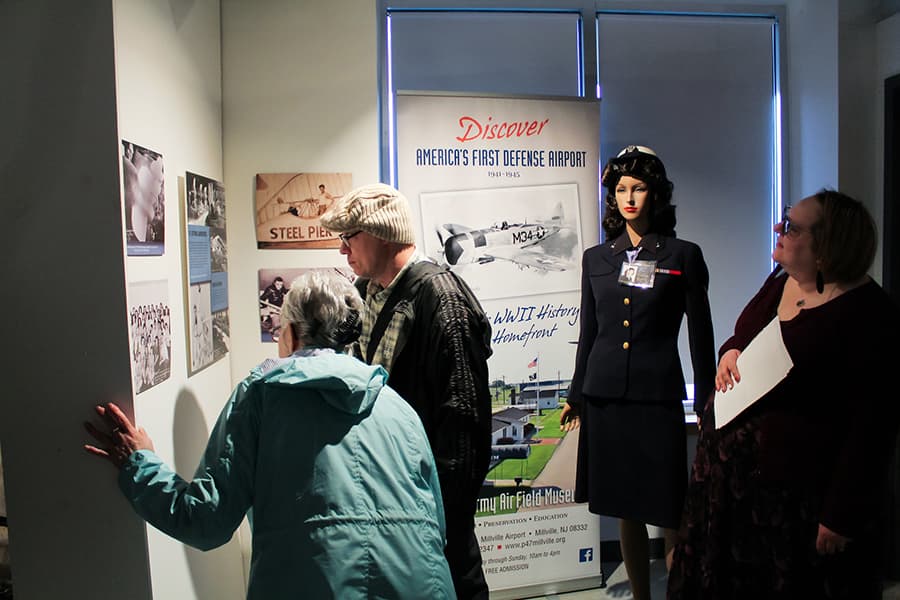
Exhibit curator Patty Chappine sifted through oral histories, testimonies and archival records documenting the wide range of people connected to Camp Boardwalk during World War II.
By framing the exhibition around individual experiences, Chappine connects Atlantic City’s story to national conversations about the World War II homefront. Civilian defense efforts, racial segregation and expanded roles for women mirrored changes happening across the country.
“Even though this is a local history, the themes are national,” Chappine said. “The same pressures, sacrifices and community efforts seen in Atlantic City were happening across the United States.”
The exhibition was built through partnerships with regional museums and archives that supplied photographs, artifacts and primary sources spanning multiple collections. Those partners include the Atlantic City Free Public Library, Millville Army Air Field Museum, the Sara & Sam Schoffer Holocaust Resource Center, Atlantic County Historical Society, the National Guard Militia Museum of New Jersey, the Naval Air Station Wildwood Museum and Stockton University’s South Jersey Culture and History Center to assemble materials documenting the city’s wartime transformation.
“These community connections were essential in finding historic photographs, oral histories, primary sources and artifacts for the exhibit,” Chappine said. She noted that the Atlantic City Free Public Library preserves extensive local archives, while the Millville Army Air Field Museum loaned artifacts and the National Guard Militia Museum contributed materials from its oral history collection.
Chappine also credited Stockton alumna Celeste Casino ’24, who designed the exhibit panels, and alumna Alexa Novo ’19, who created an online supplement to the exhibition.
Chappine received a bachelor’s degree in Sociology in 2006 and a master’s degree in Holocaust and Genocide Studies in 2009 from Stockton University. She later earned both a master’s and a doctoral degree in history and culture from Drew University. She currently serves as a part-time Rudnick Fellow for the Alliance Heritage Center at Stockton.
Michael Cagno, executive director of the Noyes Arts Garage, said exhibitions like Camp Boardwalk highlight the role museums play in preserving community memory and connecting local audiences with larger historical narratives.
“Atlantic City did not simply host the war effort; it became part of it,” Cagno said. “Exhibits like this help communities see themselves inside history and recognize the people whose everyday contributions shaped the nation.”
Chappine said she hopes visitors leave with a deeper understanding of how ordinary residents shaped Atlantic City’s wartime identity. She added that discussions are underway for a physical catalog documenting the Camp Boardwalk exhibition. She said projects like this are never truly finished but continue to grow as new materials and interpretations emerge.
Chappine is leading free guided gallery tours of the exhibit on Wednesday, March 4, and Friday, March 27, from 12:30 to 1:30 p.m. at the Arts Garage. Signup is required.
Other Noyes Arts Garage exhibitions
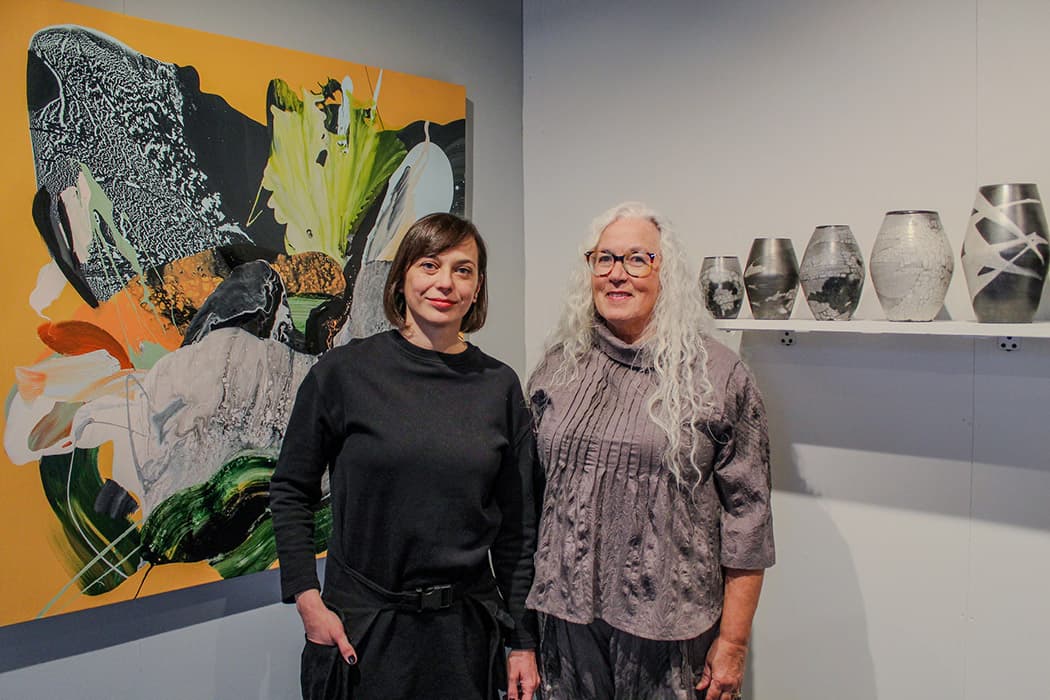
Calina Hiriza, left, and Sandra Kosinski have a new exhibition at the Noyes Arts Garage.
The Arts Garage is also presenting a gallery exploring the transformation of material and form by artists Calina Hiriza and Sandy Kosinski until March 29. Abstract artist Hiriza uses paint, dried paint chips and layers of resin to create scenes of shape and color. Kosinski, owner of High Bar Pottery, is a ceramic artist from Long Beach Island, who focuses on raku pottery.
A solo exhibition of work by Beverly Collins-Roberts is on display until Feb. 28. Collins-Roberts is an award-winning fine art documentary photographer, filmmaker and historian whose career spans more than four decades. Born and raised in Camden, Collins-Roberts has dedicated her life to documenting the transformation of her hometown. The exhibit is presented by LINKS, Inc.
Also through Feb. 26, winning entries from last year’s ACUA Recycled Art Contest will appear as a pop-up exhibition. The annual competition invites Atlantic County residents to transform trash and recyclable materials into works of art.
The Noyes Arts Garage is located at 2200 Fairmount Ave., in Atlantic City. For more information, call 609-626-3805.
-- Story by Ella Johnson, photos provided by Noyes Arts Garage