Baby Day Helps Students Prepare for Future Health Care Careers
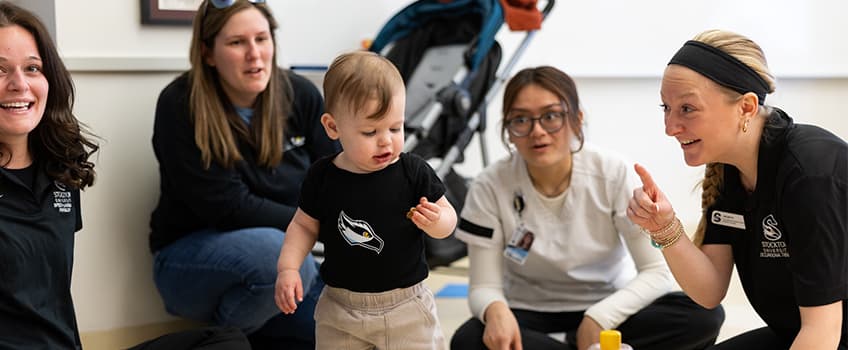
From left, Madison Kapuscinski, a MS in Communication Disorders student from Marlton; mother Sarah Citro with her son Luca; Alyanna Frias, a Nursing student from Toms River; and Kelsey Bigum, a MS in Occupational Therapy student from Manahawkin. Sarah brought her son to participate in Baby Day on April 6.
Galloway, N.J. — The hallways of West Quad filled with sounds of children on April 6 as Nursing, Occupational Therapy, Physical Therapy and Communication Disorders students gathered for the Stockton University's annual Baby Day — a hands-on interprofessional training event that has become a key component of the Health Sciences curriculum.
The event brought roughly 20 infants and toddlers, ages newborn to 3 years old, to campus alongside their parents and caregivers for a morning of structured interaction with student teams. Around 120 students from four programs participated this year, each assigned to a mixed-discipline group tasked with engaging the child while interviewing their caregiver.
"The health professions are interprofessional," said Lauren DelRossi, an associate professor of Physical Therapy who has helped organize the event for more than a decade. "So, it's preparing them for future practice. It teaches development and also how to work as a team."
Student teams of two to four are drawn from different disciplines so that no group is made up of students from the same program. Before the babies arrive, teams meet for 30 minutes to develop a shared plan for how they will interact with the child and what questions they want to ask caregivers.
Mary Kientz, associate professor and Occupational Therapy program director, said the pre-event meeting is essential to ensuring every student has a voice.
“This helps to ensure all students will engage with the baby and caregiver,” she said.
Each baby and caregiver rotates through two student groups over the course of the morning, with one-hour sessions running from 9:30 to 11:30 a.m. Faculty circulate through the three baby rooms throughout, available for guidance but deliberately stepping back to let students lead.
"Students come up with the plan for the day," DelRossi said. "Faculty is here in a support role, but for the most part the students learn and the students manage."
The day concludes with a large group debrief, where faculty use guided questions to prompt reflection on both child development and teamwork.
Flexibility Is the Lesson
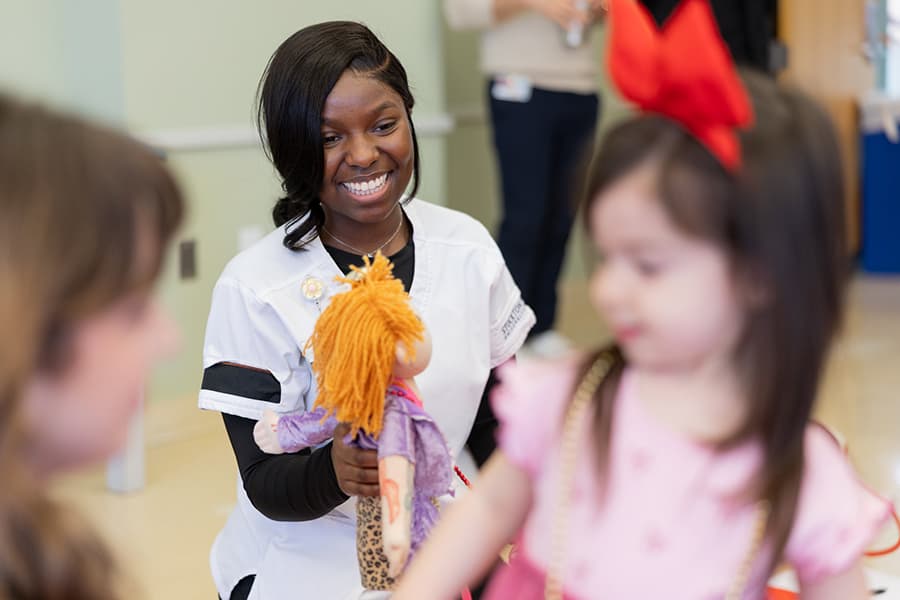
Nursing student Ruth Kilasi, of Little Egg Harbor Township, said initially she was nervous to interact with the children, but she gained confidence throughout the morning.
Working with children under 3 means the unexpected is always possible. Families occasionally cancel the morning of the event when a baby falls ill, causing students to be reassigned on short notice.
Kientz said those disruptions often turn into teachable moments.
"The reassigned students realize they know much more about child development than they thought," she said, "and still end up having good learning experiences."
For Nursing junior Ruth Kilasi, of Little Egg Harbor Township, that spirit of improvisation was the defining lesson of the day. Students were given limited information about their assigned child ahead of time, putting the pressure on teams to adapt in the moment.
"Prepare for what you don't know," Kilasi said. "We weren't given a lot of information, so I kind of had to improvise."
She said managing the uncertainty was its own challenge.
"The only challenge was not being stressed out about it. Most of the time when I don't know something, I get stressed. I've been learning to be calm, just go with the flow — and it makes things a lot easier," Kilasi said.
By the end of the morning, she said the confidence came.
Students are assessed against six objectives, ranging from building trust with families and respecting the roles of other professions, to practicing active listening and recognizing developmental milestones in infants.
Alumni Return to Give Back
A notable feature of Baby Day is the number of Stockton alumni who return as participating caregivers, many of them graduates of the very programs their student teams represented.
Sarah Citro brought her son, Luca, to campus this year as a caregiver — and as a Stockton alumna who earned her Doctor of Physical Therapy in 2020. The full-circle moment wasn't lost on her.
"It's cool to think that I was just here seven years ago," she said. "It's nice to give back."
Citro said events like Baby Day fill a gap that classroom learning alone cannot.
"Some people go their entire college career without interacting with a child or patient — like, how do you know if you truly want to go into this career?" she said.
Looking back on her own time as a student, she said the experience shaped how she approaches families in practice.
"I learned a lot about interacting with the parents — to give them a subjective interview, be comfortable, and how to handle the babies. Understand what you are getting the baseline for," she said.
Catherine Richmond, a 2009 Occupational Therapy graduate who now works as a certified hand therapist, also returned with her baby and reflected on how the event shaped her career.
"I learned to just be very grateful for every profession," she said. "It opened me up to be really flexible, because we need a lot of different roles."
Richmond said she noticed the quality of the student interactions firsthand.
"They played with the kids, and they are definitely creative," she said, adding that the group format remains valuable. "They all bring something different to the table."
A Year in the Making
Behind the morning's seemingly seamless activity is roughly a year of logistical planning. Faculty from all four programs collaborate to reserve space, develop student assignments, recruit families through alumni networks and email, coordinate institutional review board approval for research use of student data, and assign teams and rooms.
"It involves reserving space at least a year in advance," Kientz said. At minimum eight faculty members are involved on the day itself, alongside support staff from the School of Health Sciences and Stockton Event Services.
The event has run for many years and was even adapted to a virtual format during the COVID-19 pandemic. Faculty said feedback from students and families is reviewed annually, though few major changes have been needed in recent years.
"It takes a lot to coordinate everything," Kientz said, "but it is worth it."
Stockton’s School of Health Sciences offers bachelor’s, masters and doctorate programs in a wide range of studies, including Exercise Science, Nursing and Occupational Therapy. For more information, call 609-652-4501 or email hlth.school@stockton.edu.
— Story by Ella Johnson, photos by Susan Allen