Spotlight On: Amee Shah
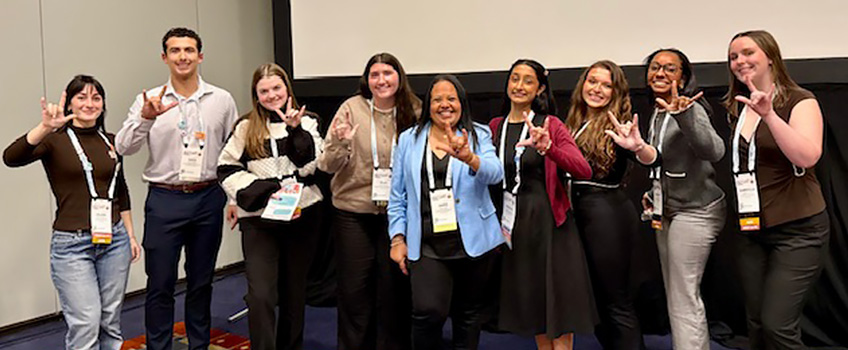
From left, students Jillian Anderson, Luca Lopresti, Reilly Pizzelli and Ella Blithe pose with Amee Shah, professor of health science, center; Deesha Chokshi, Natalie Halko, Melody Mercado and Gabriella Vacca, who are signing “I love you” in American Sign Language at the ASHA convention.
Galloway, N.J. – Amee Shah, professor of Health Science, was selected as a Centennial speaker at the American Speech, Language, and Hearing Association’s (ASHA) annual convention, held in November at the Walter E. Washington Convention Center, in Washington, D.C. Shah was featured in the conference’s Centennial Session, a highly selective honor marking ASHA’s 100th anniversary.
Additionally, Stockton’s affiliated chapter of the National Student Speech, Language, and Hearing Association (NSSLHA) club made a showing with eight students, and their faculty mentors, Diane Laverty, assistant professor of Health Science; and Kelly Maslanik, clinical specialist, Communication Sciences & Disorders. Shah shared that the chapter successfully applied for their own funding through Stockton, allowing them to attend and participate in the conference. The students were Jillian Anderson, Luca Lopresti, Reilly Pizzelli, Ella Blithe, Deesha Chokshi, Natalie Halko, Melody Mercado and Gabriella Vacca.
Below, Shah shares what the conference experience was like, how being picked for such a significant role there impacted her, and how this work continues to evolve.
🎤 What did it mean to you to be selected as a Centennial speaker during ASHA’s 100th-anniversary conference?
Being selected as a Centennial speaker was deeply meaningful. It signaled that this line of work is recognized by the profession as “forward-thinking with the potential to significantly impact the field.” After contributing to ASHA for 23 consecutive years, having the opportunity to present during the 100th-anniversary celebration felt both validating and inspiring. The conference is highly selective, with more than 15,000 attendees, so being chosen to help lead an essential conversation at such a historic moment was truly an honor. I was grateful to stand alongside fellow innovators who are shaping the next century of our profession.
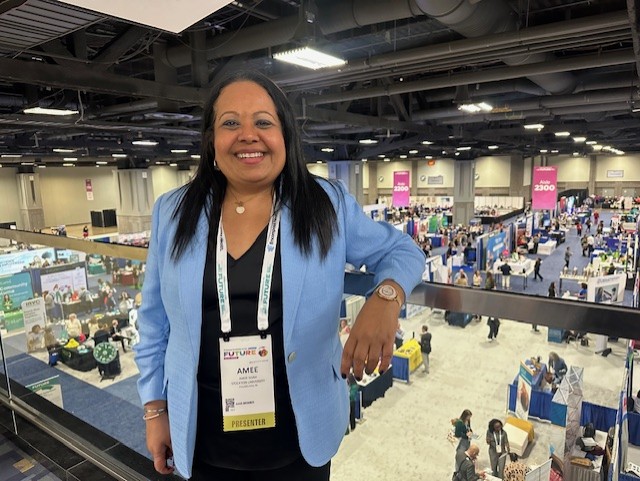
Shah stands overlooking the exhibit hall at theASHA annual conference in Washington, D.C., where she served as a Centennial speaker during the organization’s 100th-anniversary celebration.
🎤 How would you explain “listening gamification,” and why can it help advance inclusive behaviors within ASHA and Stockton’s clinical and academic communities?
In today’s globalized world, we interact daily with people whose languages, accents, and cultural backgrounds differ from our own. Yet, until recently, there were no systematic training tools to help people listen effectively to diverse accents. Most individuals were left to “sink or swim,” which often led to frustration, unconscious bias, and avoidance of cross-cultural communication.
More than a decade ago, I created the Accent Listening IQ game, a gamified training tool that helps people strengthen their ability to understand diverse accents. By pairing a fun, low-stakes game with an unconscious-bias awareness webinar, “Foreign Accent Perception & Sensitivity Training,” we activate the dopamine-driven engagement of play while also building awareness, empathy and confidence. Research with large groups of students, and later with executives, administrators, police and first responders, shows that this approach improves inclusive behaviors and reduces fear-based reactions.
Rather than blame or shame, listening gamification offers a gentle, practical way to build new neural pathways that support curiosity, openness and more accurate communication. In high-stakes contexts, such as policing or emergency response, these skills can help reduce automatic fight-or-flight reactions and promote more conscious, respectful decision-making. In academic and clinical spaces, it creates a more welcoming environment and strengthens cultural responsiveness.
🎤 Were there any audience reactions or discussions during your session that felt especially meaningful or surprising?
Yes. Many attendees expressed excitement about the innovative, engaging way we approached such a sensitive topic, and several were eager to experience the training themselves. A particularly meaningful moment came during a lively discussion with a few dissenting voices who reflected elements of cancel-culture thinking. While challenging, the exchange was productive; it energized the room and underscored how important open dialogue is for scientific progress.
Our eight Stockton students witnessed what I consider a historic moment in our field during their very first ASHA conference. They left feeling inspired, empowered, and energized.
🎤 You’ve contributed to ASHA for 23 consecutive years. How has the field evolved, and how has your work evolved with it?
The field has expanded dramatically — both in size and in the scope of communities we serve. ASHA has more than doubled in membership since I began, now exceeding 250,000 professionals. Along the way, the profession has grown in its sensitivity to diversity, equity, cultural responsiveness, and representation.
My work has evolved in parallel. I have focused on addressing an overlooked area of service: helping clinicians and professionals build evidence-based, culturally responsive listening skills. I’ve shifted from a speaker-centered model to one that emphasizes the environment — training listeners, leaders, and individuals in positions of authority to use their agency in equitable, accountable, and empathetic ways. We have made real progress, but there is still important work ahead.
It was surreal and deeply humbling to see my work recognized by ASHA’s Office of Multicultural Affairs as one of the profession’s most impactful moments across 100 years. To be included among milestones that have advanced multicultural understanding is an honor, and it reinforces my commitment to continue contributing to this essential area.Amee Shah
🎤What does your inclusion in ASHA’s 365-day Centennial calendar represent to you?
It was surreal and deeply humbling to see my work recognized by ASHA’s Office of Multicultural Affairs as one of the profession’s most impactful moments across 100 years. To be included among milestones that have advanced multicultural understanding is an honor, and it reinforces my commitment to continue contributing to this essential area.
🎤 Eight Stockton students earned funding to attend ASHA this year — what does their initiative say about the culture and leadership within the Stockton NSSHLA chapter?
I am incredibly proud of their initiative. Not only did they commit to attending the premier conference in our field, but they independently researched and secured their own funding. This reflects the culture of big-picture thinking, leadership, and follow-through that we foster at Stockton.
Their presence at ASHA strengthens Stockton’s visibility on the national stage and shows that our students value professional growth, collaboration, and excellence.
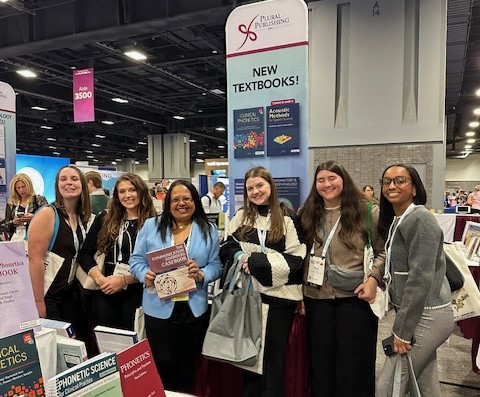
🎤 What was it like sharing the experience with the students, including the moment they met Plural Publishing and saw your co-authored book featured?
It gave me a chance to highlight the impact Stockton faculty are having nationally and to introduce them to Angie Singh, the visionary co-founder of Plural Publishing. I wanted the students to see firsthand the leadership, philanthropy and innovation that shape our field. My hope is that the experience planted seeds of ambition and possibility. They weren’t intimidated; in fact, they were excited and energized.
🎤 Looking ahead, how do you hope your Centennial session and research will influence Stockton’s curriculum, student training, and the profession?
I already integrate these concepts into my coursework, but receiving this recognition from my professional community strengthens my ability to expand the scholarship through future publications and presentations. I hope to continue influencing Stockton’s curriculum, culture, and training approaches while contributing to the profession’s broader commitment to inclusive communication.
🎤 What’s next for your work on inclusive listening and neural pathways?
My colleague in NAMS, Melanie Schroer [instructor of Biology], and I are finalizing a publication on our neurobehavioral model. I am also working on scaling the training program and preparing grant proposals to support the expansion. Beyond that, I’m continuing to present this work nationally — for example, I am currently preparing a paper for the National Black Association for Speech-Language and Hearing’s conference, themed “Rooted in Resistance: Advocacy. Resilience. Liberation.”
The demand for this work is significant, and our challenge is keeping pace with the need.
✨ You’d Never Guess: I’m a Phambassador
I’m a designated Phambassador — Philadelphia Ambassador — through the Mayor’s Office and Philadelphia Visitor Center. It allows me to combine my passions for photography, arts and culture, and poetry.
I get to explore unique experiences across the city and share them through creative storytelling. With America’s 250th anniversary approaching, it’s an especially exciting time to be involved. I bring some of these happenings to the attention of our students to foster curiosity, adventure and help them broaden their horizons.
Reported by Mandee McCullough
Photos submitted