Spotlight On: Deborah Gussman
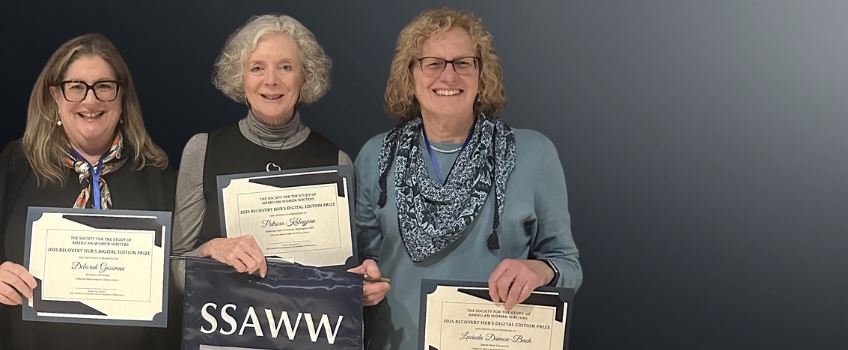
Professor of Literature Deborah Gussman, left, with fellow CMSOL editorial team members Patricia Kalayian and Lucinda Damon Bach, after accepting the Study of American Women Writers’ (SSAWW) Recovery Hub Digital Edition Prize.
Galloway, N.J. — Professor of Literature Deborah Gussman, along with her co-editors, were named the first recipients of the Society for the Study of American Women Writers’ (SSAWW) Recovery Hub Digital Edition Prize, a new national award recognizing excellence in the digital recovery and publication of American women’s writing. The honor recognizes their work on the Catharine Maria Sedgwick Online Letters project, a digital archive that recovers and publishes the correspondence of one of the most influential American writers of the 19th century.
🎖️ As the first recipient of this newly established award, what did it mean to you to receive this recognition, both professionally and personally?
Professionally, this award is meaningful because it affirms digital recovery work as rigorous scholarship. By honoring excellence in digital editing and publishing, the Recovery Hub helps move this work from the margins of literary studies into the center, alongside more traditional forms of scholarly production.
The award was also especially meaningful for the Catharine Maria Sedgwick Online Letters (CMSOL) editorial team — Lucinda Damon Bach, Patricia Kalayian and myself, who have each spent more than 25 years recovering Sedgwick’s work and restoring her literary reputation. To be recognized by an organization that has led the literary recovery movement makes that long-term commitment feel deeply seen and valued.
Personally, the award was both exciting and affirming. It was gratifying to have the work I’ve devoted so much of my career to honored by peers who understand its intellectual and cultural significance.
🌍 How does this award reflect the broader impact of the CMSOL project beyond Stockton?
This award highlights the project’s impact well beyond Stockton by recognizing the CMSOL as part of a long-term, international, collaborative effort to recover Sedgwick’s life and work. The letters offer invaluable insight into her development as a writer — revealing her intentions, influences and relationships with publishers, reviewers and fellow authors.
They also deepen our understanding of the major social and political issues that shaped her world, including gender roles, religious conflict, courtship and marriage, economics and material culture, immigration, enslavement, Native American removal and the environment. By making these materials accessible, the project extends Sedgwick’s relevance to scholars, students, and general readers today.
Recovering Catharine Maria Sedgwick and her work may be more important today than ever. We are living in a moment of intense debate about how literature and history are written and taught — about which voices are valued, which texts endure, and whose stories shape our understanding of the past.Deborah Gussman,
Professor of Literature
📚 For readers who may not be familiar with Catharine Maria Sedgwick, why is her work, and the recovery of her letters, significant today?
Recovering Catharine Maria Sedgwick and her work may be more important today than ever. We are living in a moment of intense debate about how literature and history are written and taught — about which voices are valued, which texts endure, and whose stories shape our understanding of the past.
Sedgwick was a prominent and widely respected author at a time when few women had the opportunity to publish, yet she was largely erased from literary history in the early twentieth century. Her recovery, and especially the restoration of her letters, underscores both the challenges and the rewards of building a more inclusive literary history. At a moment when the nation is reflecting on its past during the semisesquicentennial, Sedgwick’s work helps us tell a fuller, more accurate story of the development of American literature and culture.
🔓 The project emphasizes open access and digital recovery. Why is it important to make these historical materials freely available to scholars and the general public?
Before the CMSOL site launched, only about 300 of Sedgwick's 3,000 letters were transcribed and published; the rest were accessible only via microfilm or by visiting archives like the Massachusetts Historical Society, where most of the letters are stored. Published collections of letters from women of this era are quite scarce, so making Sedgwick's letters freely available not only benefits students and scholars studying her life but also provides insights into the thoughts and concerns of a woman of her time, enhancing our understanding of US history.
The project is also part of the Primary Source Cooperative at the Massachusetts Historical Society. It aims to publish online works from various editors who are preparing archival and manuscript records for scholarly and public access, while also developing and sharing the infrastructure needed to support the creation of new editions.
🌿🐾 What’s something you enjoy doing to recharge?
When I'm not teaching or working, you can usually find me reading contemporary women's fiction or walking in the woods with my husband and our dog, Peach. I especially love the Black Run Nature Preserve.
🔮 How does this recognition shape or affirm the future direction of your work, either on this project or in digital humanities more broadly?
The CMSOL team intends to publish all of Sedgwick's known letters, which should keep us busy for the foreseeable future. We are currently bringing additional Sedgwick scholars on board as consulting editors to help build out the website, with contextual essays and timelines, as well as involving students at Stockton and other universities as graduate assistants and interns.
We are also developing pedagogical materials for using the letters in classrooms. In fact, this month I’ll be introducing the letters to local high school teachers at a “Why the Humanities Matter” workshop on "Teaching with Primary Sources in the Humanities Classroom" here at Stockton.
Gussman has been a member of the Stockton faculty since 1999. Over her career, she has combined teaching, scholarship, and mentorship, engaging students in research while contributing to national conversations in literary studies and the digital humanities.
Reported by Mandee McCullough
Photo submitted