Fish Monitoring Study Gives Students Data to Explore
Port Republic, N.J. — A school of killifish swam in a ribbon formation through the shallow water of the boat basin at the Stockton University Marine Field Station on Nacote Creek.
The afternoon sun cast their tiny shadows on the muddy bottom.
Iridescent shimmers flashed as dozens of killifish swam inside a fish trap resting in water just deep enough to cover the trap.
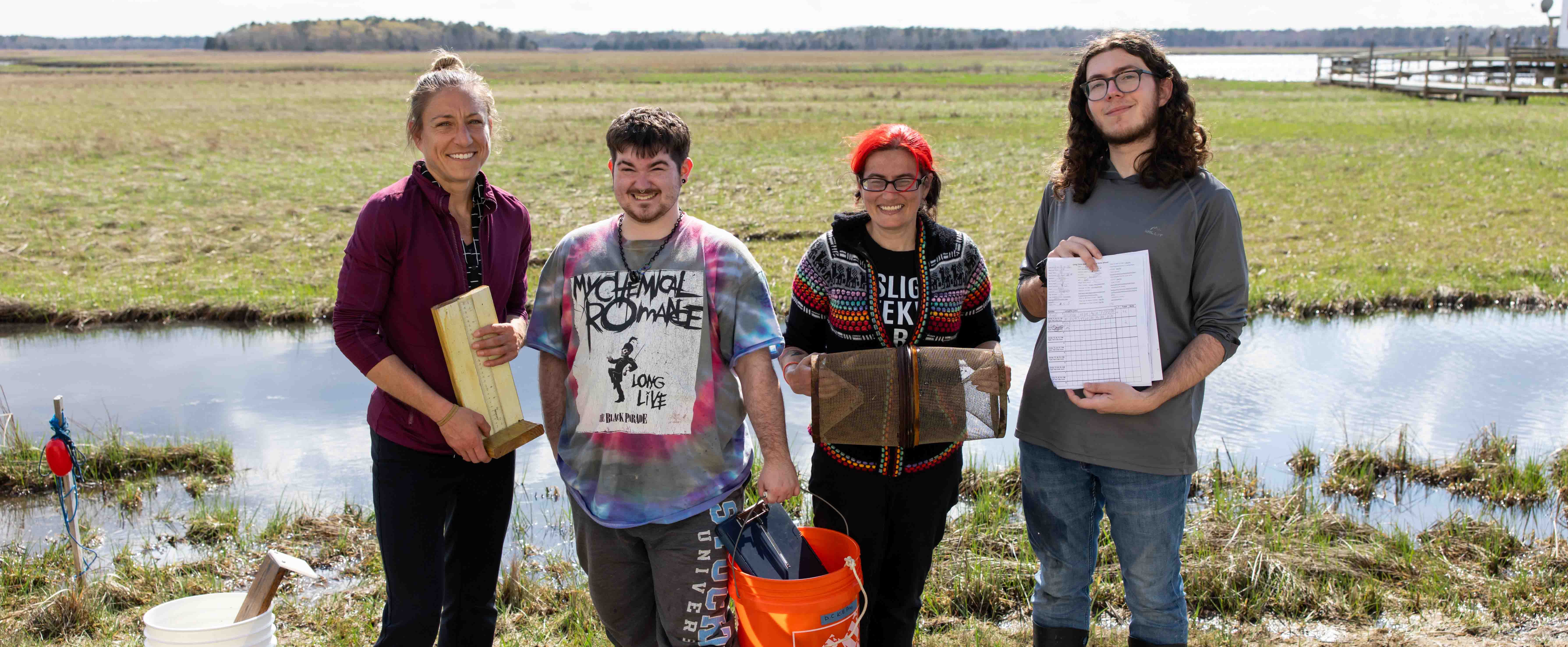
Dana Christensen, an adjunct professor in Stockton’s School of Natural Sciences and Mathematics, is working with students to conduct a long-term fish monitoring survey on the creek to describe small-bodied fish assemblages local to the Field Station using a series of minnow traps.
“We want to identify where the fish are now and how that changes over time. We can look at the size of the fish, the number of species that we get, the potential age classes of the fish, look at different micro habitats and see which ones are preferred,” she explained.
Christensen, still dressed from teaching science at Jackson Township High School, and her team gathered fish measuring boards, buckets, dip nets and a measuring tape and made their way to the dock to begin checking traps.
Minnow traps are set in the subtidal creek, shallow water in the boat basin and in a marsh pool protected from the open, deeper water.
In the Mullica River Great Bay estuary, mature killifish, also called mummichog, typically prefer subtidal creek, marsh edges and marsh pools for feeding and congregating, but in the last two years, the team hasn’t caught one in the mid-creek trap, which is the deepest sampling location to date.
“The biggest surprise is that the mummichogs here at the Marine Field Station don't appear to be using the marsh pool that we were sampling at as significantly as we'd be expecting them to. We're seeing very significant use of this boat basin, the intertidal anthropogenic habitat,” said Alexander Wroblewski, a senior from Havertown, Pennsylvania..
The observation suggests that there could be differences in habitat use.
“The data set itself is a good indicator of how the habitat is doing,” Christensen said, and it gives students the opportunity to ask research questions and search for answers through analysis.
View the photo story below.
Words and photos by Susan Allen
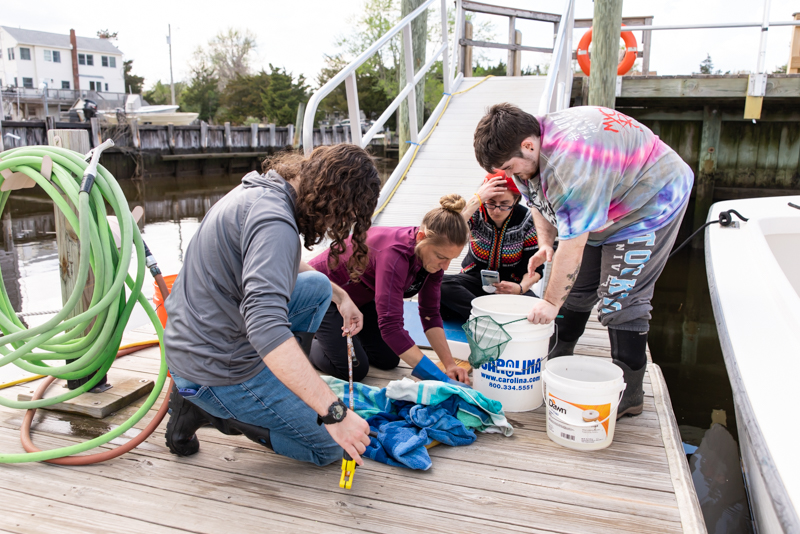
The first trap was set in deeper water by the R/V Petrel. The chaotic movement of an American eel quickly became noticeable as the trap surfaced.
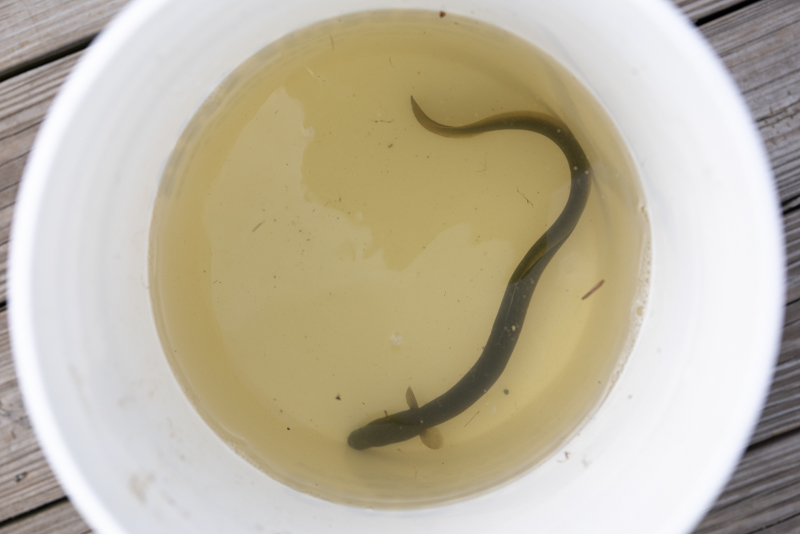
The slippery eel wriggled in the dip net, but the students carefully persisted to outstretch the snake-like fish alongside a measuring strip. They quickly returned it to the estuary where it will live until the time it reaches maturity and migrates to the Sargasso Sea in the Atlantic Ocean to spawn.
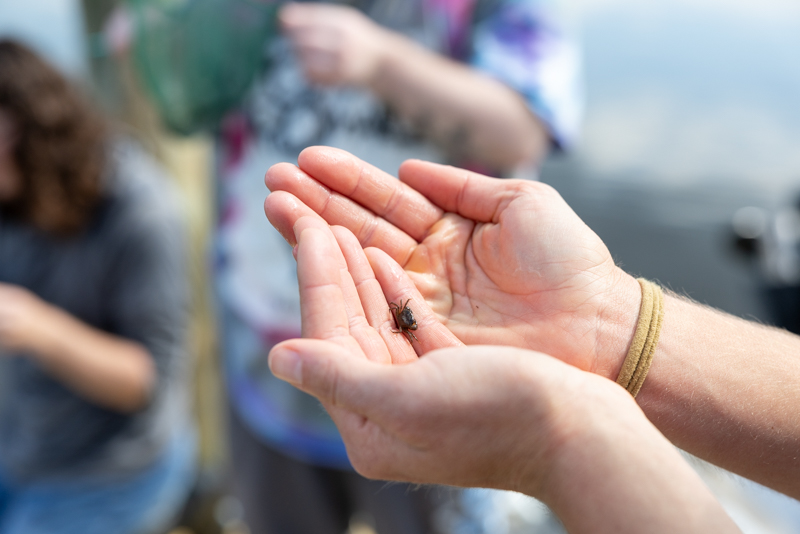
A student holds a tiny crab that entered a fish trap.
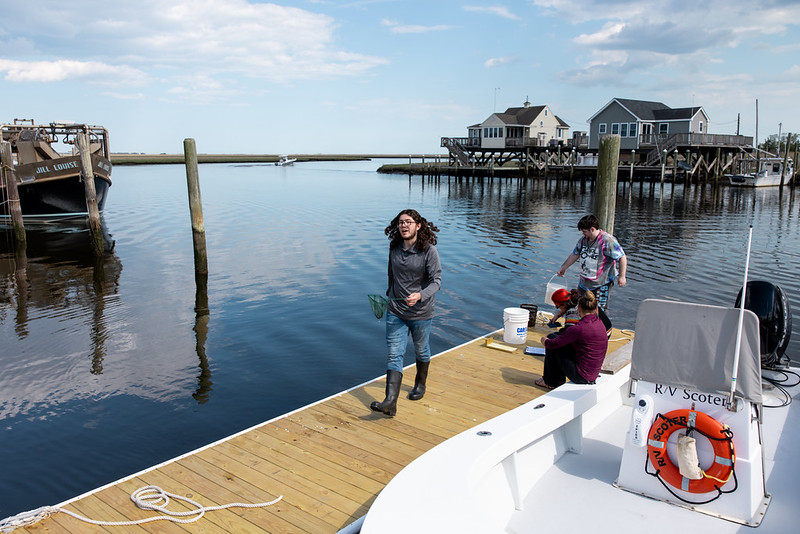
Alexander Wroblewski, a senior Marine Science and Environmental Science major from Havertown, Pennsylvania, got involved after seeing a flyer in the Marine Science Club’s GroupMe chat. “It's been really impactful and really empowering. I’ve had the opportunity to do data collection on something that I'm interested in, have the data to work with however I want, and then be able to provide results and actually put the skills that I'm learning in classes into practice in the real world, doing things that are meaningful, doing things that I'm enjoying, and doing things that I can see a career be built out of,” he said.
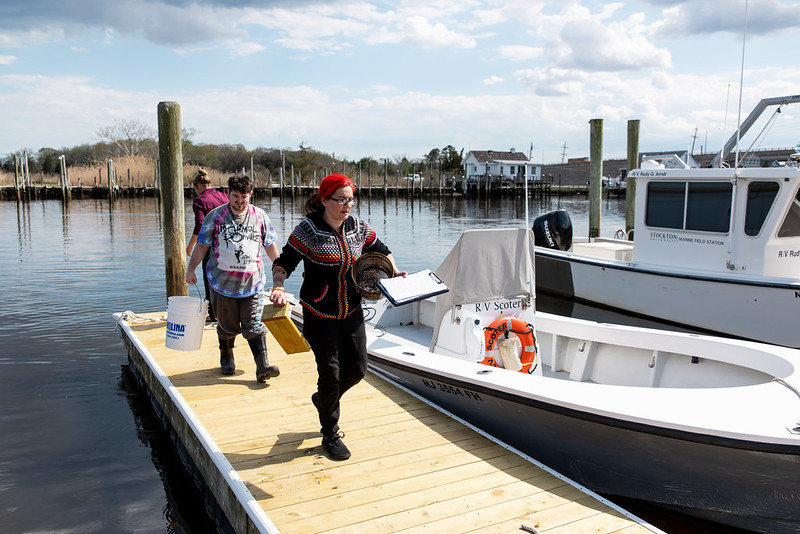
Jess Taylor, a first-year Marine Science major from Whiting, was excited at the chance to choose a project of her own to study based on the data. “Every couple of months I get to present, and I still get nervous, but I still have so much more experience that it's getting easier. Now getting up in front of my classmates and doing a class project is no issue,” she said. Her next project is looking at parasites. “All fish have parasites. I'm looking specifically for nematodes and other intestinal parasites and then whatever else I find,” she said.
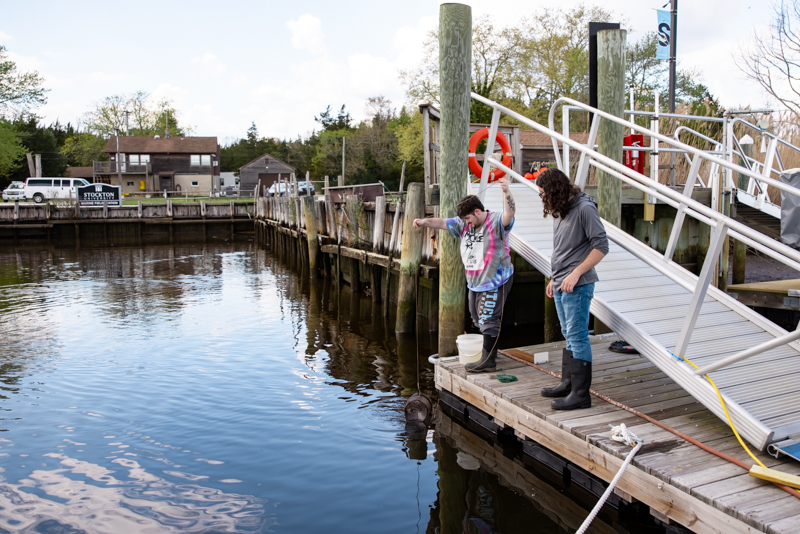
River Hammell, a senior Marine Science major from Deptford, called the study an “invaluable experience, both with knowledgeable staff and with equipment that I otherwise wouldn't have ever gotten to work with. I've learned a lot even in the span of the last few weeks that I've been able to volunteer.” They added that the opportunity was “a way for me to kind of bridge the gap where I needed that experience and I needed that extra hands-on in a way that made sense, that was tangible for my schedule, in a way that wasn't overwhelming but still got me involved.”