Can Horseshoe Crabs Survive Sea Level Rise?
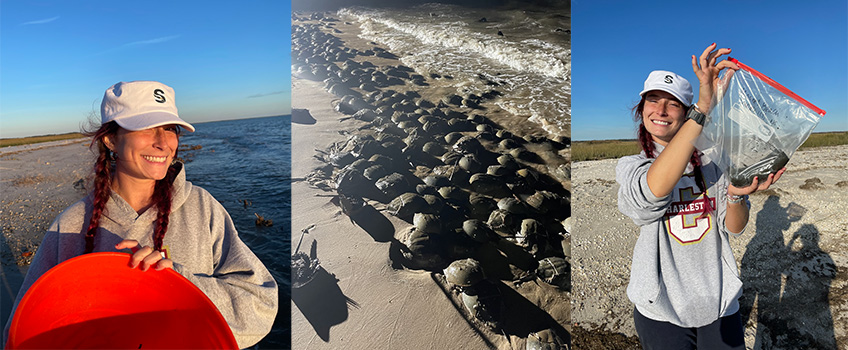
Paige Baney '23, a Coastal Zone Management master's student, created a habitat suitability index for horseshoe crabs at five beaches along the Delaware Bay in New Jersey.
Delaware Bay, N.J. - The Atlantic horseshoe crab outlived dinosaurs, but how long can they outlive rising sea level?
Paige Baney, of Brick, grew up seeing horseshoe crabs spawning on small segments of sandy beach along the Barnegat Bay during spring tides under full and new moons.
As a Stockton University Coastal Zone Management master’s student and 2023 Marine Science graduate, they inspired her research project that created a habitat suitability index for horseshoe crabs at five Delaware Bay beaches.
The largest population of spawning horseshoe crabs in the world bury their eggs in the sand along New Jersey’s 52 miles and Delaware’s 50 miles of Delaware Bay coastline.
As sea level rises, spawning habitat shrinks.
The crabs, which are arthropods and more closely related to spiders, are a keystone species that support shorebird populations, drive ecotourism and have been a lifeblood of the biomedical industry.
The 450-million-year-old species existed before dinosaurs and outlived them, survived five mass extinctions and their blue blood has been used in the biomedical industry as the primary endotoxin test for vaccines and implants until a synthetic alternative was introduced.
Their protein-packed eggs feed long-distance migratory shorebirds that draw birdwatchers to the bayshore like clockwork every May and June.
Childhood Memories Inspire Career Path
Baney, who was quickly captivated by the living fossils, identified six key beach parameters with non-negotiable ranges that define habitat suitability for spawning crabs: sediment grain size, sediment depth, beach slope, tidal range, wave height and human intervention through stabilization to reduce erosion and inundation.
The purpose of an index is to inform habitat restoration projects and research on best practices for nature-based shoreline stabilization in critical ecosystems.
Baney studied Money Island Beach, Bay Point Beach, Moore’s Beach, Reed’s Beach and Thompson’s Beach, but her index can be adapted for others.
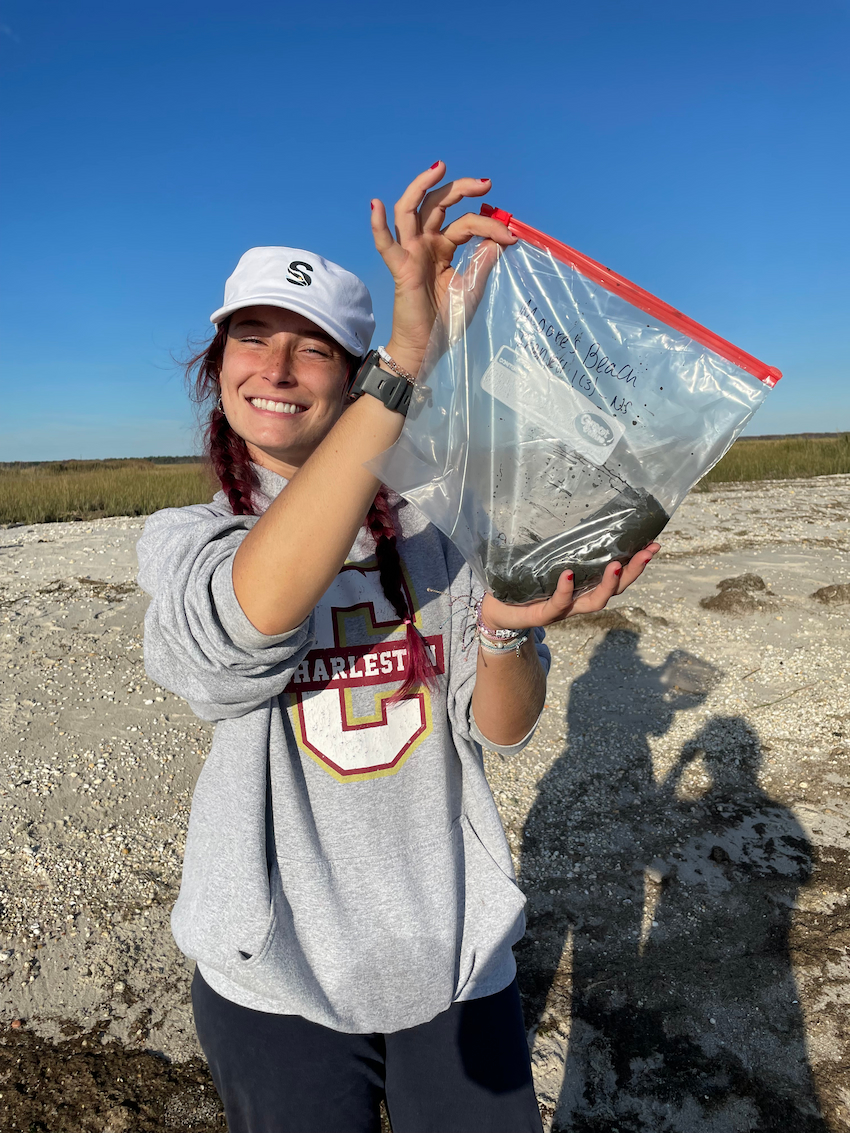
She consulted with Crist Robine, chief sedimentologist and geoscience specialist at Stockton’s Coastal Research Center, on sediment collection with a piston core and grain size analysis using the Robert L. Folk methodology that deciphers grain size by weight using mesh sieves.
He called her index “an essential tool” in guiding shoreline stabilization solutions that work with nature.
She used data on surface egg quantity and egg cluster abundance for her study sites collected by Susan Linder, of Wildlife Restoration Partnerships, and funded by the state of New Jersey through the American Littoral Society to see if her index scores matched real life spawning data.
For the five study sites, she simulated and mapped shoreline change using Google Earth and Gencade, a numerical model that simulates long-term shoreline change and sand movement, under the condition that no new stabilization occurs.
 What she discovered is that shoreline stabilization matters in preserving habitat
for horseshoe crabs. The well stabilized Money Island beach has the smallest percentage
of potential habitat loss due to sea level rise, and Thompson’s beach is experiencing
erosion and has the greatest potential for inundation.
What she discovered is that shoreline stabilization matters in preserving habitat
for horseshoe crabs. The well stabilized Money Island beach has the smallest percentage
of potential habitat loss due to sea level rise, and Thompson’s beach is experiencing
erosion and has the greatest potential for inundation.
“After completing this research, it seems to me that stabilizing the shorelines along Delaware Bay will be integral to maintaining the horseshoe crab spawning habitat there,” she said.
She added that the index can help direct funding to the beaches with the highest habitat suitability scores as opposed to sites that may have historically received more funding, but rank lower for habitat suitability.
Beach nourishment and stabilization projects are dependent on funding, but she believes they will make a difference.
“If beach nourishment as well as structuring could be done cyclically and in coincidence with sea level rise for the area, and take into account shoreline change given localized beach parameters, then I think these crabs would have no problem in the future. But really it comes down to maintenance of the habitat. That’s all about educating stakeholders as to why this maintenance is important and why the horseshoe crabs and their interconnection with migratory shorebirds helps bolster the local economy and helps to create a productive ecosystem,” she said.
With help, horseshoe crabs can likely continue to crawl out of Delaware Bay every spring to find a sandy habitat.
Reported by Susan Allen