Spotlight On: Lisa Cox
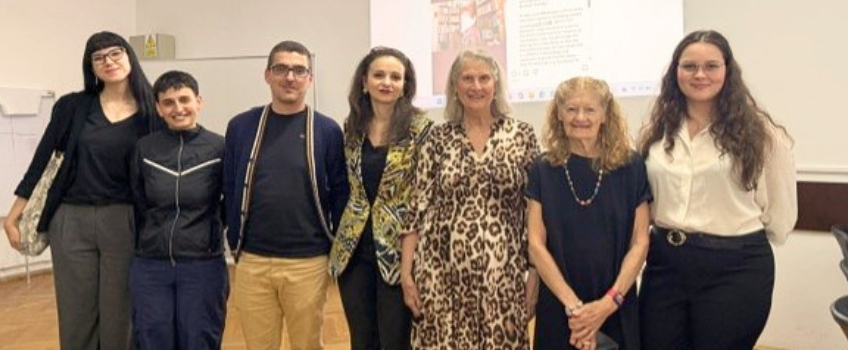
Professor of Social Work Lisa Cox (third from right) poses with graduate students who remained after her June 2 Inspire Research presentation at Babeș-Bolyai University in Cluj-Napoca, Romania.
Galloway, N.J. – For Lisa Cox, storytelling is more than reflection. It is a way to connect people across generations, disciplines and cultures.
That belief guided Cox, a professor of Social Work at Stockton University, during her recent Fulbright Teaching Specialist experience at Babeș-Bolyai University in Cluj-Napoca, Romania, where she introduced students and faculty to Guided Autobiography, a reminiscence-writing method that helps participants explore their lives through personal narrative.
The Fulbright Specialist Program connects U.S. academics and professionals with international institutions for short-term, project-based exchanges. For Cox, being selected affirmed decades of teaching, scholarship and social work experience while giving her the chance to build new academic partnerships abroad.
In the Q&A below, she shares how the experience came together, why Guided Autobiography (GAB) can be such a powerful tool and what she hopes to carry forward at Stockton.
What did being selected as a Fulbright Teaching Specialist mean to you?
Personally, being approved as a Fulbright Teaching Specialist is a dream come true. It meant that my years of teaching and research experience were recognized, valued and lauded, beyond Stockton, on an international level. Being officially accepted is a highly prestigious opportunity for elite mid-career and senior professionals to share their expertise internationally.
Unlike traditional grants, being on the roster is only step one. Subsequently, specialists must be matched with a project proposed by an overseas host institution, like a foreign university, nongovernmental organization or governmental ministry. Competition for ideal project placements varies by region and discipline.
Professionally, being selected meant that the degrees, certifications, life experience and research, scholarship and teaching talents I had acquired and honed for decades could be used for a greater global good.
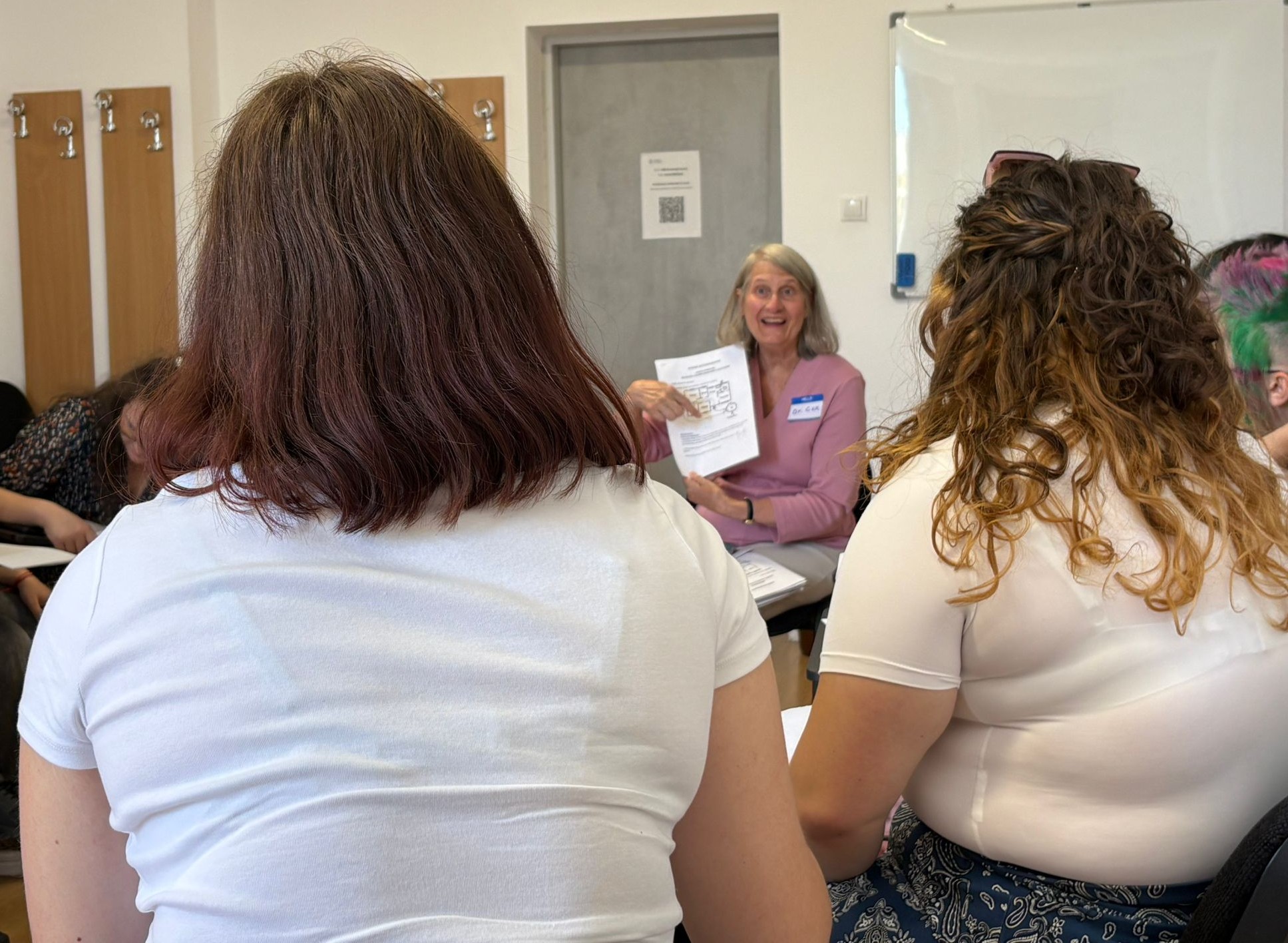
Lisa Cox teaches Bachelor of Social Work (BSW) students at Babeș-Bolyai University in Cluj-Napoca, Romania, during her Fulbright Teaching Specialist appointment.
How did the opportunity in Romania come about?
From January to August 2025, I was on sabbatical writing a book and received monthly emails from Fulbright listing open projects by discipline. Few of the projects seemed connected to my social work background until a friend from graduate school remembered a connection she had made years earlier at a professional conference in Hungary.
That introduction led me to Csaba Degi, chair of the doctoral program in sociology at Babeș-Bolyai University in Cluj-Napoca, Romania, who also taught a social work theory and methods course in the university’s Faculty of Sociology and Social Work.
During a Zoom meeting in March 2025, we discovered several shared interests. We were both licensed counselors with decades of academic experience and a passion for health social work, particularly oncology. Degi was also intrigued by my certification as a Guided Autobiography instructor.
By the end of the meeting, Degi connected me with Carmen Tagsorean, who helped facilitate the creation of a named project focused on my Guided Autobiography expertise and worked with Fulbright Commission contacts in Romania.
Located in Cluj-Napoca, Babeș-Bolyai University is one of Romania’s oldest and largest universities, with roots dating back to 1581. The multicultural institution offers programs in several languages and draws students from Romania, neighboring countries and across Europe.
What is Guided Autobiography?
Guided Autobiography is a reminiscence-writing method in which you reflect on prompting or sensitizing questions on a theme, then write a two-page essay or micro memoir.
Participants in GAB groups or workshops share their narratives in a small, supportive group, led by a trained instructor. Nine universal life themes and 10 to12 sensitizing questions act as a guide to lead people in their writing.
Universal life themes that apply to everyone include branching points, family history, the role of money, the history of one’s life work, health and body, development of sexual identity, ideas about death, spiritual life and values, and changing goals and aspirations. The process of guided autobiography often rekindles old interests and sparks optimism about the future.
What did your work at Babeș-Bolyai involve?
Each week in May, I taught guided autobiography to Romanian and Hungarian undergraduate students in Degi’s Social Work Theory and Methods class. Babeș-Bolyai faculty regularly hold classes in English to help strengthen students’ language skills, and I used icebreakers and small-group activities to build trust and encourage participation as we explored many of the nine universal life themes.
In June, I delivered a 90-minute experiential presentation on Guided Autobiography as part of the faculty Inspire Research series. Attendees included social work, sociology and psychology faculty, as well as graduate and doctoral students.
Throughout May and June, I also met with graduate students and faculty to discuss how Guided Autobiography methods could be applied to their research.
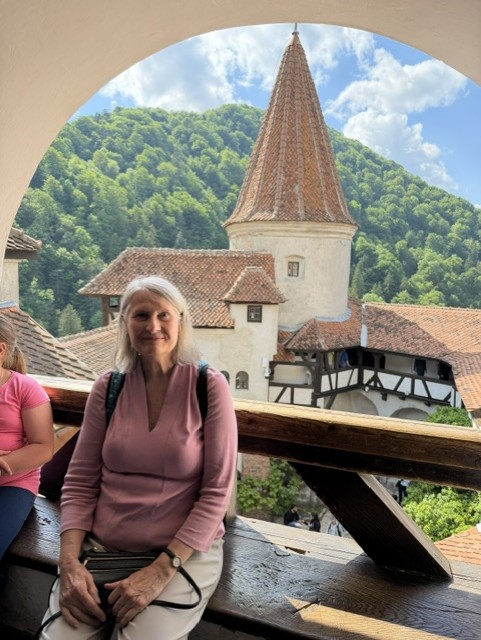
Lisa E. Cox visits Bran Castle during her Fulbright Teaching Specialist appointment in Romania.
In mid-June, during the 2026 Transylvania International Film Festival in Cluj-Napoca, I was invited by Oana Ometa, the university’s Fulbright contact and a cultural journalism professor, to give an online presentation to 72 journalism students from across the European Union. The students were preparing to interview actors, actresses and film directors, so I focused on Guided Autobiography themes such as major branching points and life’s work or career, and how those questions could help deepen their interviews and profiles.
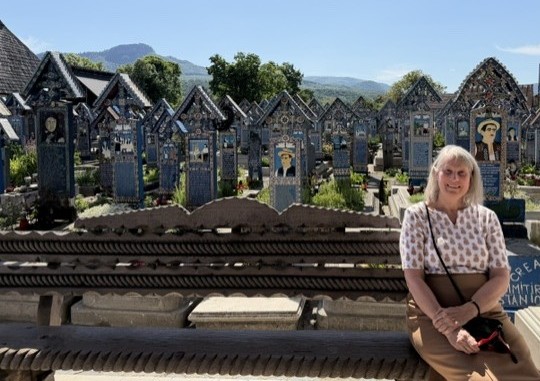
Outside of the university, I also explored Cluj-Napoca and surrounding areas of Transylvania, including museums, historic churches, Sibiu, Sighișoara and Bran Castle. Those experiences helped deepen my understanding of Romania’s history, culture and people.
How do you hope students and faculty will benefit from GAB?
Globally, we are living in an age where many people have forgotten the importance of truly relating to one another without a screen or social media. Guided Autobiography reminds us that life is a story, and that a personal history can be a moving gift for listeners, whether they are family members, colleagues, students or faculty.
I hope I left students and faculty at Babeș-Bolyai University with a strong understanding of Guided Autobiography and how it can be used to build reflection, connection and empathy.
Storytelling can be healing. When we reveal ourselves through story, we become more aware of the continuing core of our lives beneath the fragmented surface of our experiences. Listening is just as important. When someone truly listens with respect and attention, people can feel accepted and begin to discover more about themselves.
I also hope I conveyed that good listening can be learned. It requires respect, asking thoughtful questions, talking less than you listen and being willing to challenge assumptions.
Storytelling can be healing. When we reveal ourselves through story, we become more aware of the continuing core of our lives beneath the fragmented surface of our experiences. Listening is just as important. When someone truly listens with respect and attention, people can feel accepted and begin to discover more about themselves.Lisa Cox
Professor of Social Work
What moments from Romania stayed with you?
The “life of the mind” is alive and well in Romania. From the moment I walked up to the third floor of the Faculty of Sociology and Social Work and saw my name, Fulbright title and contact information on the wall outside Room 313, I felt welcomed.
I used Room 313 to prepare for classes and research presentations, and on my first day, faculty presented me with gifts and sat in a circle drinking tea and coffee and talking with me. I also worked with students who consistently completed their assignments and courageously shared their two-page Guided Autobiography essays in English. Their topics ranged from personal struggles to family histories, including stories about Romanian grandparents’ experiences after being captured by Russian forces.
I also had deep discussions with graduate and doctoral students about their research on migration patterns, artificial intelligence and other topics. I felt a strong sense of compassion and affinity for the kindness and resilience of the Romanian people, their blended cultures and their complex history.
When students asked if I was coming back next year, and faculty encouraged me to stay in touch to plan future shared research, I felt rekindled and rejuvenated. The Fulbright experience broadened my horizons, stretched my thinking, expanded my teaching skills and fostered exciting possibilities for new global research relationships.
How has your work in social work and gerontology at Stockton prepared you?
Gerontology has been my passion since my graduate school days at Virginia Commonwealth University. At Stockton, Dave Burdick introduced me to James Birren, a legend in the field of gerontology and founder of Guided Autobiography. While on sabbatical in 2006, I met Birren and sat in on one of his classes in Southern California. A few years later, I dedicated my gerontology textbook to him and became fully certified as a Guided Autobiography instructor.
Earlier this spring, Cheryl Svensson, a protégé of Birren, invited me to join the Birren Academic Research Group. We have already met, submitted a workshop proposal to a flagship gerontology conference and begun creating a research agenda.
My background in social work and gerontology helped prepare me to bring Guided Autobiography to Romania because the method is rooted in life review, reflection and meaning-making. People are living longer and have more time to reflect on their lives. Remembering can help us accept the life we have lived, promote meaning and self-growth, maintain relationships and guide behavior in times of uncertainty.
What does it mean to represent Stockton as part of the Fulbright Program?
I felt proud to represent Stockton in Cluj-Napoca. Stockton’s status as an Age-Friendly University also became a point of connection. A faculty member from Slovenia who attended the Inspire Research series had not heard of Stockton, but she was interested in learning more about our AFU affiliation and how her university might pursue similar recognition.
Stockton has supported my textbook writing endeavors over the years, and faculty at Babeș-Bolyai were thrilled to receive a copy of my most recently published textbook, “Introduction to Social Work: An Advocacy-Based Profession.”
What do you hope to bring back to Stockton?
As I return to Stockton, I am still processing my Fulbright Teaching Specialist experience in Romania, and I believe I now have a different perspective on teaching, research and life.
The experience reminded me how much can be gained through international academic exchange. I felt honored to share Guided Autobiography with so many students, faculty and researchers, and I was deeply moved by the stories, histories and perspectives I encountered in Romania.
I also return with renewed energy for teaching and research at Stockton. This experience reinforced the importance of listening, reflection and human connection across cultures.
It was unlike anything I have experienced, and I hope others at Stockton consider pursuing similar international learning opportunities.
Reported by Mandee McCullough
Photos submitted