Spotlight On: John O’Hara
Galloway, N.J. — As the nation prepared to commemorate its 250th anniversary, John O’Hara spent a year researching and writing a permanent exhibition that brings the evolving promise of American democracy home to South Jersey.
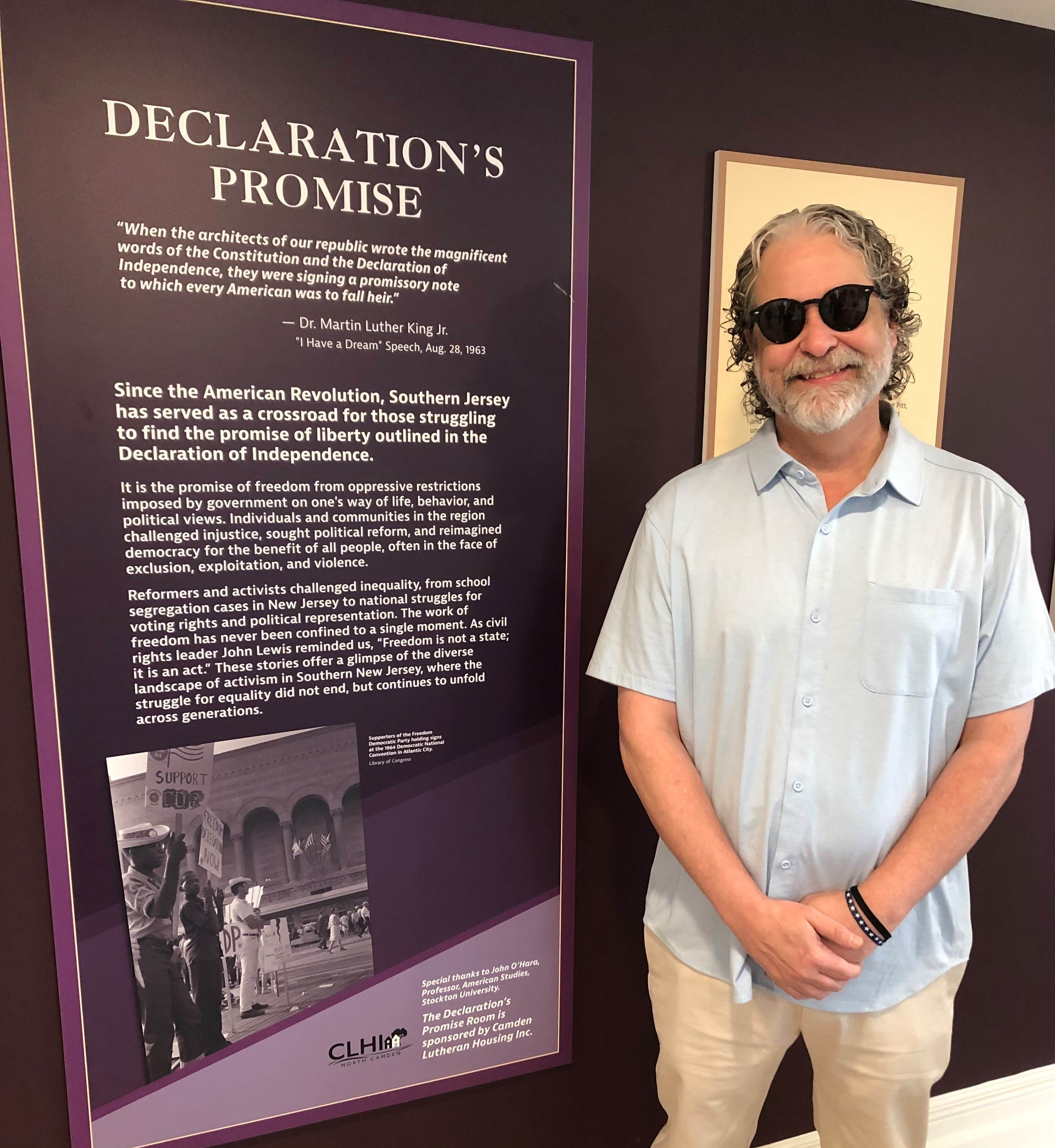
O’Hara, a professor of Critical Thinking & First-Year Studies at Stockton, served as the lead researcher and principal author for “The Declaration's Promise,” a permanent gallery at the recently restored Benjamin Cooper Tavern in Camden.
In the following interview, he discusses the complex process of shaping the exhibition’s narrative, what he hopes visitors take away from it and how the research directly relates to his teaching.
Where did your love of history come from?
My academic background is really split between literature and history, and for me those two disciplines have always gone together. Literature tells stories, and history tells stories too. Both forms are embedded simultaneously in the past and present, and both point toward the future. Literature and history both make me think about how and why stories in general are told.
I guess my love of history comes from the love of stories and the need to keep telling stories.
How does being part of a multifaceted project like this influence your work in the classroom?
The museum work and the classroom really reinforce one another because they're both about making decisions about evidence and narrative.
Whether I'm teaching first-year students or graduate students, what remains consistent across all my courses is trying to better understand the relationship between narratives and the past. Narratives are built from choices: what to include and what to exclude, what to emphasize, what to downplay, where to begin and where to end. They are also built on forgetting. Sometimes we forget because something doesn’t seem important. Sometimes we forget because events are painful or traumatic, too important in a sense. We have a capacity to repress things. Other times forgetting can be deliberate or intentional, whether from shame, regret, convenience or a desire to protect a certain image of ourselves.
In many ways, the stories we tell about ourselves and our families aren't fundamentally different from the stories we tell about nations. They’re all subject to the same challenges of evidence, memory, interpretation and narrative construction, as well as the desire to tell the story we want to tell.John O’Hara
Professor of Critical Thinking & First Year Studies
One of the most valuable lessons came from something very practical: we simply couldn't include everything. To make the calendar work, we had to choose what stayed and what didn't. That turned into a conversation about how historians and curators face those same decisions every day. Every exhibit, every monument, every marker represents one set of choices while leaving out countless others.
The same thing happens in my course projects where students research their own family histories. In many ways, the stories we tell about ourselves and our families aren't fundamentally different from the stories we tell about nations. They’re all subject to the same challenges of evidence, memory, interpretation and narrative construction, as well as the desire to tell the story we want to tell.
As you conducted your research, how did you decide which stories and historical moments to include?
I am glad to hear a question directly about “what to include” which also implies the other side – what to exclude.
One of the first things an exhibition researcher has to recognize is that the goal cannot be to tell every story. That’s impossible. The goal is to build a framework that allows visitors to discover many stories and, hopefully, inspires them to keep looking beyond the exhibition. I tried to identify moments that function as doorways into larger explorations, stories that encourage further conversations about America becoming what it is today through an ongoing process of revision, retelling, reinterpretation, and, yes, forgetting.
What's something people might be surprised to learn about you?
People who know me aren't surprised by this, but others might be. I’m what some people call a “Dylanologist.” Since the songwriter Bob Dylan received the Nobel Prize in Literature in 2016, I've taught courses on his life and work, and we’ve held Stockton's annual Bob Dylan Fest five times since 2017. I was privileged to speak at the Bob Dylan Center in Tulsa last summer.
Here is a little South Jersey hidden Dylan history. When Dylan famously “went electric” and transformed rock and roll in 1965, he recruited the musicians who would become The Band at a club called Tony Mart’s in Somers Point – where they were performing a summer engagement as Levon and the Hawks. That’s just one of those wonderful reminders of how South Jersey set the scene in so many unexpected places throughout American history.
Once you start looking, it's everywhere. Harriet Tubman lived and worked here. Vineland was a center of the women’s suffrage movement. Cumberland County was a Japanese American resettlement destination after their internment during World War II. Many came to work at Seabrook Farms, where you could say the modern frozen food industry was invented. Race, immigration, labor, agriculture, music, politics – you name it, you can find a story on almost every block in South Jersey.
The challenge with “The Declaration's Promise” was to tell many stories spanning centuries through 13 objects, reflecting the traditional number of original colonies. But even that familiar framework turned out to be worth questioning. We ultimately ended up with 14 panels because we included one examining an often-overlooked promise connected to the Declaration era: a provision in the 1778 Treaty of Fort Pitt that envisioned the possibility of a Lenape Indigenous people’s state, with representation in Congress. That promise was never fulfilled. Including a 14th panel reminds visitors that the past is rarely a tidy story. The familiar narrative of “the thirteen colonies” leaves out so much about colonial North America. This panel isn’t intended to be an afterthought. It is a reminder that organizing the past into something called history is always bound up with the telling process and the narrative frameworks we inherit, ironically from other stories of the past.
What does it mean to you to interpret the Declaration as an evolving promise rather than a single historical event?
I've always been drawn to Abraham Lincoln's observation that once the founding generation passed away, the responsibility for the nation shifted to those who followed them. The founding documents endure, but every generation must decide what those promises mean and how it intends to pursue them.
That's one of the most remarkable things about the Declaration. It was not just a one-time document. It articulates a set of aspirations that every generation measures itself against. The Declaration can proclaim equality and liberty, but it cannot guarantee them. That work belongs to the people who inherit it. The founders themselves understood that they were imperfect people. In some cases, they championed ideals that exceeded their own actions. Many spoke eloquently about liberty while participating in slavery. Voting rights were limited. Women had little political standing. They weren't passing down a finished product. They were developing an argument about what America ought to become. Every generation since has had to decide whether to narrow those promises or broaden them for the larger common good.
What do you hope visitors will reconsider after experiencing the gallery?
I hope visitors – whether they're elementary school students on a field trip, lifelong South Jersey residents, or people visiting from elsewhere – come away realizing that South Jersey has played a much larger role in American history than many people recognize. The exhibition can only scratch the surface, but I hope it encourages visitors to dig deeper. If it inspires someone to ask another question, visit another historic site, read another book, or look differently at the places they pass every day, then it's done its job. Every town in South Jersey has stories waiting to be discovered or rediscovered.
Reported by Mandee McCullough
Photos submitted