Spotlight On: Jamael Harrison
Galloway, N.J. — Jamael Harrison, director of Student Affairs Assessment and Communication, recently completed EAB’s Rising Higher Education Leaders Fellowship, a six-month program that helps emerging leaders develop practical skills and advance an institutional priority through a capstone project.
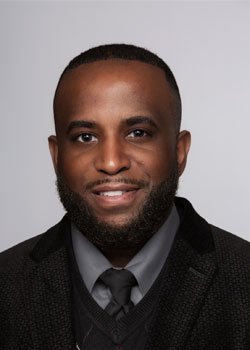
For his capstone, Harrison developed the Four Currents Framework for Strategic Planning, a way to examine the cultural, political, structural and aspirational forces that can determine whether strategic plans succeed or stall. EAB featured the project among the spring 2026 cohort’s work.
In the following Q&A, Harrison shares how the framework grew from Stockton’s own strategic planning transition and why leaders need to look beneath goals and metrics to understand what really moves an institution forward.
What made you want to participate in EAB’s Rising Higher Education Leaders Fellowship?
I was at a point in my career when I wanted to think more intentionally about leadership, not simply as a position but as the ability to influence change, build relationships and help institutions move from ideas to meaningful action. Higher education is navigating significant change, and I saw the fellowship as an opportunity to learn alongside leaders asking many of the same questions about the future of our institutions.
I was also drawn to the chance to step outside my day-to-day responsibilities at Stockton, reflect on my leadership practice and bring new ideas back to the University. The fellowship gave me space to connect my work in assessment, strategic planning, communication and student success, helping me see the broader impact I could have as a higher education leader.
What inspired you to develop the Four Currents Framework? Was there a particular moment or challenge at Stockton that helped shape the idea?
The Four Currents Framework grew out of my experience seeing that strategic planning is rarely as linear as it appears on paper. Institutions often spend significant time developing missions, goals, priorities, metrics and implementation plans, but powerful forces beneath the surface determine whether a strategy actually gains momentum.
At Stockton, I observed strategic planning during a period of transition, evolving institutional priorities, new leadership and a shift from developing a plan to implementing it. That made me ask: What is really moving underneath the formal plan? What helps one initiative advance while another struggles, even when both look strong on paper?
I identified four interacting currents: Cultural, Political, Structural and Aspirational. They shape how people interpret, support, resist and carry out strategy. The metaphor felt especially meaningful because, like water, these forces are always moving. Sometimes they reinforce one another, and sometimes they pull an institution in competing directions. The framework encourages leaders to look beneath the surface before assuming a well-designed plan alone will create change.
Of the four currents, Cultural, Political, Structural and Aspirational, which do institutions most often overlook?
I think the Political Current is often the most overlooked. I do not mean politics in a partisan sense, but the relationships, influence, trust, competing interests and informal power structures that exist within every organization.
Institutions are generally comfortable discussing structure: who is responsible, what the timeline is, what the metrics are and where resources will come from. We are also increasingly comfortable talking about organizational culture. But we do not always openly examine who has influence, whose voices are heard, where trust exists or has been lost and how relationships may accelerate or impede implementation.
Ignoring that current does not make it disappear. Understanding the political landscape
can be essential to building authentic coalitions, anticipating resistance, strengthening communication and
moving a strategy forward in a way people can genuinely support.
Director of Student Affairs Assessment and Communication
What did you take away from the fellowship that will influence your work at Stockton?
One of my strongest takeaways was the importance of approaching leadership with both curiosity and intentionality. Leadership requires data and strategy, but it also requires understanding people, context, relationships and the stories behind what the data may be telling us.
At Stockton, I want to continue bringing those dimensions together. My work increasingly sits at the intersection of assessment, strategic planning, communication and institutional improvement. The fellowship reinforced for me that meaningful change happens when we connect those areas rather than treat them as separate functions.
It also strengthened my commitment to asking thoughtful questions before jumping to solutions. The Four Currents Framework reflects that philosophy. Before asking, "What should we do next?" institutions sometimes need to ask, "What is happening beneath the surface that we need to understand first?" I plan to continue bringing that perspective to my work at Stockton.
What is especially important for the Stockton community to understand about the experience or your capstone project?
The Four Currents Framework grew directly from my experiences working at Stockton. It reflects how strategy, culture, relationships, structures and aspirations interact in real time.
A strategic plan can provide direction, but successful implementation depends on understanding the forces beneath the surface. I hope the framework can strengthen reflection, collaboration and the connection between institutional priorities and the people responsible for carrying them forward.
Reported by Mandee McCullough
Photo submitted