New Center Gives Voice to Parkinson’s Disease Patients
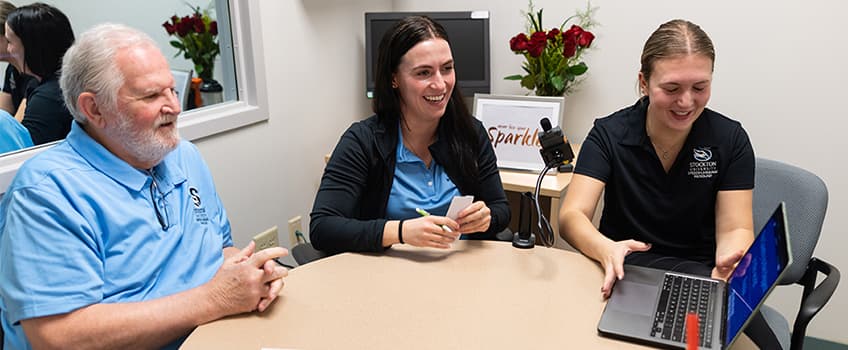
From left, John Gaynor, 71, of Egg Harbor Township, works with Stockton students Norina Cobb and Melanie Wolfson during a free Parkinson Voice Project session designed to help those with Parkinson's disease.
Galloway, N.J. — After receiving $50,000 from a national nonprofit, Stockton University recently opened the New Jersey SPEAK OUT!® Therapy & Research Center, the only center in the state, to help those with Parkinson’s disease, the world’s fastest-growing neurological disorder.
In early 2025, the Texas-based Parkinson Voice Project designated Stockton to represent New Jersey and join 27 other centers throughout the country. The center opened last summer, providing no-cost individual and group sessions led by Michelle Swartz, assistant professor of Communication Sciences and Disorders, and Kelly Maslanik, a clinical specialist with Stockton’s Master of Science in Communication Sciences and Disorders program. More than 30 people have signed up for the intervention at the clinic at 10 W. Jimmie Leeds Road in Galloway.
For Paul Chaballa, 75, the sessions have been invaluable. He noticed a few years ago that he was having tremors and that his voice would taper off. His voice was strong during a recent session as he explained that he’s very much aware of what’s happening to him.

Kelly Maslanik, a clinical specialist, demonstrates to a group of students in the Communication Sciences and Disorders program some of the techniques used in the New Jersey SPEAK OUT! Therapy & Research Center.
“Even now, I can feel it coming on,” said the Middletown Township resident. “I have to constantly remind myself about intent — what am I going to say, how am I going to say it, and am I pronouncing and enunciating myself clearly so that everyone hears me. It’s not perfect. I still stumble with it.”
The weekly in-person and virtual group intervention sessions offer education, accountability, community and practice for patients to maintain progress in regaining and retaining their voice and swallowing. Maslanik and Swartz lead the sessions, but they have also been training students in Stockton’s master’s in Communication Sciences and Disorders program to work with patients as well.
Being able to help patients with Parkinson’s disease has had a profound impact on first-year graduate student Norina Cobb, who said she witnessed the effects of the disease firsthand in her father, Brian. It’s reinforced that being in Stockton’s Communication Sciences and Disorders program is where she needs to be.
“We don’t realize how much our voices and our speech make us an active member in each other’s lives until you lose it, or someone close to you loses it,” she said. “If you’re able to help someone be an active member and talk to their family, talk to their loved ones and have an active social life for longer, then I believe that’s the greatest gift you could provide to anyone in their life.”
One of the patients Cobb has worked with is John Gaynor, 71, who was diagnosed with Parkinson’s five years ago and has experienced tremors for approximately 12 years. Additionally, he struggles with the volume of his voice. He’s been with Stockton’s program since July and loves the fact that it’s in person.
“It’s intimate. It’s close,” said the Egg Harbor Township resident. “I enjoy being able to read facial expressions. It just feels more personal.”
In addition to the sessions held at Stockton, participants also have access to extensive resources through the Parkinson Voice Project website, including daily virtual SPEAK OUT! home practice sessions at no cost. Gaynor said he uses the extra resources to practice every day and comes to the Stockton sessions twice a week.
“It’s the difference between me losing my voice and not losing my voice. It’s cut and dry in my mind,” he said. “Strengthening those muscles and learning how to think of something that previously I just took for granted and needing that constant reminder is so important.”
Student Rachel Scalese got involved with the SPEAK OUT! therapy program to gain experience working with adults. Before joining Stockton’s master’s program, she taught children science in Philadelphia.
“I wanted to jump right in and work with clients and see if I like it,” said the 29-year-old from Haddonfield. “It’s great to see them make connections and build a community amongst each other.”

Last year, the Texas-based Parkinson Voice Project selected Stockton to represent New Jersey as a SPEAK OUT! Therapy & Research Center. The nonprofit provided $50,000 to train Stockton’s faculty and students over a five-year period.
That sense of community drew John Nigro to the New Jersey SPEAK OUT! Therapy and Research Center. The 74-year-old from Hazlet was diagnosed with Parkinson’s in April. He’s been participating in virtual classes since June.
“I look forward to doing the classes because I probably wouldn’t do it on my own if I wasn’t doing it with this group,” he said. “It’s all been positive, and I feel like my voice may not be getting stronger, but at least it’s not getting worse.”
Maslanik and Swartz have also seen positive connections emerge between patients and the graduate student clinicians working with them since the clinic opened.
“The energy is palpable. You can see the progress and sense of community firsthand during our group sessions,” Maslanik said. “There’s a fellowship that has grown organically through conversations about shared experiences that they all seem to relate to.”
In addition to training graduate student clinicians and providing care to patients, Swartz and Maslanik also conduct research projects aimed at investigating the holistic care of patients with movement disorders.
“Our hope is to continue expanding our reach so that we can offer no-cost services to a growing number of patients with movement disorders and their families,” Swartz said.
Call 609-652-4920 or email speakout_njctr@stockton.edu to schedule an online or in-person SPEAK OUT! evaluation in English or Spanish. Research participation opportunities are also available.
— Story by Mark Melhorn, photos by Susan Allen