Tourism Leaders See Strong Summer Potential
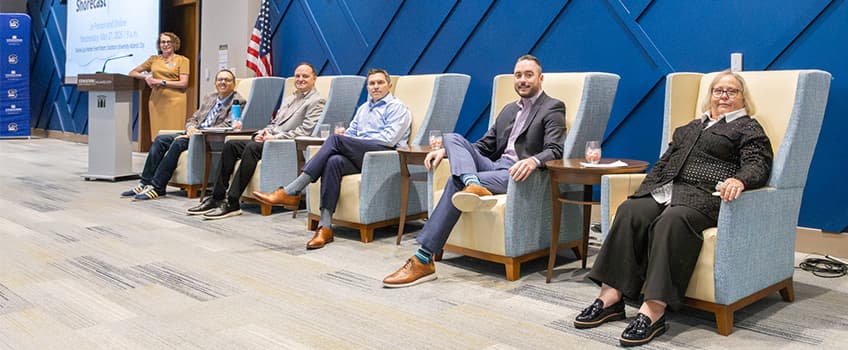
From left, Jane Bokunewicz, faculty director of Stockton University’s Lloyd D. Levenson Institute of Gaming, Hospitality and Tourism (LIGHT); panel moderator Scott Cronick of WOND Radio; Michael Chait, public information officer for the Casino Reinvestment Development Authority; Oliver Cooke, associate professor of Economics at Stockton University; Dan Gallagher, executive director of the Atlantic City Sports Commission; and Diane Wieland, director of Tourism/Culture and Heritage for Cape May County Department of Tourism. The panelists spoke at the 18th annual Jersey Shorecast, sponsored by LIGHT and Stockton.
Atlantic City, N.J. — Local tourism experts highlighted an industry that is optimistic but cautious for the Jersey Shore just days after Memorial Day, the official start of the summer season for the region.
Resilience and evolution of South Jersey’s tourism economy amid economic uncertainty and changing traveler behavior dominated the discussion at the 18th annual Jersey Shorecast on May 27, sponsored by the Lloyd D. Levenson Institute of Gaming, Hospitality and Tourism (LIGHT) at the Stockton University School of Business. The discussion was held at the Stockton University Atlantic City John F. Scarpa Academic Center and streamed online.
Panelists emphasized increases in overnight stays and strong event attendance in the past year, while acknowledging that inflation, reduced consumer confidence and inconsistent tax data blur the actual picture of what’s ahead for the season.
LIGHT Faculty Director Jane Bokunewicz opened the discussion, which was moderated by Scott Cronick, host of “Off The Press” on WOND Radio.
Panelists reflected a cross-section of hospitality and tourism from Atlantic and Cape May counties, including:
- Michael Chait, public information officer for the Casino Reinvestment Development Authority
- Oliver Cooke, associate professor of Economics at Stockton University.
- Dan Gallagher, executive director of the Atlantic City Sports Commission
- Diane Wieland, director of Tourism/Culture and Heritage for Cape May County Department of Tourism
Before the discussion, Bokunewicz presented statistics from the 2025 season that was shaped by economic uncertainty, tariffs and inflation. Total gross gaming revenue was up 14% in the 2025 summer season, driven by increases in internet gambling and table games. The average total employment for the season declined 2.6%, and the number of vehicles passing through the Atlantic City Expressway Pleasantville Toll Plaza was flat compared to the prior year.
Bokunewicz said Atlantic City casinos are reporting record internet gaming, which has surpassed brick-and-mortar gaming and shows no sign of slowing.
Panelists expressed shifting strategies to boost this summer’s numbers, including a focus on experiential and event-driven tourism like FIFA World Cup-related activities, concerts and this weekend’s Atlantic City air show.
Following is a recap of the questions and some of the answers from the panel:
How did the local tourism industry perform in 2025?
Chait: I think if you look at the tourism economics report that the state puts out each year, it was about $8.4 billion in visitor spend, so it's trending up. I think the daily visitor volume, according to that report, was down slightly, but overnight stays were up across Atlantic County.
Cooke: Summer employment in Atlantic and Cape May counties usually bumps up around 9-10% in summer months. Last year it was only about 8%, so that’s not huge, but it’s maybe an indicator of some hesitancy going back to last summer, some of the policy chaos and inflationary pressures. The hotel and motel tax collections for the two-county area were down substantially over the entire summer. It’s still a little unclear to me why.
Wieland: Cape May County is the No. 1 tourism destination in the state. We saw an increase of 4.2% in overall visitor spending, in spite of the June weather and the forecasted decline in Canadian tourists. We were down 32% in occupancy tax according to the State Treasury, but our lodging was up 6.7%. I’m not sure how the formula works. It did not make sense.
Gallagher: From the meetings industry as a whole, it was fairly flat across the nation. However, Atlantic City performed rather well. The ease of access to get here plays a major factor.
The Soar and Shore Airshow presented by Visit Atlantic City is this weekend. The main reason (it was moved to May 29-31) was to get on the calendar of the Blue Angels and the Thunderbirds. It will be a three-day show, Friday-Sunday, from 12-2:30 p.m. each day. We think it will be a good kickoff to summer moving forward.
How would you describe the region’s current economic circumstances?
Cooke: There is decent momentum moving right now. Job growth in April was up a robust 3% in the region. About half of that is tied to restaurant and bar employment. That’s a good indicator that the folks making the hiring decisions early are hopeful.
Wieland: We took a look at a “tank of gas away” campaign. Within 300 miles there are 30 million people. We used every format of marketing we could. It is resonating with visitors. We had a great Memorial Day weekend. Towns were packed. It was a great time for the restaurants, bars, wineries, shopping and other nonbeach activities.
Are there trends from 2025 that will continue to have an impact on the 2026 summer tourism?
Gallagher: With the air show, Slippery Stairs and (ShopRite LPGA Classic golf) tournament, we are expecting a very strong, robust economic spend this weekend. But it’s more than that. We are bringing back the American Power Boat Association June 27 and 28. Then we have WWE coming back June 29 for the first time in many years. Rufus Du Sol is scheduled for a beach concert Aug 28. Big acts like Shakira are coming. We are starting to see large-scale, consumer-based events.
Chait: We are trying to find ways to activate Boardwalk Hall. Those large events are an influx of disposable income. People come, they stay, they go out to dinner and shop. It brings people back to town that maybe haven't been here in a while, and it brings some new people to town. So, large-scale events are critical to our economy, and it keeps Atlantic City on the map.
Wieland: We have events every weekend in every town. Emerging travel trends are people are looking for local culture, a little more rural. They want to accumulate experiences and memories.
The FIFA games in Philadelphia are going to be important to us. We are already out there marketing. A large portion of people coming to FIFA don’t have tickets but want to be part of the excitement.
Do you see international events like the FIFA World Cup impacting New Jersey’s summer tourism season?
Gallagher: Atlantic City was awarded a grant from the state for a watch party on the beach July 18 and 19. And the Haiti team selected Stockton University as their base camp and is staying in Atlantic City. Global political strife is impacting (the games.) Ghana was supposed to send 10,000 delegates. No visas were approved. So, what you’re seeing in cities like Philadelphia, who blocked off 10,000 rooms, they’ve cut that by 80%. It will be interesting to see what the impact is on the region, not because of people not interested in the games, but because of how spread out it is, the ease and accessibility to get to some of these areas.
Cooke: There is wide reporting on this. FIFA itself is largely responsible for the very poor, to date, ticket sales. It will be interesting to see what happens to ticket prices over next few weeks.
Do you anticipate anything else impacting performance this summer? What will the impact be?
Cooke: I think the big wild card for me about this summer is we have recent indicators that consumer confidence is near or at all-time lows. I think a lot of this is tied to inflation, and the war is probably part of this as well. I think people got higher tax returns than they assumed they would be getting, so there is some counter there. Maybe this means folks still take their vacations, but the total spend is a little bit less. I think there is a lot riding on consumer sentiment at the end of the day.
Chait: What I am hearing anecdotally from friends is they are doing Airbnbs, they’re bringing their own food and cooking. They have a budget now that they have to stick to. Also, I don’t know how this impacts performance over the summer, but there are year-round sports. The growth of these clubs and youth sports is absolutely pulling from vacation time of what families used to do.
Wieland: The weather always is a major factor we have to watch for, but what we're finding is people are looking for less crowded destinations. They're not traveling in the height of the season, and we’re seeing more and more people coming in fall. We are seeing continued growth in the fall and into the winter. That is a great change for us.
Looking into the future are there new challenges/new opportunities to consider in 2026?
Gallagher: I think you have to have a really diverse portfolio. There is no magic pill that is the perfect fit for Atlantic City. It’s about consistent messaging, branding and letting them know Atlantic City remains open for business, not just three months out of the year.
-- Story by Stacey Clapp, photo by Abbigail Erbacher