Graduate Students Showcase Research at Spring Symposium
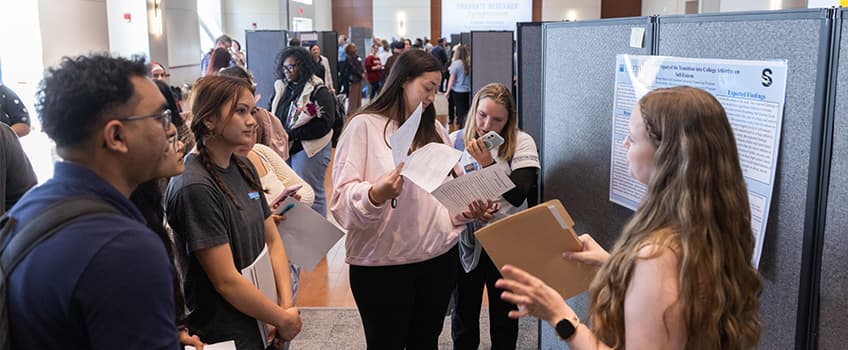
The symposium serves as both a capstone experience and a professional development opportunity for graduate students.
Galloway, N.J. — Stockton University's Office of Graduate Studies hosted its Spring 2026 Graduate Research Symposium on April 27 in the Campus Center Event Room, bringing students from across the university's graduate programs to present original research, capstone projects and creative work.
This year's event featured more than 100 students across 45 presentations, with participants given flexibility to present using digital posterboards, physical displays, slideshows or any other format meeting guidelines set by their instructors. The event, organizers said, reflects the continued strength and growth of Stockton's graduate community.
The symposium opened with remarks from Dean of Graduate and Continuing Studies Naima Hall. Hall framed the afternoon as a moment of collective recognition, calling it "a celebration of depth, rigor and impact" and adding that the work on display represented more than academic achievement.
We are honored to showcase the work of our students, which reflects not only intellectual curiosity, but also a commitment to addressing real-world challenges and advancing knowledge across disciplines."Naima Hall, dean of Graduate and Continuing Studies
This year marked the first time the symposium presented formal research awards. Organized under the theme Innovation, Inquiry, Impact, the 2026 Graduate Symposium Research Awards recognized students across four categories: the Provost's Award for Graduate Student Scholarship & Impact; the Graduate Research Award for Innovation & Applied Impact; the Graduate Research Award for Interdisciplinary & Integrative Scholarship; and the Emerging Graduate Student Scholar Award.
Through many presentations, students demonstrated that impact does not always look the same. For many, it meant increasing access to services or systems that have not always worked equally for everyone. Innovation was the pursuit that drove them there, and inquiry was how they got to work.
Tonya D. Coston, who is completing her doctorate in Organizational Leadership and set to graduate in May, said her research examined how dual enrollment programs are being implemented across New Jersey school districts and what that means for students' access to college credit.
"Even though counselors and school administrators had a vision for doing dual enrollment, how they thought it should be implemented really was not explored," Coston said. "I think that had a direct impact on access and the support that students were given."
Coston said parents’ understanding of dual enrollment also came up as a significant gap in her findings. Since completing her research, she has written to New Jersey's Secretary of Higher Education and to state legislators serving on the education committee, urging them to consider how dual enrollment policy connects to broader workforce preparation. For Coston, the inquiry was always in service of something larger than a degree.
Carly Girgenti and Autumn Bott, both master’s students in the Clinical Mental Health Counseling program, presented research on how counseling spaces can be made more inclusive and supportive for clients. Their work grew from Chi Sigma Iota, the counseling honor society both students are members of, which challenged them to explore the concept of enhancing belonging in counseling.
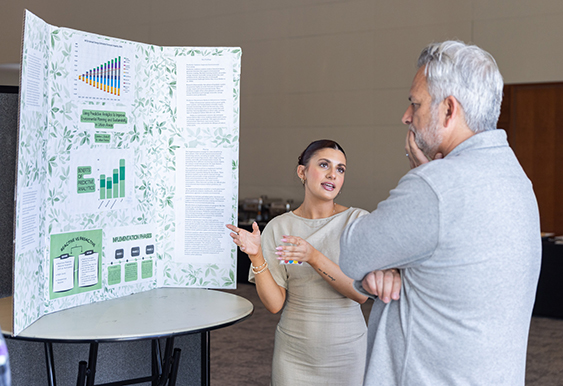
Caroline Endicott presents her research titled 'Using Predictive Analytics to Improve Environmental Planning and Sustainability in Urban Areas' and the Graduate Research Symposium.
For Girgenti, the answer came from her undergraduate studies in Buddhist psychology. The course left an impression she carried into her graduate work, and together the two students set out to explore how its principles could be applied to creating a greater sense of belonging in therapeutic settings.
"We found that Buddhist psychology really informs a lot of the therapeutic modalities that we use, and that we're taught in the counseling setting," said Girgenti, of Burlington County.
The research pushed back against the limitations of what Western psychology tends to prioritize, arguing that foundational concepts rooted in Buddhist thought deserve a more central place in how counselors are trained and how they practice.
"I think that teaching these practices younger is probably better, especially when it comes to interconnectedness, mindfulness and things like that," said Bott, of Mays Landing. "Those are just really the basics of helping somebody function in society, but they're not prioritized in Western psychology."
For a group of first-year Communication Sciences and Disorders students, the question of access took shape in the therapy room itself. Kayla Jones, of Blackwood, Maximilian Kaplan, of Wall, Gavin MacNatt, of Galloway, and Courtney Rickert, of Sewell, investigated whether telepractice can be as effective as in-person speech and language therapy for school-aged children.
The students reviewed peer-reviewed literature across multiple databases, finding that virtual therapy can produce clinically comparable outcomes to in-person sessions, particularly in expressive and receptive language development. Their research also identified barriers that can affect how well telepractice works, including access to technology, client engagement and the level of caregiver involvement. Their findings also raised new questions, including how demographics, software platforms and specific intervention strategies affect outcomes.
Kaplan said the experience felt like a rehearsal for the professional world ahead, connecting the inquiry of the classroom to the impact of the clinic.
"It eases our nerves," Kaplan said. "This is as if we are getting practice with managing our clients and caregivers so that when we do have to eventually see people in person, we're prepared for what might happen and feel like we can take control of the situation."
The symposium, which accepted presentation applications through March 31, serves as both a capstone experience and a professional development opportunity, giving graduate students practice communicating complex research to a broader public audience and engaging in scholarly dialogue with faculty and peers across disciplines.
– Story by Ella Johnson, photos by Abbigail Erbacher