Students Make Waves on Florida Marine Science Cruise
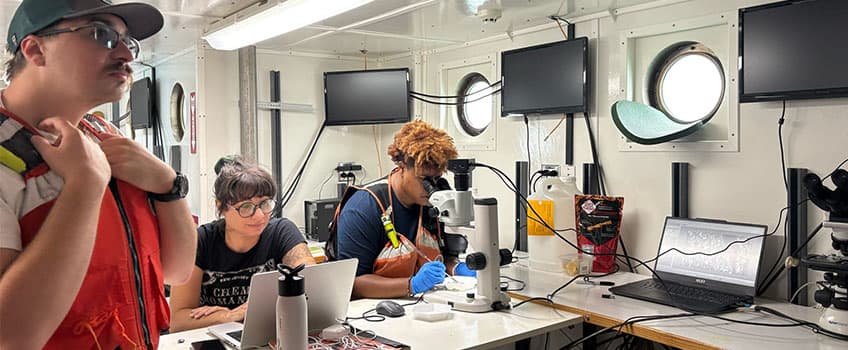
From left, recent Stockton graduate Dylan Meier, of Brick, Assistant Professor of Biology Lauren Seyler and senior Tatiana Anderson, of Riverside, do research on the R/V Hogarth during a research cruise sponsored by Peerside in the Gulf of Mexico off the coast of Florida at the end of July.
Galloway, N.J. – Dylan Meier spent four years working on a fishing boat out of Point Pleasant. Tatiana Anderson served nine years aboard a U.S. Navy aircraft carrier. Both Stockton University students have always been fascinated by the ocean but wanted to know more about what lies beneath.
“The ultimate dream is to do anything with cephalopods, you know, octopus and squid,” said Anderson, a senior from Riverside.
“I absolutely love being at sea,” said Meier, of Brick Township, who graduated in May.
That brought them to Stockton’s Marine Science program and a rare opportunity this summer to spend three nights on the R/V Hogarth, a 78-foot research vessel in the Gulf of Mexico off the coast of Florida.
The two Marine Science majors joined junior Hannah Elliott, of Bridgewater, and Stockton Assistant Professor of Biology Lauren Seyler as part of the Peerside program at the Florida Institute of Oceanography in St. Petersburg, Florida. The program is designed to train the next generation of marine scientists and technicians.
Seyler applied to become a mentor and the chief scientist on the research cruise to examine “blue holes” on the West Florida Shelf. Blue holes are marine caverns on the sea floor that are remnants of sinkholes that filled with water as sea level rose at the end of the last ice age. The holes have created microenvironments within the seafloor that are very different from the water above them. Today, they function as hotspots of biological activity, Seyler said.
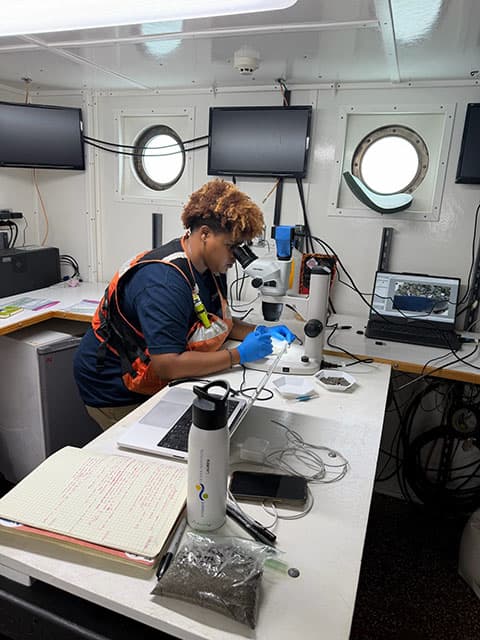
Tatiana Anderson examines a water sample with a microscope on board the R/V Hogarth off the coast of Florida at the end of July. The senior Marine Science major said she's 'always had a fascination with the ocean.'
Peerside provided funding for the cruise, and Seyler took students to collect sediment from the blue holes and samples from the water above them.
“As a mentor you are training students how to conduct science at sea, and that includes not just going to sea and being on a boat and doing science, but also all the planning that leads up to that – the logistics, figuring out what equipment you’re going to need, how you are going to store your samples,” Seyler said. “Once you’re out at sea, you can’t just run to the hardware store to pick something up. You’re out there.”
And Seyler and the students were definitely out there – eight hours off the west coast of Florida on the Hogarth. For Anderson, the trip was a dream come true.
“I’ve always had a fascination with the ocean because it’s right there, and there are so many things that we don’t know about it,” she said. “I’ve wanted to be a marine biologist since I was 6. We know more about space than the ocean, and that didn’t sit right with me.”
For Meier, it was a chance to take what he’s learned in a lab and use it in the field.
“For all my projects that I’ve been involved in, I’ll go into the lab and all my samples are right there waiting for me to analyze them and get whatever data I need,” he said. “However, when you go out to sea, you have to collect the data yourself. And I’ve heard that research at sea can go wrong and will go wrong at times when you least expect it.”
Unfortunately, that’s exactly what happened. With only single-beam sonar and no dynamic positioning to stabilize the boat’s position, the Hogarth had difficulty locating the blue holes. Then, the boat’s remotely operated vehicle malfunctioned.
But the biggest impediment to the team’s research was the weather – consistent 6-foot swells and stiff winds created what Seyler called a “trial by washing machine” at the hole sites.
“Our whole crew was going through it, getting seasick and nauseous,” Anderson said. “But we all came together in that moment, checking up on each other and making sure we all got the work done that we could.”
Seyler said the students were able to take some sediment and samples from the water column above one of the blue holes, but the weather made it difficult to find the other two they were looking for.
After one night of extremely rough seas, Seyler made the decision to return closer to Tampa Bay and sample sites in calmer waters.
“As disappointing as this was, I think it’s important for students to see that in the real world, science almost never goes the way you think it’s going to go and you have to be flexible,” she said. Seyler added that during the week in the St. Petersburg area the students also took several tours on land of different marine research facilities.
For Meier, who’s trying to decide what he wants to pursue in marine science, the experience provided insight into career paths, such as a marine tech or a boat captain, that he hadn’t considered.
“I got to network with the crew and my colleagues. I got to learn invaluable research and collection methods and how to operate machinery,” he said. “When you are a student, you’re just so used to seeing researchers and professors that you don’t see what else you could do beyond that. That was truly eye-opening.”
-- Story by Mark Melhorn