Holocaust Resource Center Joins National Museum Network
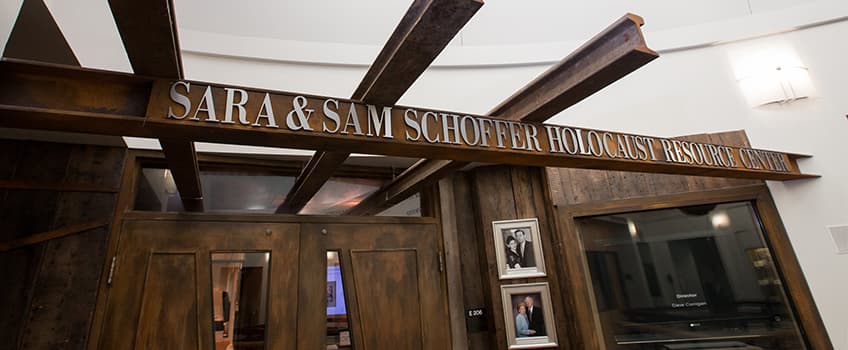
The Sara and Sam Schoffer Holocaust Resource Center at Stockton University was recently invited to join the Community of Holocaust Education Centers program by the United States Holocaust Memorial Museum in Washington, D.C. The program consists of 86 Holocaust education and remembrance organizations across the country.
Galloway, N.J. — Stockton University’s Sara and Sam Schoffer Holocaust Resource Center recently joined a select nationwide group of organizations recognized for advancing Holocaust education and remembrance.
The Community of Holocaust Education Centers (CHEC) program consists of 86 Holocaust education and remembrance organizations across the country. These groups participate in training by the United States Holocaust Memorial Museum in Washington, D.C., to learn about how its educational resources and historical content can be integrated into existing teacher professional development programs.
The national museum invited Stockton to the CHEC program, making it the fourth in New Jersey and the only center based in the southern part of the state.
This relationship with Stockton is really special because Stockton developed one of the first programs to earn a college degree in studying the Holocaust. It’s really wonderful to see this new chapter of supporting Stockton through the CHEC program.”Christina Chavarria, program manager for the U.S. Holocaust Memorial Museum
Irvin Moreno-Rodriguez, director of Stockton’s center, said the HRC has always had a close relationship to the U.S. museum, but he’s excited about the prospects that joining the network will bring to the university.
“It’s a confirmation of all the wonderful work that we’ve been doing over the past few years, and the historic work that’s been done under the previous center director, Gail Hirsch Rosenthal,” he said. Rosenthal was the director of the HRC from 1991 until her death in October 2023. “I’m excited to bring all of the resources of a national museum here to our southern New Jersey community.”
Chavarria said the CHEC program will provide several benefits to Stockton’s HRC as part of a two-year introductory cohort, including:
- Training of best practices in Holocaust education using the national museum’s collection and subject matter expertise.
- Integration of the national museum’s content and resources on Stockton’s website and into the HRC’s teacher professional development programs.
- Monthly learning and networking opportunities with other CHEC partners.
After those two years, CHEC partners remain engaged and meet regularly with the national museum and others in the program to learn from leading educators, experts and each other to advance Holocaust education, memory and awareness.
“It’s really exciting because what the CHEC program does is it encourages us to work together to support Holocaust education. It has helped to break down the silos between organizations,” Chavarria said. “We often can turn to one another if we need more ideas or different ideas for teacher development or for how our resources help them meet their goals.”
Chavarria said the national museum has a series of unique lesson plans that are based on the wealth of primary sources it has collected. Those lesson plans encourage teachers and students to do more critical thinking and examine the Holocaust the way historians do.
One area where both the national museum and Stockton’s center have initially found synergy is the push to reach new audiences, specifically Spanish-speaking students.
“We are at the forefront of Spanish language Holocaust education. We are focused on making Holocaust education more inclusive and recognizing that more and more students are coming from Spanish-speaking households and many of those students are first-generation,” said Moreno-Rodriguez, whose family is from Mexico. “So, we have to have Spanish language resources for them.”
Chavarria said the national museum is undertaking a very large project to translate its lesson plans into Spanish as a way to attract English as a Second Language teachers to bring Holocaust studies into their classrooms. The museum has also translated its Holocaust encyclopedia into Spanish and Brazilian Portuguese.
“These lesson plans are free and accessible on our website,” she said. “Spanish is the second most used language of our resources. We have launched a significant project where we’ve collected archives from Latin American countries of Jewish refugees attempting to go there during the Holocaust.”
Moreno-Rodriguez has hosted several public forums on campus to bring more attention to the role Latin America played in the Holocaust, and he’s excited that the new partnership will allow him to continue to share that information with South Jersey teachers.
“This partnership is a wonderful honor, but it’s also a challenge to us,” he said. “It just reinforces the idea that we still have a lot more to talk about regarding the Holocaust and a lot more to learn to educate the next generation of scholars.”
— Story by Mark Melhorn