Stockton Selected as Exclusive N.J. Partner for Auschwitz Legacy Fellowship
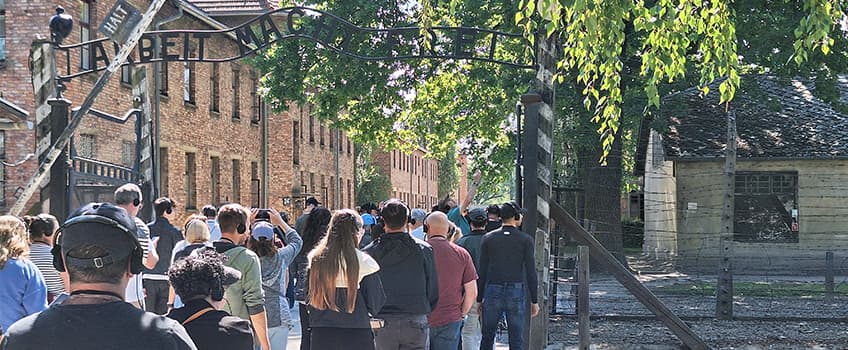
Stockton University students enter the Auschwitz concentration camp during a study trip this past summer. Six high school teachers from New Jersey will be selected to take a trip to the camp in summer 2027 as part of the Auschwitz Legacy Fellowship sponsored by the Auschwitz-Birkenau Memorial Foundation.
Galloway, N.J. – Six New Jersey high school teachers will have the opportunity to travel to Poland, visit the Auschwitz-Birkenau Memorial and Museum and receive specialized Holocaust education training through a new partnership between Stockton University's Sara and Sam Schoffer Holocaust Resource Center, the New Jersey Commission on Holocaust Education and the Auschwitz-Birkenau Memorial Foundation, which developed, funds and administers the fellowship program.
“We are proud that we are the exclusive Holocaust Resource Center partner site for the Auschwitz-Birkenau Foundation to bring the Auschwitz Legacy Fellowship here to New Jersey,” said Holocaust Resource Center Director Irvin Moreno-Rodriguez. “Our selection speaks to the caliber and the quality of the work that we do in New Jersey and across the country.”
Sponsored and fully funded by the Auschwitz-Birkenau Memorial Foundation (ABMF), the fellowship is a year-long educational experience designed to equip teachers with the knowledge, tools and confidence to teach the Holocaust with depth, accuracy and empathy.
Moreno-Rodriguez said applications are open now through Nov. 15 for teachers to apply. Applicants must have never visited Auschwitz-Birkenau before and must plan to teach in the classroom for at least another five years.
It’s a once-in-a-lifetime experience with professionals and educators who want to give high school teachers the resources to offer high-quality Holocaust education to the classroom."
Irvin Moreno-Rodriguez, the director of the Sara and Sam Schoffer Holocaust Resource Center
The fellowship will culminate with a weeklong summer trip to Warsaw and Krakow, Poland, and the Auschwitz-Birkenau Memorial and Museum. The trip will include walking tours, expert-led seminars and an in-depth exploration of Jewish history and heritage in Poland.
The work with Stockton’s Holocaust Resource Center in New Jersey is part of the foundation’s larger goal of providing 500 fellowships for teachers in all 50 states.
“By joining the Auschwitz Legacy Fellowship, teachers become part of a national network of passionate educators committed to memory, truth and civic responsibility,” said Dr. Maria Zalewska-Glezer, executive director of the Auschwitz-Birkenau Memorial Foundation. “Together, we are helping the next generation understand not only what the Holocaust was, but how and why it happened and what its lessons mean for the world today.”
Moreno-Rodriguez said the fellowship represents an important investment in Holocaust education by providing teachers with firsthand experiences they can bring back to their students.
“It’s a once-in-a-lifetime experience with professionals and educators who want to give high school teachers the resources to offer high-quality Holocaust education to the classroom,” he said.
Visiting Auschwitz-Birkenau is a crucial component of the fellowship, Moreno-Rodriguez said.
“I’m a big believer that to understand the history of the Holocaust, we have to understand space, place, location and geography,” he said. “Seeing the scale of the camp really brings it home for a lot of the students, educators and community members that we take to Auschwitz. To realize how vast this murder was, and this complicated system that the Nazis built, it becomes a very emotional journey. And it can give you that energy and drive to continue teaching this for generations to come.”
-- Story by Mark Melhorn