Spotlight On: Faculty Present at GSA Conference
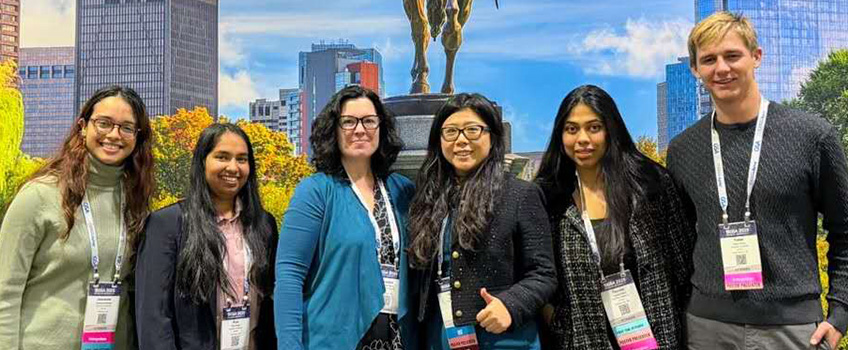
From left to right, Jeannine Elmasri, student; Riya Goyal ‘25, Jessica Fleck, professor of Psychology; Duo Helen Wei, professor of Computer Science; and students Tasnim Raisa and Yater Henry at the Gerontological Society of America (GSA) Annual Scientific Meeting.
Galloway, N.J. – Stockton University students and faculty attended the Gerontological Society of America (GSA) Annual Scientific Meeting held in November at the Hynes Convention Center in Boston, where they also presented exciting research. This year’s conference theme was "Innovative Horizons in Gerontology."
“There were over 4,500 attendees, featuring more than 625 paper presentations and 1,975 scientific posters. Amid this vast exchange of ideas, Stockton stood out with five presentations that highlighted the university's collaborative research model and its commitment to training the next generation of experts,” Helen Wei, professor of Computer Science, shared.
Wei presented her work, “GenAI Outperforms Human Reviewers in Classifying Alzheimer's Disease and Related Dementia Research,” which was co-authored with Riya Goyal ‘25, Stockton students Tasnim Raisa and Jeannine Elmasri, and Jessica Fleck, professor of Psychology at Stockton.
When asked how this type of research translates to the field, Wei said, “I think it’s good news if GenAI can do better than us in classification, because it means we can automate all the tedious, repetitive work and get much more accurate results in important areas, like medical diagnostics. This doesn't mean we're out of a job, though. Our work changes. We need to focus on being the responsible adults in the room, checking the AI's work for bias, applying our complex ethical judgment, and using our creativity and empathy to turn those classified findings into meaningful actions.”
Wei said working with both current students and alumni was important to this project, sharing how the process works: “We first identify a research topic that is not only interesting, but also impactful. Second, build a synergistic team so that current students and alumni can complement each other. Finally, regular check-ins and progress discussions to keep the team aligned and motivated.”
Fleck also presented “Understanding Successful Aging: The Power of Growth Mindsets and Openness to Experience,” with Katherine Wilkinson and Tanya Sharma.
When asked what inspired her to explore those traits in gerontology, Fleck said, “Much of the research we complete in the lab explores the protective effects of lifestyle factors — diet, exercise, social engagement — on brain health. People who participate in activities that protect the brain build more cognitive reserve, which helps the brain sustain normal function even as it declines physically.
“In an earlier study, we observed that participating in a range of leisure activities was associated with better thinking and memory in older adults. This led us to consider why some people prefer regularly completing the same leisure activity, while others prefer variety.
“Openness to experience is a stable personality construct that influences behavior throughout the lifespan. Generally, people who are higher in openness are willing to try new things and seek out novel experiences. We thought openness may be related to successful aging — higher life satisfaction, better mood and memory — through its impact on the range of leisure activities people enjoy. And that’s what we observed: People higher in openness participated in a more diverse array of leisure activities, which was associated with more successful aging, likely through the positive effects of leisure activities on cognitive reserve.”
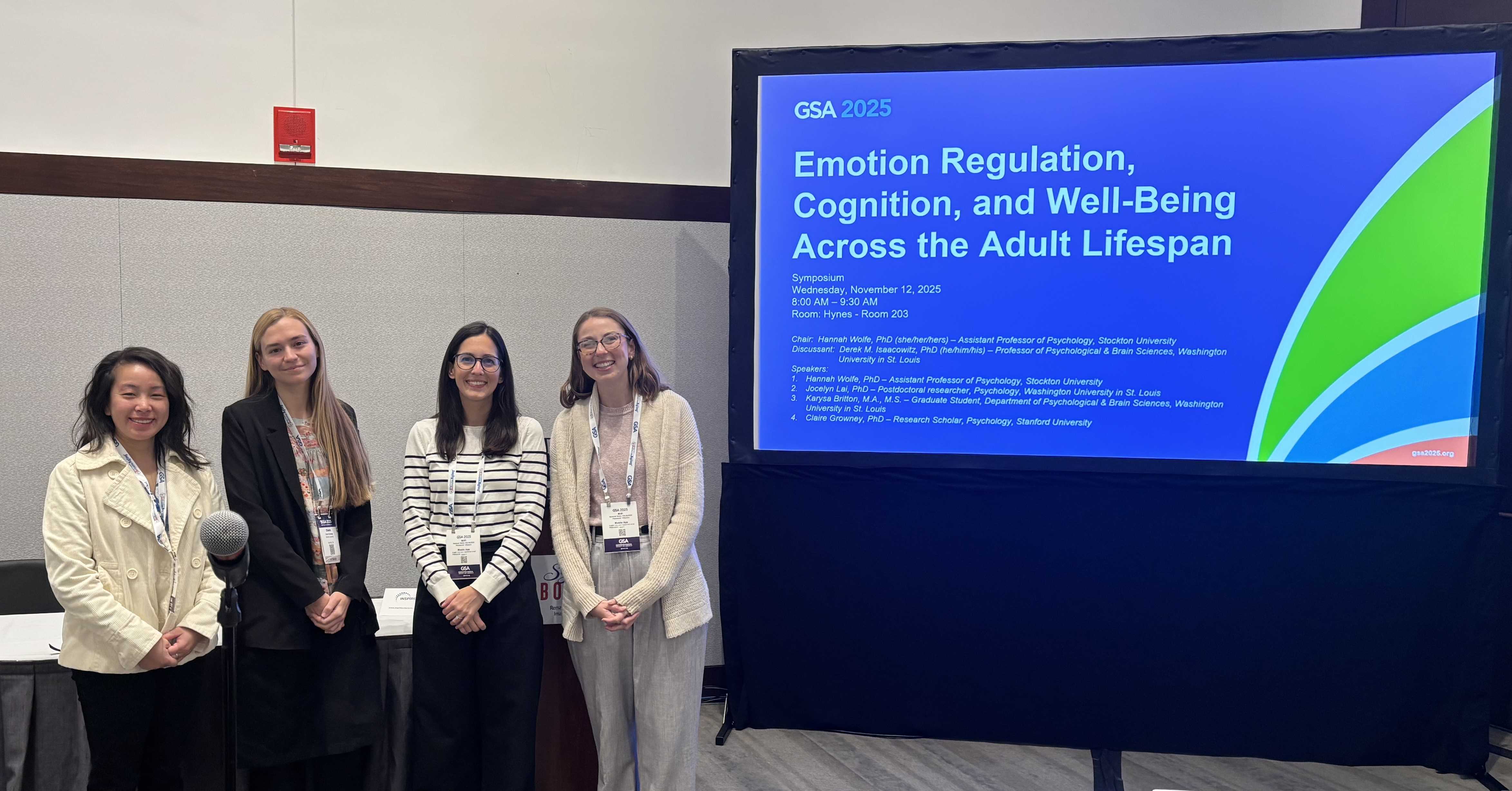
Hannah Wolfe, assistant professor of Psychology, pictured far right, with fellow co-presenters, during their symposium titled, “Emotion Regulation, Cognition, and Well-Being Across the Adult Lifespan.”
Hannah Wolfe, assistant professor of Psychology, chaired a symposium titled, “Emotion Regulation, Cognition, and Well-Being Across the Adult Lifespan.”
Reflecting on the session, Wolfe said, “The presenters and I in this symposium highlighted that, despite normative declines in cognitive abilities with age, older adults are often highly skilled at regulating their emotions, even compared to much younger individuals. We wanted attendees to leave with a sense that aging is a multidomain process, where cognitive functioning and emotional experiences are linked in sometimes surprising or even contradictory ways.”
She also presented findings on “Cognitive Demands and Memory-Related Outcomes of Emotion Regulation Tactics” at the conference.
“I found that the emotion-regulation strategy we use while taking in new information can impact our memory for that information, even when we didn’t know we would be tested,” Wolfe said. “Specifically, using positive-approaching strategies, such as focusing on the positive aspects of an image, seemed to preserve memory the best, while trying to avoid or ignore the negative aspects — negative-receding — was associated with the worst memory for those images.
“In sum, the way we regulate our emotions while learning new information affects our memory. Focusing on positive aspects may help memory, while trying to ignore negative aspects may impair it.”
Successful Aging and Layered Perspectives
The concept of aging evokes many topics and even feelings, so it is not surprising that a collaborative approach across multiple disciplines is essential for meaningful results.
“Because aging is such a complex topic, you need different perspectives to really understand it,” Wei said. “The psychology side helps us understand the human experience, while computer science gives us the tools to analyze data and build models. When we put those together, we can ask better questions and find new solutions that one field alone might miss.”
Fleck echoed this, sharing, “The biopsychosocial model of aging proposes that to understand healthy aging, we must develop a complete understanding of the person and the context in which they live. All aspects of the person — biology, psychology and environmental contributors - are relevant. Forming this deep understanding of aging is only possible when we bring together research teams with diverse training and expertise.”
Reported by Mandee McCullough
Photos submitted