Three Receive Fall 2025 Board of Trustees Fellowships
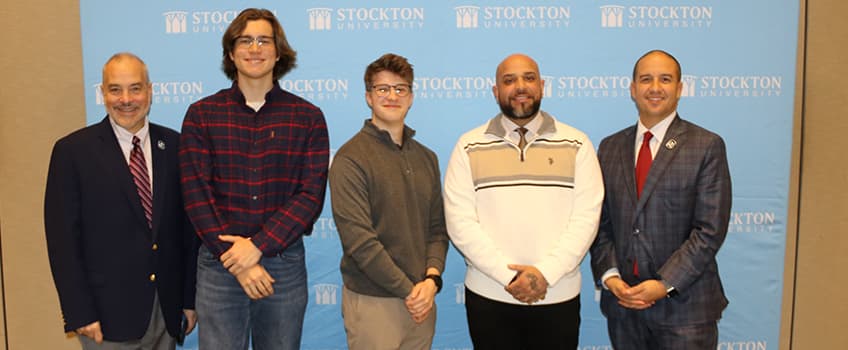
Stockton President Joe Bertolino, left, and Stockton Board of Trustees Chair Jose Lozano, right, pose with the Fall 2025 Board of Trustees Fellowship winners (from second left) Harrie Fehr, Maxim Wunder and Jose Morales.
Galloway, N.J. — The three recipients selected to receive the fall Board of Trustees Fellowship for Distinguished Students were announced at the Dec. 3 meeting.
The students’ projects range from physics to gardening to geology, and they will each receive a $1,000 award to support their projects.
“Whether it’s advancing our understanding of critical minerals, building bridges between Stockton and local classrooms, or creating new tools to detect environmental contaminants, these projects show how undergraduate research can make a real difference in our communities and our world,” said Ian Bouie, director of Academic Achievement Programs. “These students embody Stockton’s commitment to hands-on learning, public service and innovative problem-solving, and the university is excited to support them as they bring their ideas to life.”
The fellowship program was established by the board in 1986 and supports student-initiated projects of undergraduate research and/or creative work in keeping with the educational philosophy and mission of Stockton.
The fall cohort and their projects are:
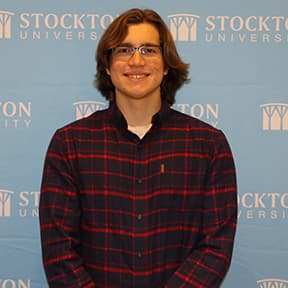
Harrie Fehr, junior, Geology, Northfield
Project: Skarn fluid evolution through the lenses of garnets
This project aims to study compositions of hydrothermal fluids in skarn systems by looking at the geochemistry of garnets. I will be comparing data from four different skarns, or coarse-grained metamorphic rocks. The information gained from this study can be used to better identify different types of skarn systems, how they form, and potential future sources of critical minerals and rare earth elements. The results will be communicated at the Northeast Section of the Geological Society of America Conference in Hartford, Connecticut, and then again at Stockton's NAMS Poster Day/Day of Scholarship in April.
From Fehr: “I chose this project because it has the potential to help society in the natural resources sector and because it aligns well with my plan on furthering my education in the field of economic geology.”
Advisor: Matthew Severs, associate professor of Geology
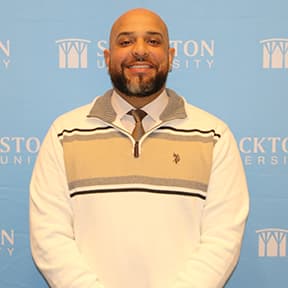
Jose Morales, sophomore, Business Administration, Pleasantville
Project: Planting Knowledge, Growing Community
The Planting Knowledge, Growing Community project brings a hydroponic learning tower into elementary classrooms to help students learn how plants grow and how food is produced in a simple indoor system. Students take part in each step of the process, which teaches responsibility, patience and basic science skills. The project also connects Stockton students with local schools, giving them a chance to volunteer, assist with lessons and support teachers through a hands-on community partnership.
From Morales: “I am doing this project because of my own experiences growing up and my commitment to helping young people in my community. I want students to have learning opportunities that build confidence and show them what they are capable of doing. This project gives them a chance to care for something and see real progress through their effort. It is a way for me to give back, support the next generation, and encourage students to believe in themselves and their future.”
Advisor: Jovin Fernandez
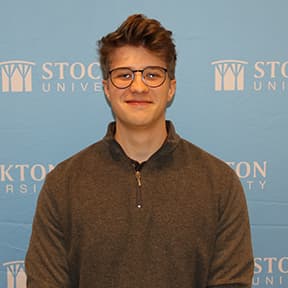
Maxim Wunder, junior, Applied Physics, Egg Harbor Township
Project: Fluorescent Salophen-Based Sensors for PFAS Detection
Per- and polyfluoroalkyl substances (PFAS), such as perfluorooctanoic acid (PFOA), are persistent environmental pollutants commonly found in drinking water and are associated with long-term health risks. Detecting these “forever chemicals” quickly and cost-effectively remains a major challenge. This project investigates the use of organic ligand-based fluorescent sensors as a simple, low-cost method for detecting PFOA. Specifically, it focuses on salophen, a compound known for its tunable light-emitting properties.
From Wunder: “I’ve always been drawn to physics because it’s about understanding how small changes lead to measurable effects. This project lets me apply that way of thinking to a real environmental problem, where understanding structure–property relationships can actually improve how we detect PFAS.”
Advisor: Daniel Ki, associate professor of Chemistry
-- Story and photos by Mark Melhorn