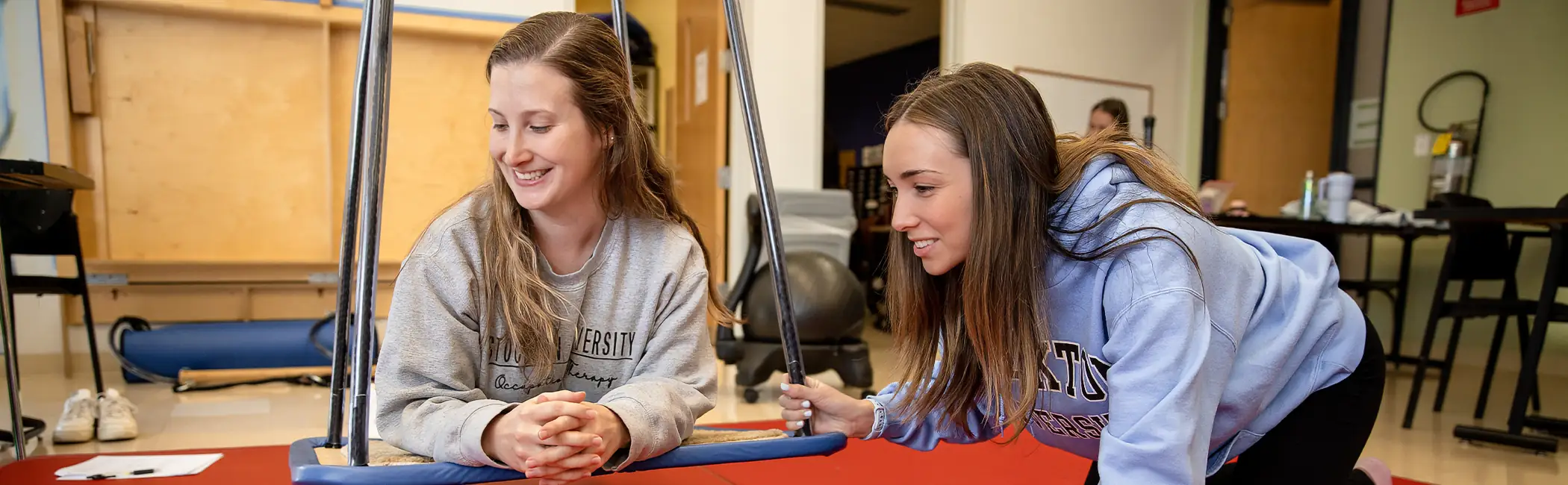
The Master of Science in Occupational Therapy at Stockton University prepares students to help people live more independent and meaningful lives. Occupational therapists work with individuals across the lifespan when injury, illness, disability, or other challenges affect their ability to participate in everyday activities. Through a client-centered approach, students learn to understand each person’s needs, strengths, goals, and environment.
Stockton’s two-and-a-half-year, in-person MSOT program combines occupational therapy coursework with case-based learning, research, and clinical education. Students build skills in evaluation, intervention, clinical reasoning, evidence-based practice, and professional communication. Level I and Level II fieldwork experiences connect classroom learning with occupational therapy practice in a variety of practice settings including hospitals, outpatient facilities, schools, and other community-based, and emerging areas of care.
- MSOT Technical Standards
- Costs
- The School of Health Sciences
- Financial Aid
- Scholarships
- Graduate and Continuing Studies
 Stockton University’s Master of Science in Occupational Therapy program is accredited
by the Accreditation Council for Occupational Therapy Education (ACOTE). Graduates are eligible to take the National Board for Certification in Occupational
Therapy (NBCOT) examination. After passing the exam, graduates earn the Occupational
Therapist, Registered (OTR) credential.
Stockton University’s Master of Science in Occupational Therapy program is accredited
by the Accreditation Council for Occupational Therapy Education (ACOTE). Graduates are eligible to take the National Board for Certification in Occupational
Therapy (NBCOT) examination. After passing the exam, graduates earn the Occupational
Therapist, Registered (OTR) credential.
Build Skills That Improve Everyday Lives
Why pursue a Master of Science in Occupational Therapy at Stockton University?
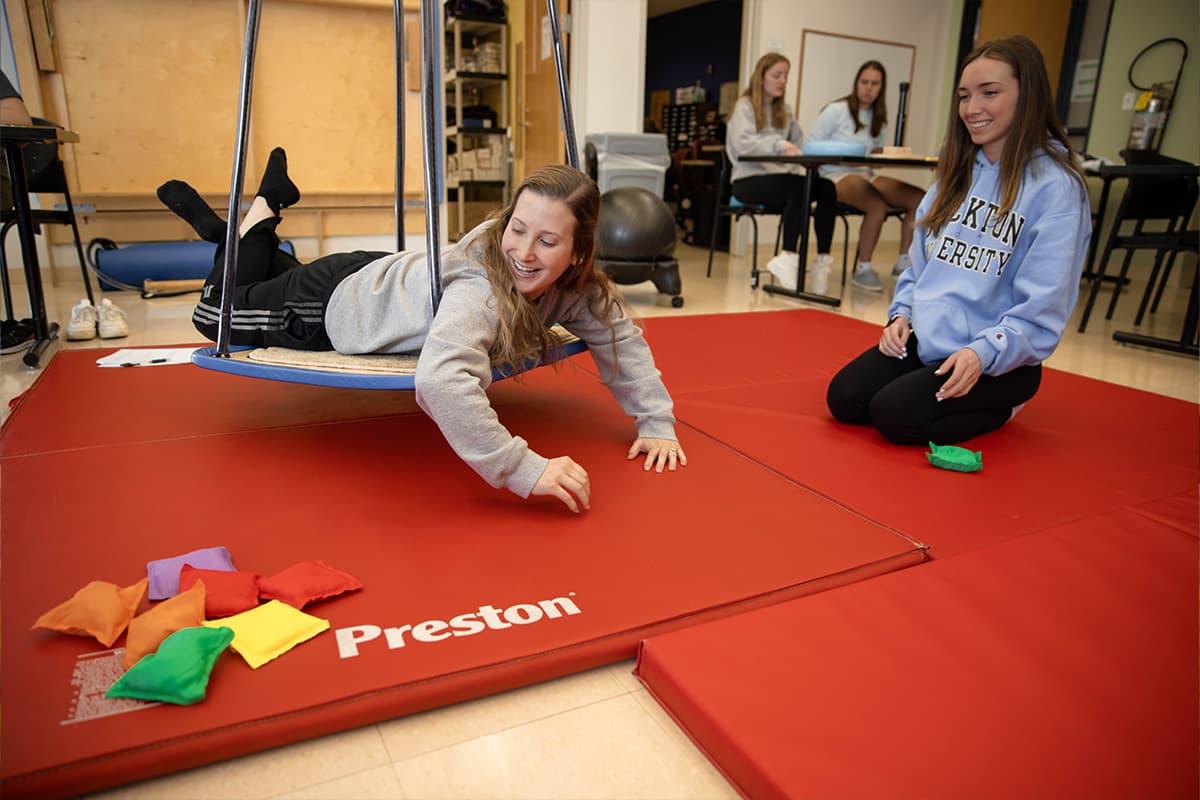
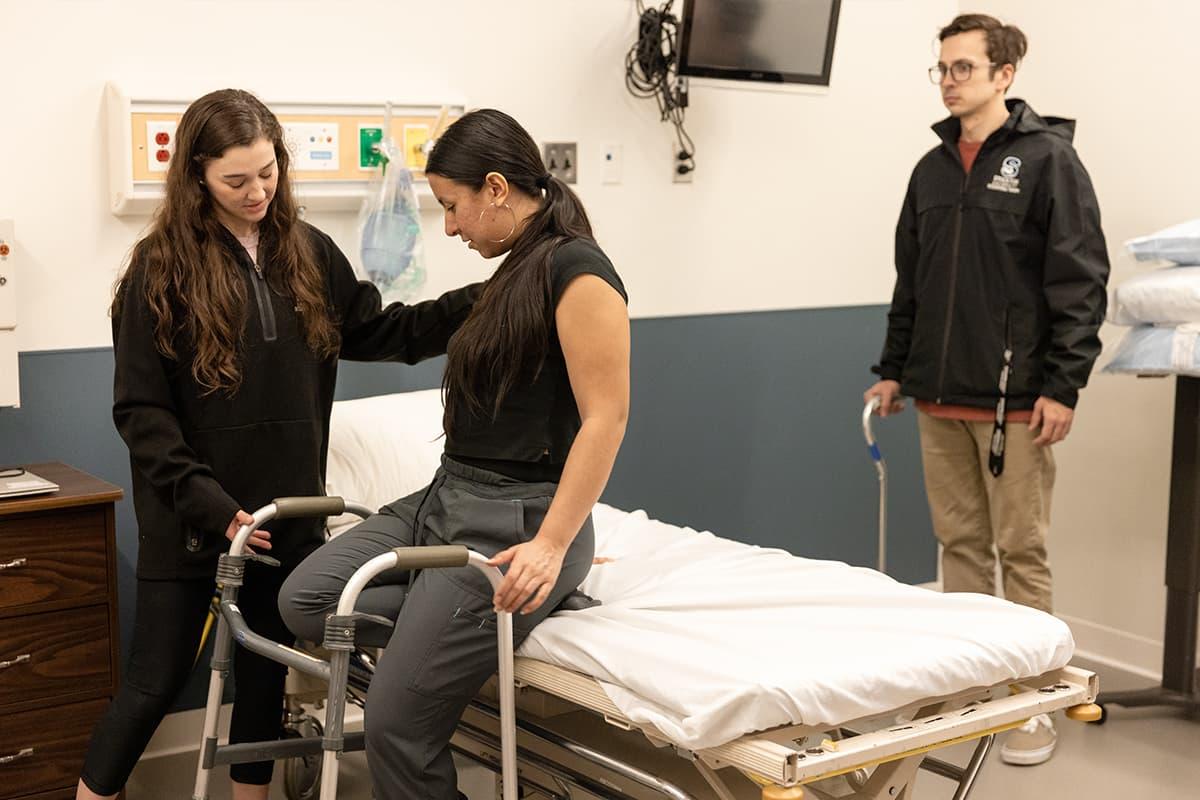
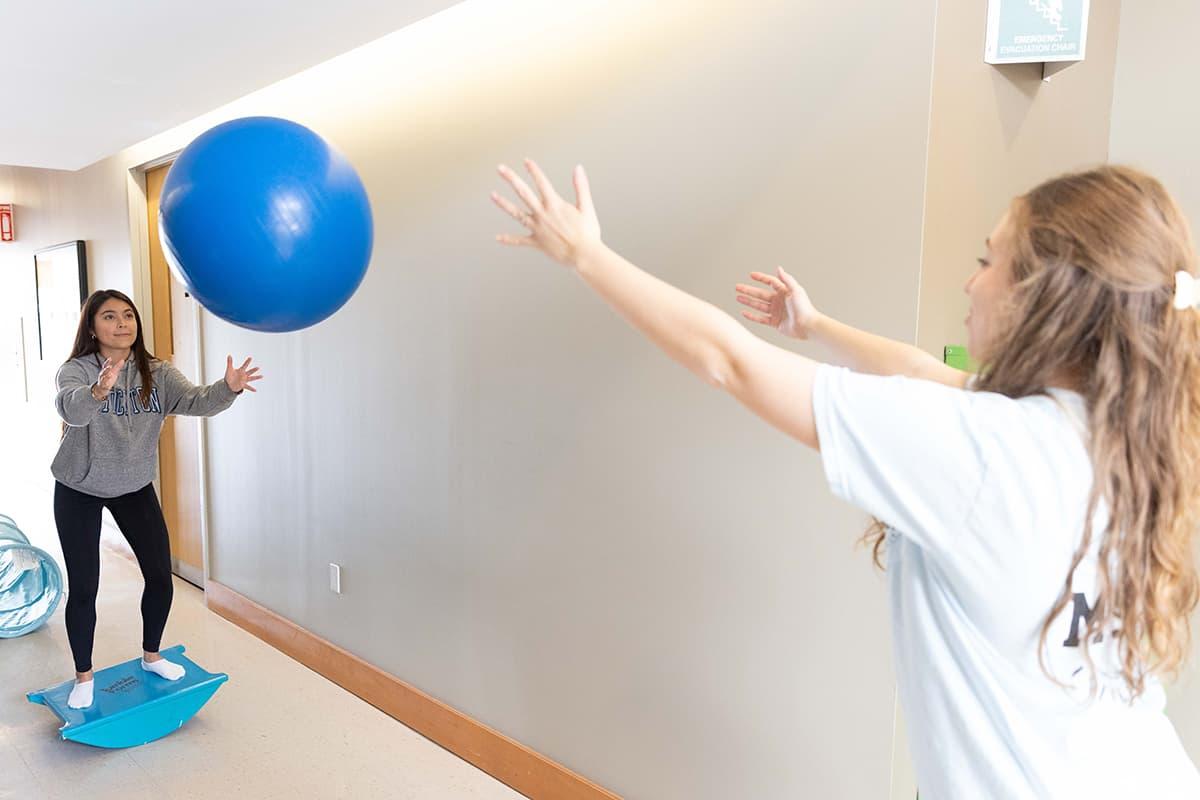
Stockton University’s Master of Science in Occupational Therapy combines individualized faculty support with case-based learning, research, and clinical education. Students develop occupational therapy practice skills while learning to provide client-centered, occupation-based care to people across the lifespan. The program also includes community-based experiences and opportunities to explore traditional and emerging areas of occupational therapy practice.
What will I study in the Stockton MSOT program?
Students study human occupation, development across the lifespan, occupational therapy evaluation, intervention planning, clinical reasoning, and evidence-based practice. The occupational therapy curriculum also develops skills in research, professional communication, technology, cultural awareness, and interprofessional collaboration. Coursework progresses from foundational concepts to advanced problem-solving and entry-level application.
How long is the Master of Science in Occupational Therapy program?
The Stockton University Master of Science in Occupational Therapy is a two-and-a-half-year, full-time, in-person program held in ADA-accessible classrooms on the Galloway Campus. It includes four semesters of coursework, a short summer session, and two three-month Level II fieldwork rotations, which must be completed within 24 months of academic coursework to meet New Jersey licensure requirements. A new cohort begins each fall.
What fieldwork experiences are included in the MSOT program?
Stockton occupational therapy students complete both Level I and Level II fieldwork. Level I fieldwork begins during the academic portion of the program and connects weekly practice-based experiences with subjects studied in class. After completing their coursework, students participate in two full-time Level II fieldwork rotations that build clinical reasoning, intervention, communication, and client-service skills in different occupational therapy settings.
How does the Stockton MSOT program prepare graduates for occupational therapy practice?
The program prepares graduates to evaluate clients, develop occupation-based interventions, use evidence to guide care, and work effectively with clients, caregivers, and health care professionals. Graduates are eligible to take the national certification examination administered by the National Board for Certification in Occupational Therapy.
Mission & Philosophy
Mission of the Occupational Therapy Program
The mission of the Occupational Therapy Program at Stockton University is to help our students become competent, caring practitioners who are lifelong learners with an understanding of global perspectives. We are committed to helping our students develop the capacity for continuous learning based on the belief that human beings learn and acquire knowledge as unique individuals who engage in the educational process through personally held values, interests, and beliefs, as well as individual drives to participate in desired occupations.
Learning occurs in a variety of curricular and co-curricular contexts/environments requiring the integration of cognitive, motor, perceptual, social, and sensory skills. This ensures that students are prepared to apply knowledge in the dynamic environments of a diverse and multicultural society. The Program recognizes the diverse needs of students and faculty in learning the process. We utilize various pedagogical tools and methodologies, including educational technology, instruction in global and diverse perspectives, and interprofessional educational experiences. These ensure the development of critical thinking and problem-solving, resourcefulness, scholarship, creativity, and intellectual achievement. Students emerge with integrated knowledge and skills to provide client-centered, occupation-based, holistic occupational therapy services and understand the need to engage in lifelong learning.
The Occupational Therapy Program at Stockton University is also committed to the development of southern New Jersey through research and community service.
Philosophy of the Occupational Therapy Program
The philosophy of the Occupational Therapy Program at Stockton University is based on the philosophy of occupational therapy education and an articulated approach to human beings and how they learn (AOTA, 2018).
The Occupational Therapy Program at Stockton University is also based on the profession’s philosophy that describes occupation as the uniquely personal and meaningful activities that provide clients with a sense of personal identity and support participation in various contexts/environments. Occupation is expressed uniquely in clients across the lifespan, along a developmental continuum, and within varied contexts. Occupational therapy is a profession that understands the primary importance of occupation in allowing clients to be productive, satisfied, and contributing members of society. When biological, psychological, societal, or contextual factors prevent clients from participating in occupations, dysfunction may occur. The occupational therapy practitioner utilizes occupation for both intrinsic and therapeutic purposes. The occupational therapy practitioner’s understanding of the restorative, normalizing, and life-enhancing role of occupation enables clients to engage in occupation to support participation in context(s) (AOTA, 2025).
American Occupational Therapy Association (2018). Philosophy of occupational therapy education. American Journal of Occupational Therapy, 72(Suppl. 2), 7212410070. http://doi.org/10.5014/ajot.2018.72S201
American Occupational Therapy Association (2025). Philosophical base of occupational therapy. American Journal of Occupational Therapy, 79(Suppl.3), 7913410200. https://doi.org/10.5014/ajot.2025.79S301
Program Faculty
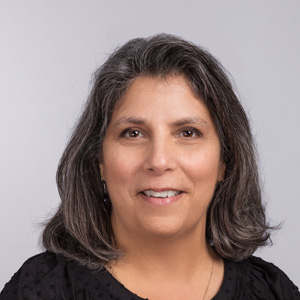
Mary Kientz

Janette Boney
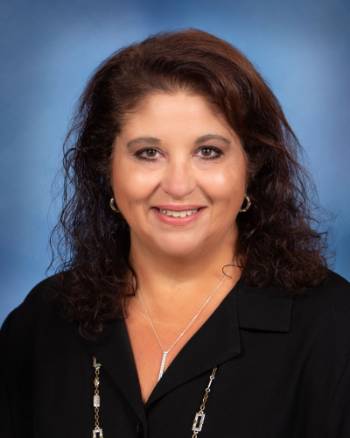
Felicia Chew

Rebecca Mannel

Susan Pullman-Bernstein
Fieldwork
The American Occupational Therapy Association's document entitled The Standards for an Accredited Educational Program for the Occupational Therapist governs the length and type of clinical training required of students to receive the appropriate amount and type of clinical experiences needed to meet these Standards. These clinical training experiences may also be referred to as clinical affiliations and fieldwork and will occur in varied locations where occupational therapy services are provided or in community settings where an occupational therapy role is not yet established. In some cases, students will have the opportunity to learn in role-emerging practice areas to help identify where occupational therapists can improve health and well-being of a wider-range of people. The two different types of mandated fieldwork integrated into your academic experience at Stockton are level I and level II fieldwork. During level I fieldwork, students observe and may participate in the delivery of the occupational therapy services. Level II fieldwork begins after completion of the academic portion of the MSOT program. In the level II fieldwork, students gradually assume responsibility for client services at their fieldwork site under the supervision or support of a licensed practitioner.
At Stockton, level I fieldwork occurs in conjunction with specified courses and begins in the second semester of study. Level I fieldwork involves weekly experiences at a fieldwork site that relates to the course of study emphasized each semester. As an example, when studying occupational therapy as applied to children, students will go once a week to various locations where occupational therapy is provided to children or is being developed for children. In this manner, level I fieldwork provides students with the opportunity to correlate academic learning with practice-based experience.
At Stockton, level II fieldwork occurs after successful completion of all required academic coursework. Each student will be assigned two different level II fieldwork experiences. The length of each level II fieldwork affiliation is typically 12 weeks of full-time clinical experience. Participation in level II fieldwork is contingent upon several factors including, but not limited to, student preparation, clinical site availability and suitability for clinical skill development. The general intent of level II fieldwork is to provide the broadest exposure to the field of occupational therapy with experiences across the lifespan and in a variety of settings or treatment models. Participation in level II fieldwork is designed to include experience in a traditional medical setting and a community-based setting where psychosocial, developmental, and physical disability evaluation and intervention occur. In addition, to the mandated level I and II fieldwork experiences, the Stockton MSOT program provides additional clinical experiences and community-based student learning experiences throughout the academic program. Given usual circumstances, failure to complete all Level II Fieldwork requirements within 24 months of completing academic coursework will result in dismissal from the program, except in circumstances including military deployment or other circumstances that are permitted by the NJ Division of Consumer Affairs.
Admissions Criteria
Application Deadline
Fall 2027: Verified in OTCAS by November 21, 2026
Each application will be reviewed once verified in OTCAS and admission decisions will
occur on a rolling basis.
Prerequisite Requirements:
- Completion of a baccalaureate degree
- Cumulative (from all institutions attended) 3.2 GPA or higher
- Completion of prerequisite coursework with a grade "B-" or better
- Beginning with the 2026–2027 admissions cycle, applicants may have no more than three prerequisite courses without a final grade at the time of the fall application review. Courses in progress are considered outstanding until a final grade is posted. Applicants with four or more outstanding prerequisite courses may not be considered for admission and may reapply during the next admissions cycle. This policy ensures that faculty have sufficient evidence of an applicant’s academic performance and readiness for the program.
Prerequisite Courses- Must be completed with a "B-" or better. The Stockton course acronym and number that corresponds with the pre-requisite is provided for Stockton students. To view a list of all acceptable courses from New Jersey institutions of Higher Education, please click here.
Anatomy & Physiology: Two semesters are required; at least one semester must have a lab. The B- must be obtained in the lecture portion if the lecture and lab are given separate grades. Choose an option.
Option 1: Anatomy and Physiology I for Health Sciences with a lab: BIOL1260 and Anatomy and Physiology II for Health Sciences with a lab BIOL 2260
Option 2: Human Anatomy with Lab (BIOL 2180/2185) and Principles of Physiology (BIOL 2150/2151)
***The anatomy courses MUST be completed within 4 years of application to the program.
Introduction to Psychology/ General Psychology (PSYC 1100)- MUST BE THE INTRODUCTION TO PSYCHOLOGY COURSE. We WILL NOT accept higher level courses as substitutions.
Psychopathology (PSYC 2211 or Abnormal Psychology)
Life Span Development (Human Development or Development Psychology across the Life Span) or Human Behavior in the Social Environment (PSYCH 3322 or SOWK 1103). To meet this requirement, the course (or courses) must cover all stages of life span (infants through geriatrics) and various areas of development (cognitive, physical, and social).
Introduction to Anthropology or Introduction to Sociology (ANTH 1100 or SOCY 1100)- MUST BE THE INTRODUCTION TO ANTHROPOLOGY OR SOCIOLOGY COURSE. We WILL NOT accept higher level courses as substitutions.
Statistics or Applied Biostatistics (CSIS 1206 or HLTH 2305 or PSYC 2241 or PUBH 2330 or PUBH 2310) To meet this requirement, the course must cover statistical methods primarily and not research methods or simple math.
Advanced Placement credits are accepted for all pre-requisite course requirements EXCEPT the Anatomy and Physiology pre-requisite courses.
Please note that we no longer accept CLEP scores for pre-requisites for the MSOT program.
For course descriptions, please visit The University's Course Catalog.
Application Process
You must submit an application through the Occupational Therapy Centralized Application System (OTCAS) Your OTCAS application must be verified by or prior to November 20th.
Your application to OTCAS must include:
- Official Transcripts from all schools attended (including Stockton)
- Three letters of recommendation required: One must be from a professor with whom you have taken a course, and the other two must be professional/academic references (no personal references accepted).
- Essay, resume, and any other additional information
- Documentation of 40 hours on the Volunteer/Work Hours Form (uploaded in the Documents section of CAS)
-
The admissions process may include an interview with program faculty. Information will be sent to your email accordingly.
- For more details about this process, visit the OTCAS Instructions and FAQ page.
Admissions FAQ
1. What is the length of the program?
The Stockton University Master of Science in Occupational Therapy Program is a two and one-half year entry-level professional program. It includes four semesters of course work, one short summer session, and two three-month Level II fieldwork rotations that must be completed within the 24 months following the completion of the academic work to comply with New Jersey licensure regulation.
2. Do you have an online, part-time, evening, or weekend program?
No, the MSOT program is a full-time, on site program. Classes occur during the week. Most days students are in class from 8:30-5:30 with a break for lunch.
3. Do I need a degree for this program?
To matriculate into the MSOT program, you must already have a Bachelor's degree. However, students may apply in the final semesters before receiving a Bachelor's degree.
4. Do I need to have a specific degree for admittance into the program?
No, as long as you have completed the prerequisite requirements any Bachelor's degree may be considered. To view the list of prerequisite courses, please click on the "Admissions Criteria" tab at the top of this page.
5. Is there a specific degree that will increase my chances of getting admitted to the program?
6. Are GRE scores or similar test scores required?
7. Is there an undergraduate program in Occupational Therapy at Stockton?
8. May I transfer into the program as an undergraduate?
9. Does it increase my chances of getting into the program if I am a graduate of Stockton?
10. My cumulative GPA is less than a 3.2. Can I still apply to the MSOT program?
11. What are the prerequisite courses that I need to take for admission into the MSOT Program?
12. Do courses taken at Community Colleges count toward the required prerequisite courses?
13. Do you accept Advanced Placement credit for pre-requisite courses for admission to Stockton’s MSOT Program?
Yes, Advanced Placement credits are accepted for all pre-requisite course requirements EXCEPT the Anatomy and Physiology pre-requisite courses.
14. Do you accept transfer of credits for admission to Stockton’s MSOT Program?
Stockton accepts undergraduate coursework to fulfill prerequisite requirements, even if the credits were transferred to the applicant’s graduating institution. However, Stockton does not accept transfer credits from Occupational Therapy programs at other institutions.
15. Does the Stockton MSOT Program give credit for work experience or other experiential learning when considering admissions or prerequisite requirements?
Some consideration is given to individuals who have served the occupational therapy profession as an Occupational Therapy Assistant or as an aide in an Occupational Therapy clinic (2 or more years). However, this experience does not guarantee admission to Stockton’s MSOT Program. Stockton does not give credit for non-occupational therapy-related work experience or other experiential learning when considering admissions or prerequisite requirements. However, having a breadth and depth of experience can assist the applicant during the interview process.
16. Do prerequisite courses have to be completed with a specific amount of time?
17. Can my lab prerequisite course be online?
18. I have a grade of less than a B- in one (or some) of my prerequisite courses. Can I still apply to the MSOT Program?
19. Do I need to do observations of Occupational Therapists prior to applying?
20. Can I observe a Physical Therapist and count those hours towards my observations in an OT setting if an OT is not present?
No, all observations MUST be done specifically with an Occupational Therapist. In addition, the Volunteer/Paid Work/Clinical Hours Verification Form MUST be signed by the Occupational Therapist who you observed.
21. If I do more than the required 40 hours of observation will that increase my chances of being admitted to the MSOT Program?
22. Do I need to complete all of my 40 hours of observation prior to applying to the program?
23. Do you assist applicants in finding places to complete their observation hours?
24. Who can write a letter of recommendation for me?
Your letters of recommendation must be completed by individuals who can attest to your academic excellence and/or work and volunteer experience and skills. Three letters of recommendation required (quantitative form is required, narrative in addition to quantitative form is optional). One must be from a professor with whom you have taken a course, and the other two letters must be professional/academic references. We do not accept references from personal friends or family members even if they are an Occupational Therapist (unless you have completed your observation hours with them) or other healthcare professionals. Your letters of recommendation go directly to OTCAS.
25. Can I claim New Jersey residency on my application?
26. Can I take my CPR course online?
27. When are students admitted to the program?
28. Is it possible to set up a meeting with someone from the MSOT program to answer my questions?
29. Can someone from Stockton review my transcripts and qualifications prior to applying to the program?
30. When is the due date for application to the MSOT program?
31. Do all of the prerequisite courses and observation hours need to be completed by the November 20th application deadline? When does the supplemental application fee need to be submitted?
32. How soon after the application deadline will I know if I have been accepted?
The MSOT program admits students via rolling admissions. After an application is received and verified by OTCAS, it will be reviewed. Qualified students are invited to an interview. After interviews are completed, letters of acceptance, waitlist letters, or denial letters are generally emailed once a decision has been made based on the applicant’s qualifications and the applicant’s ability to succeed in the MSOT Program. Those admitted will need to provide a deposit to secure their seat in the program. Those placed on the waitlist may later be admitted to the program should a seat open. Please note that meeting the minimum requirements does not guarantee an interview or admission to the MSOT program. All applications should be submitted to and verified by OTCAS by November 21, 2026, for the fall 2027 cohort.
33. Is Stockton's MSOT Program accredited?
Yes, Stockton's MSOT Program is accredited by the Accreditation Council for Occupational Therapy Education (ACOTE) of the American Occupational Therapy Association (AOTA), located at 7501 Wisconsin Ave., Suite 510E, Bethesda, MD 20814. ACOTE's telephone number, C/O AOTA, is (301) 652-6611. The ACOTE website can be found at: http://www.acoteonline.org.
34. Is there a certification examination required once I complete my MSOT education?
Graduates of the program will be eligible to sit for the national certification examination for the occupational therapist administered by the National Board for Certification in Occupational Therapy (NBCOT). After successful completion of this exam, the individual will be an Occupational Therapist, Registered (OTR). In addition, most states require licensure in order to practice; however, state licenses are usually based on the results of the NBCOT Certification Examination. Note that a felony conviction may affect a graduate's ability to sit for the NBCOT certification examination or attain state licensure. Information about NBCOT or the NBCOT certification exam can be obtained at http://www.nbcot.org/.
35. What is the pass rate for Stockton MSOT Program graduates taking the NBCOT exam?
To see the performance of our graduates on the NBCOT exam, please visit the following link: https://secure.nbcot.org/data/schoolstats.aspx. Stockton MSOT students typically officially graduate in December and take the NBCOT exam in the next calendar year.
36. Do graduates of Stockton's MSOT Program find employment once they graduate and begin a job search?
37. Do you have any statistics in regards to the satisfaction of Stockton's MSOT graduates with their education and subsequent employment?
Based on a survey of Stockton MSOT alumni graduating December 2024 (conducted 12 months after graduation), of the nine items rating level of job satisfaction, the majority of alumni indicated being "satisfied" (4.18 on a 5 point scale) with each of the items. Of the 17 items rating level of preparedness with competencies for the job, the majority of alumni chose "well prepared" (3.96 on a 5 point scale) for all of the items.
38. Do you have any statistics in regards to the satisfaction of employers of Stockton MSOT graduates with their preparedness to perform effectively as an Occupational Therapist?
Based on a survey of employers of Stockton MSOT alumni graduating in 2024 (conducted 12 months after graduation), employers rated our graduates an average of 3.4 on a 4.0 scale on 20 indicators of performance.
39. Does Stockton University offer its MSOT program graduates any options for enhancing their knowledge in the Occupational Therapy field?
Stockton University is pleased to offer continuing education courses for occupational therapy personnel. Courses offered are convenient, affordable, and provide updated and useful professional information. To see current continuing education courses, please go to www.Stockton.edu/health-sciences/continuing-education.html.
40. Should I apply to other OT programs?
Obviously this depends on individual circumstances. Nationally the application process is competitive. Applicants may wish to have a strategy for obtaining their OT education elsewhere in case they are not admitted to Stockton.
41. Where can I get information about occupational therapy as a profession?
The best source of written information about occupational therapy, the populations that occupational therapists serve and the focus of occupational therapy interventions is by visiting the website for the American Occupational Therapy Association at www.aota.org. There are many resources for students and consumers as well.
Accreditation
The Master of Science in Occupational Therapy Program is accredited by the Accreditation Council for Occupational Therapy Education (ACOTE) of the American Occupational Therapy Association (AOTA). ACOTE is located at 7501 Wisconsin Ave., Suite 510E, Bethesda, MD 20814. ACOTE's telephone number 301-652-6611. Graduates of the program are eligible to sit for the National Certification Examination for the Occupational Therapist administered by the National Board for Certification in Occupational Therapy (NBCOT). After successful completion of this exam, the individual will be an Occupational Therapist, Registered (OTR). In addition, most states require licensure in order to practice; however, state licenses are usually based on the results of the NBCOT Certification Examination. [Note that a felony conviction may affect a graduate's ability to sit for the NBCOT certification examination or attain state licensure.]
A Stronger Foundation for Your OT Career
Stockton University’s Master of Science in Occupational Therapy offers a supportive,
practice-focused graduate experience designed to help students grow academically and
professionally. Students benefit from individualized faculty attention, case-based learning,
a variety of clinical training experiences, and access to occupational therapy resources
on Stockton’s Galloway Campus.
An Accessible Graduate Education
- Affordable tuition
- Graduate assistantships and financial aid opportunities
- Access to detailed Cost of Attendance information
Faculty Support and Applied Learning
- Faculty with expertise across a variety of occupational therapy practice areas
- Individualized attention and learning opportunities
- Case-based and service-learning experiences
- A variety of clinical training opportunities
Resources for Your Success
- ADA accessible classrooms
- Modern electronic classroom facilities
- Occupational therapy resources that support coursework and clinical preparation
- A scenic Galloway Campus environment
Career Information
Apply today. If you have further questions or would like to Request More Information please call the Office of Graduate Admissions at (609) 626-3640 or E-mail gradschool@stockton.edu.
{{ studyArea.title }}
{{ studyArea.type }}