
Fall 2026 Issue
Breaking Down Digestion
Written by Kayla Caputo '25, M.B.A. '25
Every time we eat, digestion begins far sooner than most people realize — before food ever reaches the stomach. But what exactly happens in those first moments, and how well do scientists capture that process? For Stockton student Jehili Sanchez '26, this curiosity led to an undergraduate research project focused on digestion’s earliest stage: the mouth. By studying how the body begins breaking down different foods, Sanchez set out to answer a seemingly simple but important question: Do the ways we study digestion in the lab truly reflect what happens in real life?
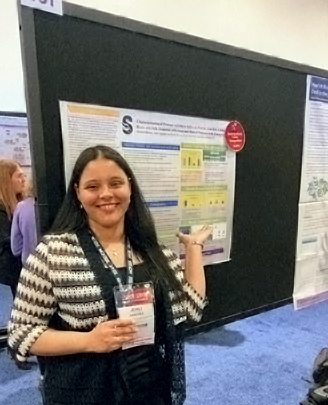
That curiosity ultimately led Sanchez into the lab, where she began exploring digestion through hands-on undergraduate research at Stockton University. Majoring in biochemistry and nearing the end of her undergraduate career, Sanchez wanted to better understand how biological processes discussed in class operate in everyday life. Through faculty‑mentored research with Dr. Kelly Keenan, she was able to move beyond the textbook and into real experimentation, examining digestion as a complex and highly individualized system.
Sanchez’s project focused on saliva, the starting point of digestion. Saliva contains enzymes, such as amylase and proteases, that begin breaking down food the moment we start chewing. While many commercial laboratory tests assess enzyme activity using a single standard protein (often milk‑based casein), Sanchez and her research peers questioned whether those tests accurately represent the variety of foods people actually eat.
To explore this, Sanchez helped design experiments using proteins from common foods like beef, chicken, and beans. These foods were dehydrated, turned into powders, chemically modified to be easier to test, and then exposed to saliva samples. Enzyme activity was measured using standard laboratory assays and a technique called zymography, which allows researchers to visually see how enzymes break down proteins.
One of the most surprising findings came from comparing saliva samples from different
individuals. Sanchez and her lab partners recorded what they had eaten prior to testing,
whether meals were carbohydrate‑heavy or protein‑rich, and discovered that enzyme
activity varied significantly from person to person. In some cases, diet appeared
to influence enzyme levels, but not always in expected ways. A vegetarian participant,
for example, showed the highest protein‑digesting enzyme activity, raising new questions
about how long‑term diet, genetics, and individual biology may all play a role.
These differences suggest that people may digest and absorb nutrients in very different ways,” Sanchez explained. That could impact dietary needs, digestion efficiency, food sensitivities, and even how certain health conditions are identified or managed.”
Beyond the data itself, the research experience helped Sanchez grow as a scientist. When she first joined the lab, much of the equipment and methodology was unfamiliar. Over time, she gained hands-on experience with enzyme assays, gel preparation, data analysis, and interpreting experimental results, skills that extend far beyond the classroom. Sanchez also had the opportunity to present her work at the 2026 ASBMB annual conference, where she shared her findings alongside other undergraduate and graduate researchers. Presenting helped her gain confidence in explaining complex scientific ideas to diverse audiences and reinforced the value of undergraduate research as a learning experience.
Looking back, Sanchez sees undergraduate research as one of the most rewarding parts of her time at Stockton. It not only deepened her understanding of biochemistry, but also helped her clarify future goals, including pursuing advanced studies in pharmacy. Her advice to other students interested in research is simple: ask. “Reach out to your professors,” she says. “If you’re interested in their work, just ask if you can get involved. You don’t need to wait until you feel fully prepared, that’s how you learn.”
By questioning everyday processes like digestion and examining them one bite at a time, Sanchez’s research highlights how undergraduate students can contribute meaningfully to scientific understanding while gaining skills that shape their academic and professional futures.