Consuming and utilizing shellfish has a long history in North America. Beginning with
Mid-Atlantic Native Americans, specifically the tristate area and New Jersey, Native
peoples like the Nanticoke Lennie-Lenape produced shell middens.
A shell midden is a collection of shells and other refuse distributed by historic
populations. They were constructed purposefully or accidentally by a community over
varying periods of time. Their discovery by archeologists yields valuable clues about
how a society lived. The size of a midden may have indicated the size of the population
that contributed to it, or the length of time they lived there. Middens often contain
other waste, like fish bones, or animal DNA, which can give researchers hints about
the diets of their creators. Middens also help archeologists in another way: when
shells weather, they help buffer acidic soils which can preserve archeologically important
organic material in the soil. Archeological evidence suggests that shells at the bottom
of shell middens were on average larger than shells on top, leading some researchers
to believe that oysters have been consistently overharvested by different human populations.
Today, shell middens continue to be culturally significant to Native American tribes
and offer a way for tribes that have been separated from the ancestral homeland to
reconnect with their land and ancestors.
The importance of shellfish for the Mid-Atlantic doesn’t stop with Native Americans
though. Dutch settlers in New Amsterdam (New York City) were voracious consumers of
the abundant oysters surrounding the early city. In fact, there were whispers of foot-long
oysters in Dutch literature during this time period. When the British came knocking
on the doorstep of the Dutch colony of New Amsterdam, New Yorkers welcomed their new
rulers renaming New Amsterdam to New York City.
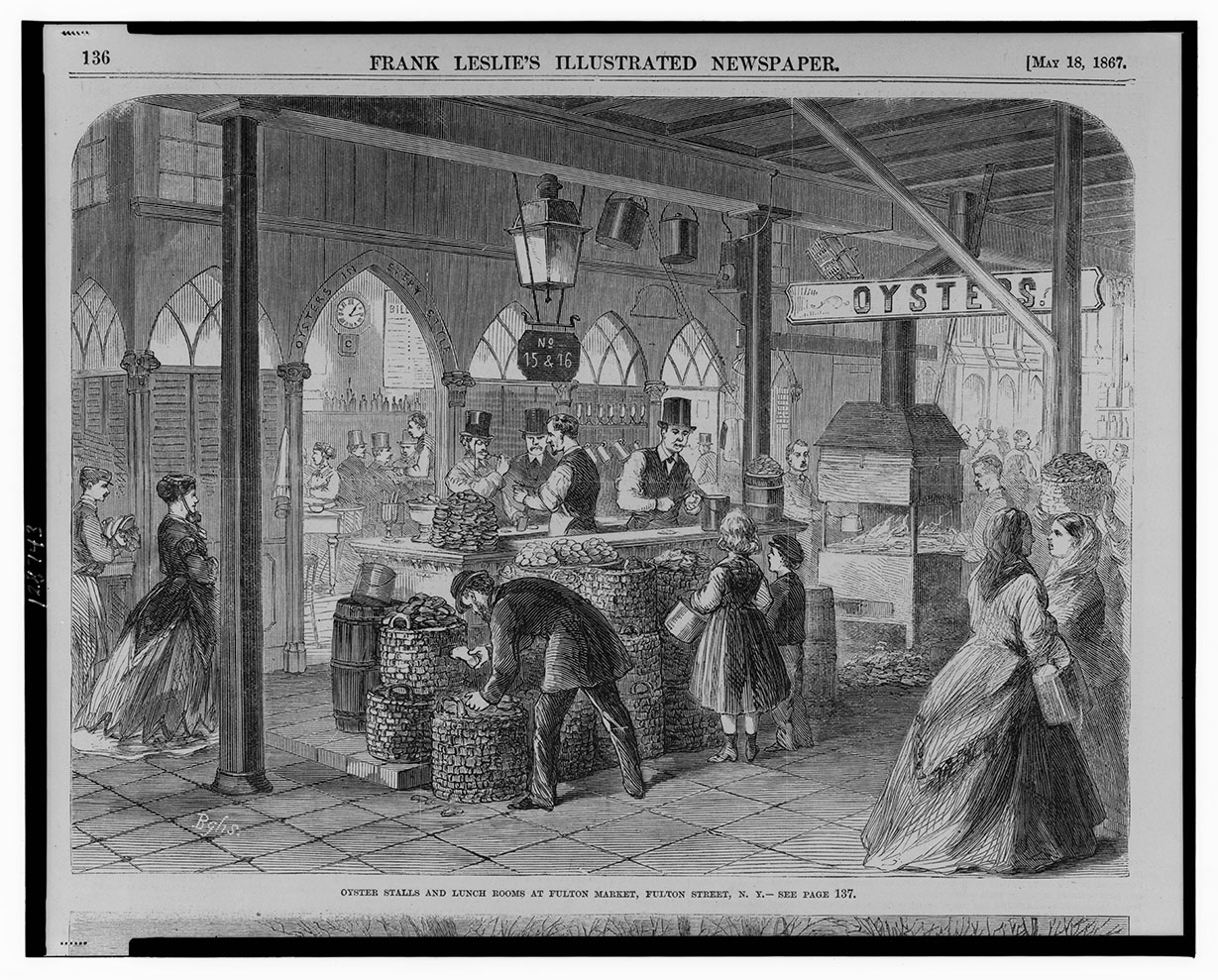
"Oyster stalls and lunch room at Fulton Market", 1867. By Albert Berghaus (Bghs) - Library of CongressCatalog: https://lccn.loc.gov/2001696865.
As New York City flourished throughout the colonial and independence periods, oysters
formed a unique place in the palate of New Yorkers. They were respected as the peak
of fine dining and served to the richest of the city’s residents while also providing
food for the city’s destitute. At that time, New York’s oyster reefs weren’t suffocating
from pollution, and were able to support hordes of hungry people rowing out to beds
and harvesting their meals using tongs. They were a staple food for many, and could
be gathered freely by a single person, or bought cheaply from any number of street
vendors. The plentiful oyster beds employed thousands of people and were world-renowned
with nobles in Paris and London squawking over the dominance of a New York oyster.
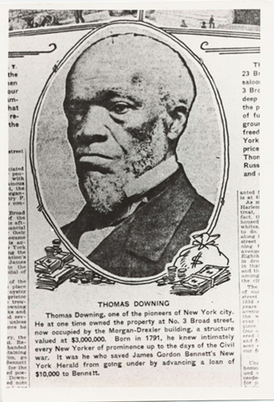
Illustration featuring Thomas Downing. Courtesy of Columbia University, Mapping the African American Past (MAAP) project.
More importantly, oysters provided for the successful careers and livelihoods of countless
immigrants and free Black citizens. These groups arrived in a city of extreme prejudice
but were still able to support themselves thanks to the industrious oyster. Take Thomas
Downing as an example. Born to formerly enslaved people, he moved to New York and
opened Downing’s Oyster House in 1825. It was considered one of the first fine dining establishments in the new United States
and was a favorite of the New York elite. Downing was hailed as a culinary legend,
but there was another side to his story. He leveraged his success in the restaurant
business to ferry enslaved Black people on the Underground Railroad. Using the profits
from his business, he built a pivotal station along the network to ferry black people
to true freedom in Canada.
The oyster’s place as a cheap food for the masses, and as a staple of fine dining
cements its place as a uniquely unifying food within the shining new American democratic
republic. Sadly, this status would not last; Advances in harvesting technology led
to faltering oyster populations.
Natural History Society of Northumbria (2026). The Wild Oysters Project. [Video]. YouTube.
Traditional and sustainable harvesting techniques like using long metal tongs were
slowly phased out for more unsustainable dredging which harvested oysters by dragging
a metal bar along the seafloor with a net attached to capture all the oysters collected.
New Jersey’s official tall ship, the AJ Meerwald, collected its oysters using the
dredge method. Sailing ships were limited in speed and restricted in their ability
to sail in stormy or dead seas. Newer steamships allowed oysters to be harvested continuously,
without regard to weather or wind. Oysters create their own biogenic habitat by growing
on top of one another. When an area is completely cleared of oysters, as dredging
does, oyster populations struggle to recover, in the same way that clear cutting a
forest decimates an ecosystem.
Eventually, the relentless consumption of New York’s oyster beds outstripped nature’s
ability to replenish them. Unregulated industry and residential hydrologic contaminants
made it impossible for the creature to breathe and eat. Natural beds were deemed unsafe
to eat and closed by public health officials. Once covering over 220,000 acres (about
the area of Austin, Texas), New York’s once abundant oyster beds have fallen barren.
Oysters exist in the New York area today; they are still deemed unsafe for consumption.
Today, the city is seeing an oyster renaissance. New York Governor Kathy Hochul recently
announced the development of a new Shellfish Hatchery in Islip, Long Island. The development
represents intentionality among lawmakers to boost the aquaculture industry and is
a clear recognition of the benefits of oysters. Meanwhile, the New Jersey oyster has
been slowly chugging along for years, producing economic value and cleaner waters.
It too has been bolstered by different programs, including shell recycling programs
in Port Republic and Long Beach, as well as a flourishing aquaculture industry in
the Delaware Bay and Atlantic coast. Oysters present a unique opportunity for economic
development and environmental sustainability. State leaders need to continue supporting
oysters and the aquaculture industry to reap benefits for their constituents and save
the species that was a core part of our early democratic republic.
Workers with the Billion Oyster Project prepare to place oysters in the waters near
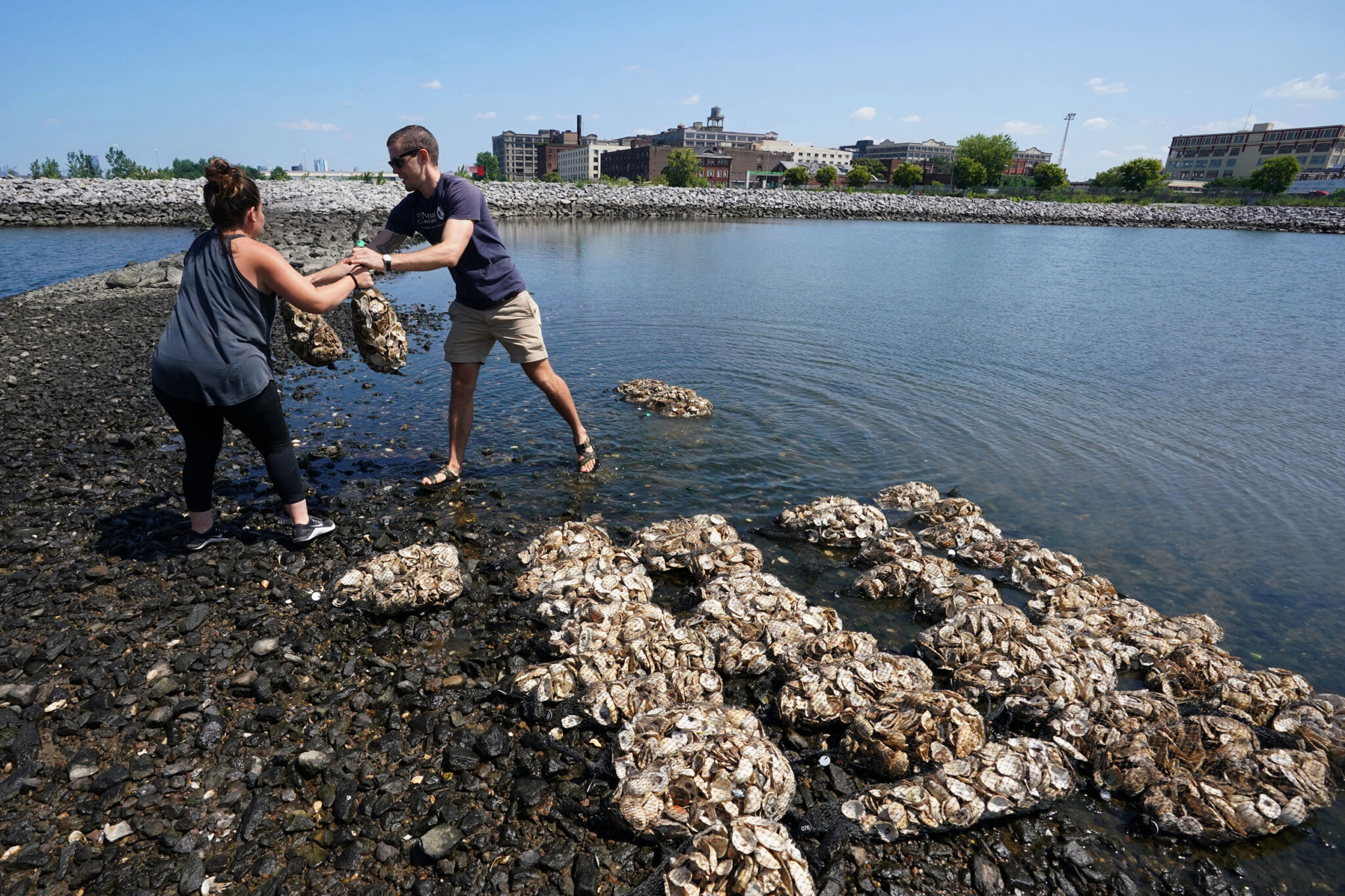
Brooklyn’s Bush Terminal Park in New York City. Credit: Don Emmert/AFP via Getty Images