Diplomacy Lab
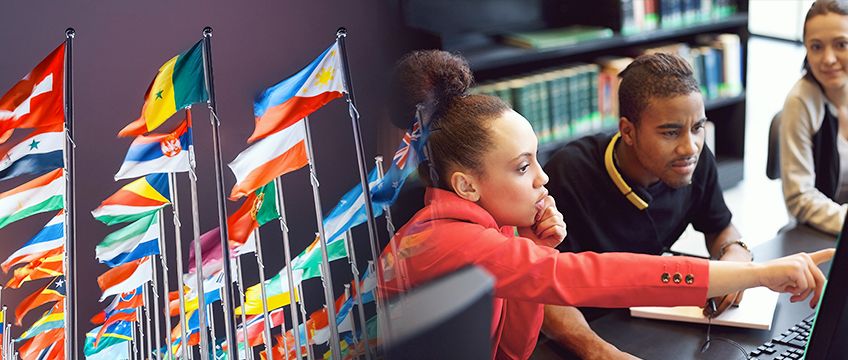
The Diplomacy Lab at Stockton University is a partnership with the U.S. Department of State, offering students and faculty the opportunity to tackle real-world foreign policy challenges. It allows students to engage directly with policymakers, contributing to the policymaking process and leveraging academic expertise to address global issues.
Launched by Secretary Kerry in 2013, the Diplomacy Lab is a public-private partnership that enables "course-source" research and innovation related to foreign policy challenges by harnessing the efforts of students and faculty experts at colleges and universities across the U.S. Students participating in Stockton’s Diplomacy Lab explore real-world challenges and work under the guidance of faculty members who are authorities in their fields.
This initiative allows students to contribute directly to the policymaking process while helping the government tap into an underutilized reservoir of intellectual capital.
As one of the few non-R1/R2 schools participating in this program, it is because of
our proven track record of success with previous projects that Stockton has remained
a member.
Diplomacy Lab FAQ:
What is the Diplomacy Lab?
The Diplomacy Lab underscores the government’s commitment to engaging the American
people in its work, and helps broaden its research base and more effectively respond
to a myriad of global challenges.
Students participating in the Diplomacy Lab explore real-world challenges identified
by the government and work under the guidance of faculty members with expertise in
a field related to the project. Students also discuss these issues with government
officials several times throughout the semester. The Diplomacy Lab allows students
to contribute directly to the policymaking process, while helping tap into an underutilized
reservoir of intellectual capital.
The Diplomacy Lab operated in a pilot phase from Fall 2013 through the Spring 2015
semester. An open application period was held in March 2015, selecting additional
universities to participate in the Diplomacy Lab starting in Fall 2015.
How does the Diplomacy Lab work?
In a nutshell, each semester a list of proposed projects is shared with universities
that are participating in Diplomacy. Then the coordinator solicits interest from faculty
members to lead teams of students in Diplomacy Lab projects. Over the course of a
semester, professors guide students in developing a final work product that accomplishes
the goals outlined by the government. Students have opportunities throughout the semester
to discuss their research with government officials.
Diplomacy Lab member institutions may bid on project proposals developed by the Department
6 months prior to each semester during the bidding window. Each university is encouraged
to submit bids for its top four priority projects. It is also highly recommended that
each university choose four alternate projects with an individual proposal in the
event a particular project is over-subscribed.
What sorts of topics are covered?
The federal government is responsible for responding to a wide array of international issues and challenges, including climate change, weapons nonproliferation, democracy and human rights, counter-terrorism, global health, energy security, gender equality, economic policy, trafficking in persons, food security, and conflict and stabilization. This program remains under the auspices of the federal bureacracy, which takes cues from a variety of government and non-governmental actors.
Who develops these projects?
These projects are designed and requested by career professionals in the State Department who are seeking research in the areas they deem necessary for the mission of their office(s). Diplomacy Lab projects come from offices across the Department, and the Department makes an effort to provide projects matching the strengths and interests of universities participating in Diplomacy Lab.
What does a Diplomacy Lab team of students look like?
A standard Diplomacy Lab team is generally a group of at least four or more students led by a faculty member. Students may be undergraduate or graduate students in any discipline or academic field. Interdisciplinary teams are also welcome and encouraged!
What kind of faculty commitment is expected?
In short, a lot! Each Diplomacy Lab team is supervised by a faculty member with expertise in a field related to the project. The faculty member also serves as the Project Point of Contact for government officials who have proposed the project. In exchange, faculty members reserve intellectual property rights of their work (see below for more details). The research is expected to take place in the semester for which you're bididng, and you MUST involve students. That said, your State Department liaison will rely on faculty expertise and ability to deliver a high-quality project; faculty are responsible for delivering the final project by the agreed-upon deadline. Some projects are more extensive than others, and I suggest you read the project descriptions carefully to understand their scope when submitting a proposal. There is no room to negotiate the final deliverable- you will be responsible for completing the project once you accept. Check out the Faculty page and FAQs on our Diplomacy Lab website for more information about how to incorporate these projects into your workload for the fall semester.
Can I work with others on campus to complete my project?
Yes! And you should contact potential collaborators across campus during the bidding process if you plan to rely on them to complete your project, so you can accurately list who will be involved and responsible for the final project in your bid. If you'd like to work with a Center, multiple faculty, or other offices, reach out before you finish your bid to have a discussion about what their involvement might look like and how you might collaborate. They may bring a different perspective to your project and be an equal partner, or they may opt to support you. Notice that many of our past projects have involved collaborations across campus - we've had projects completed by faculty and students working with URM - Marketing and Social Media and ITS - Production Services. Be creative in recruiting talent for these projects! We've been successful so far because of the talent and commitment of faculty, staff, and students.
What about the intellectual property of my work?
Upon completion of individual research projects, universities and faculty reserve intellectual property of all work and reserve the right to submit for publication following submission to their government liaison/director. Specific details related to intellectual property may be included in your project description and/or worked out with government liaisons and Stockton University; this would be your responsibility as a project leader to address before work on the project begins.
How much contact do students have with government officials?
Students engage directly with officials throughout the semester in a series of video- or teleconferences. Although each project’s trajectory is different, typically the first conference takes place at the beginning of the semester, so that students can meet Department officials, who provide students with additional context and direction not included in the initial project request. The second conference takes place later in the semester, to give students the chance to ask questions and officials a chance to give mid-course guidance on the students’ work. There may be a possibility of a final conference after students submit their final projects. During this last conference, students present their results to their Department colleagues and other relevant officials. Government officials will have the opportunity to provide feedback on the students’ work.
What is the final work product?
The format of the final product depends heavily on the nature of the project. The expected form of the final project is made clear in the project announcement and in communication with government officials.
How many projects/topics can each university take on?
Each university is encouraged to bid on up to four projects per cycle or semester, in addition to four alternate project proposals in the event that a certain topic is over-subscribed.
How can faculty incorporate Diplomacy Lab projects into their courses?
Faculty are encouraged to incorporate Diplomacy Lab within their curricula as best suits their teaching needs and academic goals. Please note that most of these projects have been undertaken as research projects within existing classes or as a small-group independent study, as there is no funding attached to this program.
Potential models include but are not limited to:
- Independent Study Model (most typical at Stockton): Faculty can offer for- credit,
supervised independent study opportunities to small groups of students for one or
more of its chosen projects.
- Course-Per-Topic Model (e.g., a Summer Intensive Research Project (SIRE): A faculty
member might build a course or SIRE around a chosen Diplomacy Lab topic. Students
could be asked to work collectively or in teams. The course instructor would then
coordinate and consolidate student work product, the final form of which should be
discussed with the relevant government officials before the semester begins. Possible
models for student work product involve: a compilation of the best portions of various
projects; a class-wide revision of a chosen project; or splitting the topic into distinct
pieces (i.e. country or thematic focuses) and consolidating the results into one final
submission.
- Capstone Model: Diplomacy Lab projects can be incorporated into existing capstone
or practicum programs or courses. This might include a senior seminar, a research
methods course, a GIS, or other capstone experience and the Diplomacy Lab might be
1 of several projects students can choose from.
- Multi-Topic Course Model: A university could offer one or more courses (whether Diplomacy-Lab-specific or pre-existing) in which student teams address different Diplomacy Lab topics. If multiple teams intend to address the same topic, similar methods as described above should be used to consolidate the teams’ efforts prior to submission to government officials.