Fall 2026 Issue
From the Marsh to the NJDEP: Alumna Serena Lutz Turns Stockton
Written by Kayla Caputo '25, M.B.A. ‘25
For Serena Lutz, a passion for coastal science did not begin with a perfectly mapped-out career plan. Instead, it developed through fieldwork, curiosity, and a question that eventually became the foundation of her graduate research at Stockton University: How can scientists get a more complete picture of what is happening across a salt marsh?
Today, that question has followed Lutz from the classroom and field into her professional career with the New Jersey Department of Environmental Protection (NJDEP), where she works as an Environmental Specialist in the Bureau of Coastal Permitting. Her graduate research at Stockton explored how remote sensing and aerial imagery could help scientists better evaluate salt marsh restoration, work that could contribute to more standardized ways of measuring the success of restoration projects.
Lutz arrived at Stockton in Fall 2020, after completing her undergraduate degree at Rutgers University during the COVID-19 pandemic. She felt it was time to continue graduate school and enrolled in Stockton's Environmental Science program after speaking with Tait Chirenje, Professor of Environmental Studies and Program Chair of the Professional Science Master's (PSM) in Environmental Science, who also mentioned the Coastal Zone Management graduate program (CZMT).
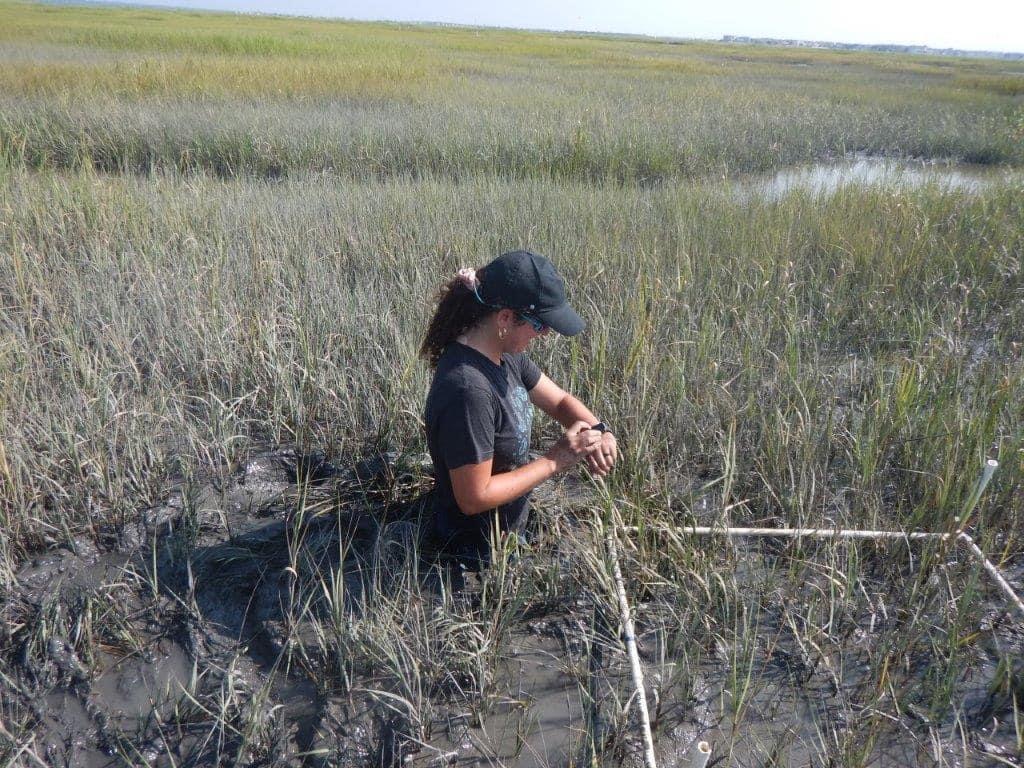
Her direction began to shift as her professional experiences brought her closer to New Jersey's coastal environments. She had previously worked on diamondback terrapin population studies through Project Terrapin with Dr. John Wnek, managing a study site and collecting field data. Then, in 2021, she began working with The Nature Conservancy on salt marsh restoration.
Being out in the marsh solidified her interest. “Once I was out there, it just kind of solidified that I really liked the coastal science,” Lutz said. “That was what I really wanted to do, and I wanted to study marshes.” That realization led her to transition into Stockton's Coastal Zone Management program and provided the inspiration for the research project she would continue developing over the next several years.
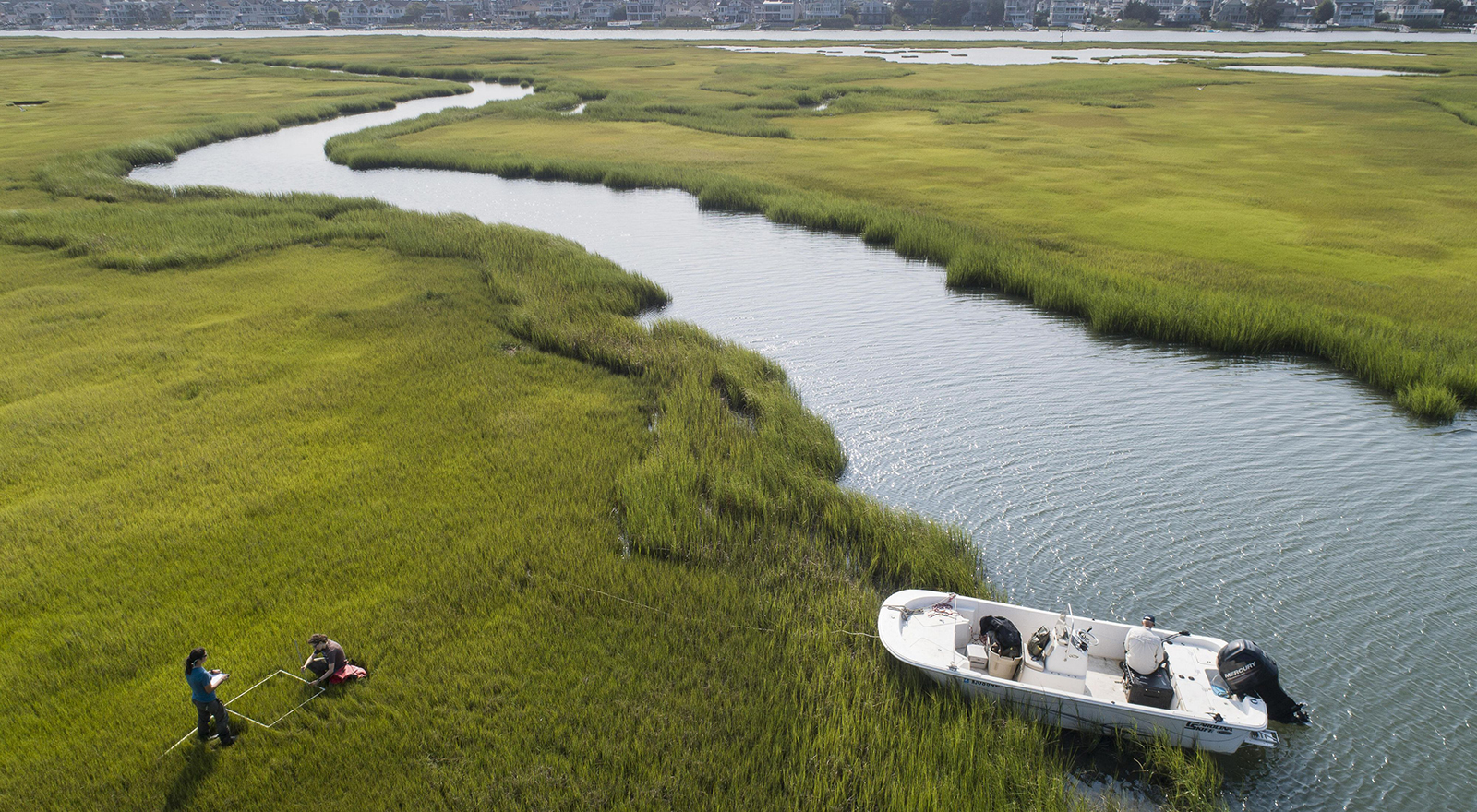
While working on salt marsh restoration monitoring, Lutz noticed a challenge with traditional field data collection. Scientists may return to established one-meter-square plots to monitor vegetation and other conditions over time. While those plots provide valuable information, they represent only small sections of a much larger ecosystem. Two observers can also look at the same plot and estimate different percentages of vegetation cover, introducing the possibility of observational bias. The question for Lutz became: What about everything in between those plots?
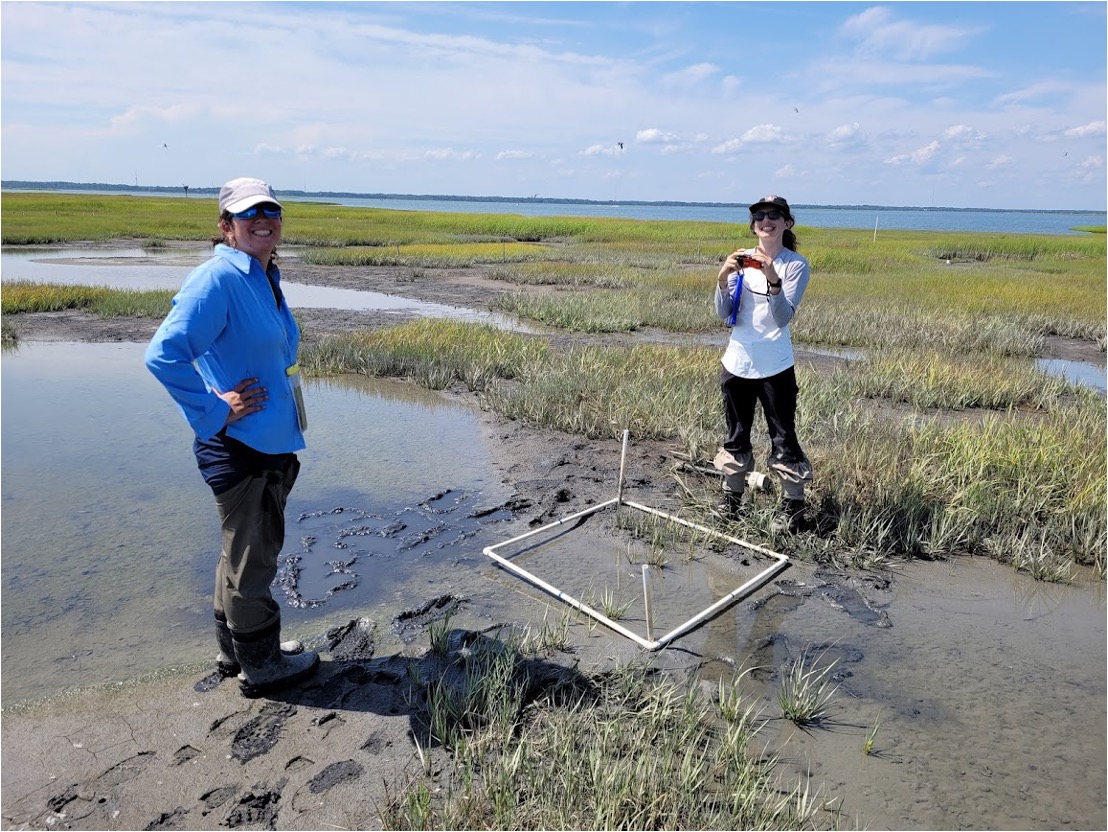
Traditional fieldwork might provide detailed information about a handful of locations across a massive marsh, but not necessarily the full picture. Lutz wanted to find a way to supplement that information and better understand changes occurring across the entire landscape. That challenge is especially important as salt marshes face increasing pressure from sea-level rise. As water reaches farther into marshes and remains for longer periods, plants that are less tolerant of prolonged flooding can die. Without their root systems holding sediment together, portions of the marsh can begin breaking apart and eventually transition into pools and mudflats.
Lutz's research focused on a restored marsh in Fortescue, New Jersey, along the Delaware Bay. At the site, dredged sediment had been placed on portions of the deteriorating marsh to raise its elevation and support its recovery. Her analysis showed vegetation returning in the treated area, including plant communities associated with higher marsh elevations.
Lutz initially planned to use ArcGIS and statistical analysis to fill gaps between field sampling locations. As the project evolved, however, so did her methodology. She began experimenting with remote sensing software, using aerial imagery to classify different areas of the marsh. Rather than simply separating broad categories such as water, vegetation, and bare ground, her analysis became detailed enough to distinguish dominant plant species and even separate areas of sand from mud.
The technology does not eliminate the need for scientists in the field. “This isn't going to replace fieldwork,” Lutz explained. “It's meant to supplement it or enhance it.” Researchers still need firsthand knowledge of a site and its vegetation to train the computer program to recognize what it is seeing in aerial imagery. Lutz's approach instead creates an opportunity to combine detailed field expertise with technology capable of analyzing a much larger area.
That combination could have applications beyond one New Jersey marsh. Lutz hopes additional case studies can eventually determine whether the method can be replicated across different types of salt marshes throughout the state. A standardized approach could help researchers compare projects, evaluate restoration outcomes, and potentially provide stronger evidence when determining whether proposed restoration techniques are likely to succeed. She also developed a manual containing her process and code so that others could replicate the methodology with their own imagery and data.
In an unexpected alignment of academics and career, Lutz joined NJDEP near the end of 2024 and found herself working in coastal permitting, specifically with dredging. The connection placed her directly within the professional world her research addressed. After completing her graduate program, Lutz presented the project to leadership at NJDEP to explore whether the work could continue through additional case studies. The discussion opened possibilities for how the agency might support further development of the research.
For Lutz, it represented an opportunity to see a graduate project potentially grow beyond an academic requirement and into something with practical applications for coastal management. Before taking her research to NJDEP leadership, Lutz had another opportunity to share it with a much broader audience at Stockton's Graduate Symposium. Presenting was required as part of her Coastal Zone Management program, but Lutz also entered her work for consideration in the symposium's awards. She recalled being nervous about condensing a complex project into an “elevator talk,” particularly for visitors without scientific backgrounds. Then people started asking questions.
Attendees who knew little about salt marsh science became engaged with the research. Some asked technical questions; others wanted to know what they could personally do to help marshes. Lutz even had visitors tell her that someone else had recommended they stop by her poster. The interest culminated in a first-place recognition for her work. “I was overwhelmed, overall, but it was obviously great,” Lutz said of hearing her name called. “I was really happy. I was really excited that it mattered that much to people.” The connection between Lutz's Stockton education and her current career extends well beyond her graduate research.
In the Bureau of Coastal Permitting, Lutz regularly works with New Jersey's coastal zone management rules and reviews site plans submitted with permit applications. She credits coursework in areas including coastal law and policy, wetland science, coastal processes, and land-use planning with giving her knowledge she now applies professionally. She believes that background also helped distinguish her when interviewing for NJDEP.
For students who may worry that specializing in coastal science is too narrow, Lutz has a simple message: don't let the word “niche” discourage you. “We need coastal scientists,” she said, pointing to opportunities ranging from marsh restoration and coastal management to seafloor mapping and other work connected to continually changing coastal environments. Her own path is proof that specializing can create opportunities rather than limit them.
Lutz also hopes students take something else from her Stockton experience: there is no single correct timeline for earning a degree. She began at Stockton in 2020 and completed her graduate journey six years later, taking breaks along the way while balancing school with full-time work and other responsibilities. At times, watching others complete their degrees sooner made her question her own progress. Her advice now is simple: don't give up.
Stockton's Professional Science Master's programs, she said, offered flexibility that let her keep working toward her goal, including evening and online course options. She encourages students, particularly working and nontraditional students, not to judge their progress against someone else's timeline. That persistence ultimately brought several pieces of Lutz's journey together: an interest in coastal environments, hands-on field experience, graduate education, research, and a career protecting New Jersey's coastal resources.
What began with noticing gaps between a handful of one-meter plots in a salt marsh has grown into research that could help scientists see the bigger picture, both literally and figuratively.