Jennifer Sagan
J ennifer Sagan '21 was five years old when oysters first caught her attention. She was splashing around in the Chesapeake Bay on a summer vacation visiting her grandparents and noticed a sign with an oyster shell graphic. Underneath was a warning from the Virginia Department of Health against consuming shellfish from the waterway.
That little girl grew up and is now collecting oyster shells from more than 20 restaurants, festivals and community dropoff locations throughout the Rappahannock watershed and using them to raise more oysters, create reef habitat and restore the Chesapeake Bay.
Back to the Bay
Sagan grew up in Columbia, in the mountainous northwestern corner of New Jersey, far from the ocean. Summer vacations introduced her to the rich culture and history surrounding shellfish and the ecosystem of the Chesapeake Bay, the largest estuary in the United States.
The environmental issues and restoration of that region stuck with her and led to her decision to major in Marine Science at Stockton University.
The Stockton Marine Field Station is where she developed her interest into skills for a career in conservation to join the restoration of the ecosystem where she discovered oysters.
“I was impressed by the early access to hands-on lab work, and I was out on a boat the second week of my first semester,” she said.
After graduating in 2021, she returned to the region she vacationed in, Northern Neck, Virginia, to work as an oyster program manager for the Friends of the Rappahannok.
On Oyster Time
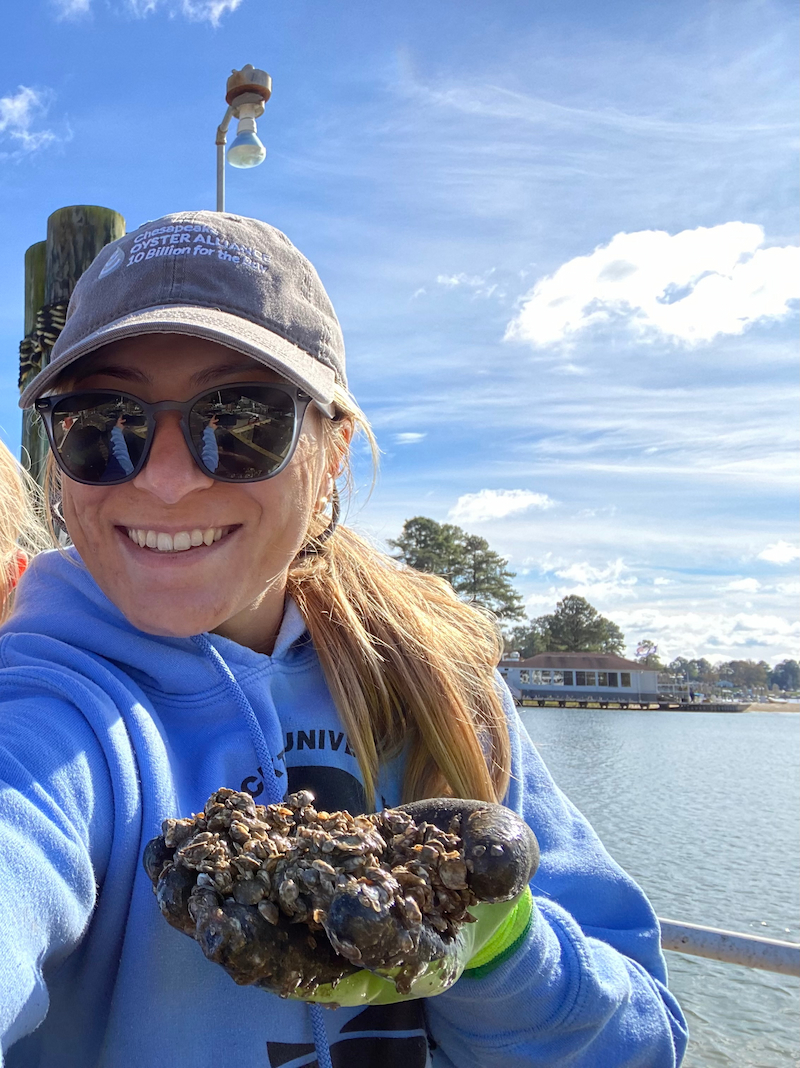
One adult oyster alone can filter up to 50 gallons of water per day. According to the Chesapeake Bay Foundation, the Chesapeake Bay’s population of oysters could once filter the entire bay, about 19 trillion gallons, in a week, but it would take a full year with the size of today’s population.
Sagan’s job is simple in concept: get more oysters thriving in the bay. The planning, strategy, logistics, public outreach and education involved in getting oysters from dinner plates to the bay is the complicated part.
She calls it “turning yesterday’s meal into tomorrow’s oyster reefs.”
One of Sagan’s goals is for people to eat oysters. Then she can collect and cure the recycled shells and return them to the bay, but there’s an additional step that accelerates the restoration process.
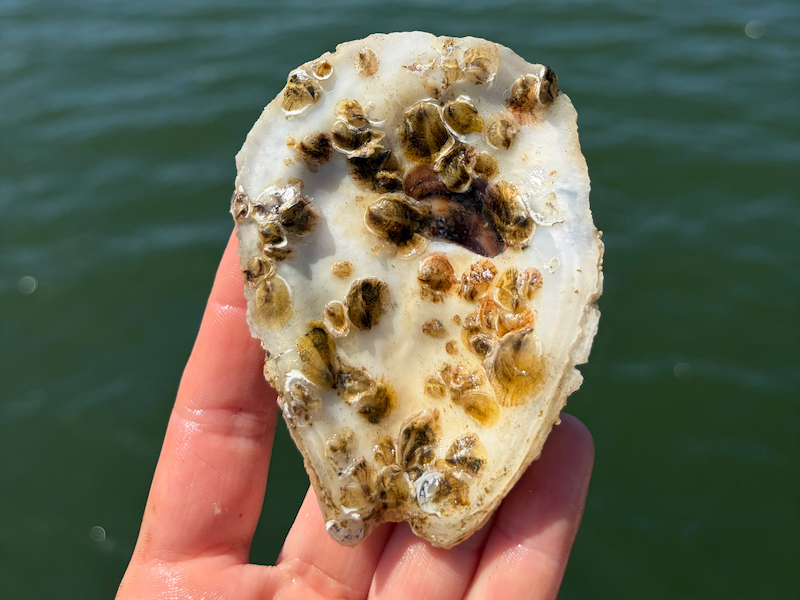
Instead of returning empty shells to the bay, she makes sure that each recycled shell is home to growing baby oysters upon return to reef sites.
For every one oyster eaten and returned, the bay is receiving two half shells speckled in spat, the scientific term for juvenile oysters.
Turning yesterday’s meal into tomorrow’s oyster reefs."
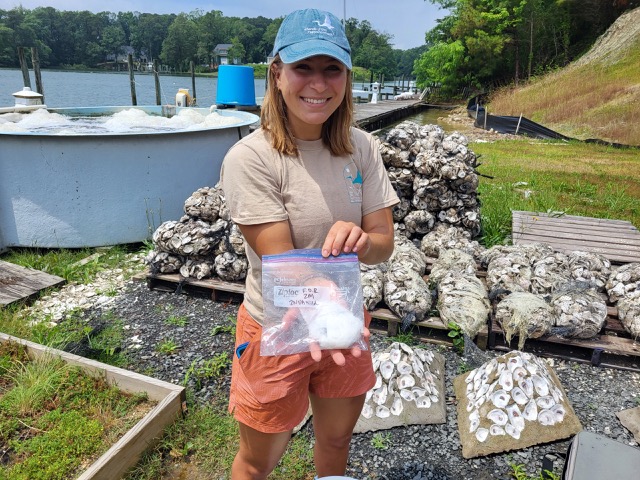
Sagan’s work schedule goes with the flow of the oyster lifecycle. In the spring, she’s acquiring oyster seed, which are baby oysters measured in millimeters, and pouring the micro dots into tanks holding bags of the recycled shell. Volunteers help to bag the shells to keep them organized in the tanks.
Oyster larvae settle and attach themselves to the bagged shell. When the spat are big enough, the oysters can be transferred to baskets and planted, or tossed overboard, into the bay.
When she’s not wearing muck boots, she’s applying for grants, advocating for legislation to protect the ecosystem and partnering with new restaurants to acquire shell.
Eating Protein to Help Save the Planet
Although she’s a vegetarian, she’s all for eating oysters. “Oysters provide all these ecosystem services that make them such a sustainable form of protein,” she said.
“There can be a lot of misconceptions. People think I might not want people to eat oysters because that's taking away from the population, but we're putting the shells back. It’s a full circle process and even as these farms are growing oysters that are ultimately destined for consumption, they're still actively filtering the water and they're still providing habitat,” she explained.
The Stockton World in an Oyster Shell
Although it’s been five years since she was on Stockton’s campus and works states away, she’s seen ripples of Stockton’s impact on her field.
When she purchases oyster seed from Oyster Seed Holdings, she’s supporting two fellow Marine Science alums, Samantha Glover ‘18 and Alexandra Blanchet ‘18, who work at the hatchery.
“It's definitely made us laugh. It's a cool little Stockton crew in Virginia,” she said.
“Oyster Seed Holdings is an awesome organization, and they run hatchery tours to educate the public. They recently started a food truck on the property for people to enjoy oysters,” she said.
She also pointed out that Stockton’s R/V Rudy Arndt, named after the late professor, was built in Reedville close to where she currently lives.
Sagan shares her salty work adventures and educational highlights on Instagram as @slightlysaltysagan and recently talked to Oyster-ology podcast host Kevin Cox on his segment “Getting Slightly Salty: Restoring Oysters One Reef at a Time with Jen Sagan.”
Story by Susan Allen