From Burnout to Betterment: Breaking the Cycle of Employee Turnover in the Hospitality Industry

ABSTRACT
The hospitality industry is grappling with unprecedented labor shortages and soaring turnover rates post-Covid-19 pandemic, which threaten the sustainability and success of businesses. Contributing factors include low wages, insufficient benefits, toxic workplace cultures, and the demanding nature of hospitality roles. Post-pandemic shifts in worker preferences, such as a desire for remote work, have further exacerbated these issues. This paper explores the root causes of labor shortages and turnover, the consequences for employees, customers, and businesses, and effective strategies for addressing these challenges. Drawing on personal experiences and research, including case studies of leading hospitality companies and a survey conducted by the author to gather insights from current and former hospitality employees, this paper highlights solutions such as improved compensation, enhanced training, employee recognition programs, and career development opportunities. By implementing these strategies, the hospitality industry can reduce turnover, boost employee satisfaction, and enhance overall operational efficiency.
Keywords
Hospitality, labor shortages, workplace culture, employee turnover, retention, burnout
INTRODUCTION
The hospitality industry has been facing a critical workforce crisis, with severe labor shortages and record-high turnover rates, particularly in the aftermath of the COVID-19 pandemic. Over the past few years, businesses in the sector have struggled to attract and retain employees, a problem exacerbated by a combination of factors such as low wages, insufficient benefits, high-stress work environments, and demanding hours. Many workers are opting for more flexible or remote positions, which has further drained the pool of available talent for in-person hospitality roles (Harver 2023). The turnover rate within the industry has been deemed the highest among other sectors, skyrocketing 204% beyond the nation’s average resignation rate and showing over 2.9 million people leaving their roles within just the first four months of 2024 (Woodalls 2024). This constant turnover disrupts day-to-day operations and undermines the overall quality of service provided to customers.
A significant aspect of the problem lies in the burnout experienced by employees who are expected to work long shifts under high amounts of pressure. With little recognition or support from management, over 57% of hospitality employees report critical levels of workplace stress (Seymour 2022). The lack of adequate training and appreciation leads to feelings of dissatisfaction, further compounding the issue of turnover. In many establishments, employees are expected to pick up the slack for the constant shift in staffing, which results in overwork and low morale. Additionally, some employees are discouraged from seeking advancement within the industry, as entry-level positions sometimes offer better compensation than managerial roles, which limits opportunities for growth and career development.
Drawing from personal experiences involving the challenges facing the industry, this commentary aims to examine the root causes of labor shortages and high turnover rates in the hospitality industry, assess the consequences for employees, customers, and businesses, and propose actionable strategies to address these challenges. This paper will utilize insights from a survey created by the author, which gathers feedback from real-life workers in the industry, as well as case studies from major hospitality companies that have implemented successful retention strategies. Through this comprehensive analysis, the paper will provide a roadmap for addressing labor issues within the hospitality sector and improving the work environment for employees, thereby enhancing overall operational efficiency and customer satisfaction.
Problem Statement: The hospitality industry's rising employee turnover rates and labor shortages undermine operational efficiency, employee well-being, customer satisfaction, and overall business success.
INDUSTRY CONTEXT
The hospitality industry is currently wrestling with severe labor shortages and high turnover rates, with many businesses struggling to maintain a stable workforce. A significant 76% of surveyed hotels report staffing shortages, and 13% indicate that these shortages are so severe that they directly affect the hotel's ability to operate (AHLA 2024). Turnover rates in the hospitality sector are alarmingly high, with the leisure and hospitality industry experiencing an 84.9% turnover rate, far exceeding the national average of 47.2% (Brunau 2022). This high turnover rate results in several negative consequences for businesses, employees, and customers alike. For businesses, the constant cycle of recruiting, hiring, and training new employees creates financial strain, with “nearly 50% of Hotel Chief Financial Officers claiming labor shortages were causing the most strain on their companies’ net operating income” (Luther 1). Additionally, current staff members must take on additional responsibilities to compensate for new hires, leading to overwork, burnout, and low morale. The impact on employee well-being is particularly concerning, as high turnover rates and a stressful work environment contribute to burnout and mental health issues, such as anxiety and depression, both of which “account for 50% of all work-related ill health cases last year” (Seymour, 2022, para.2). Mental health is also impacted when employees work in an environment where they do not feel safe, protected, or respected, considering that 63% of hospitality workers have reported this exact feeling, all of whom had filed a sexual harassment claim towards guests, managers, or coworkers (Roosted 2023). This is further compounded by a workplace culture that often lacks appreciation for employees’ efforts, with many workers reporting feeling undervalued and unsupported.
The consequences for businesses are substantial. High turnover and understaffing reduce productivity and efficiency, as the remaining employees are expected to pick up the slack. This not only affects daily operations but can also harm the quality of service provided to customers. Inconsistent staffing and inexperienced workers result in delays and a drop in the level of service, leading to customer dissatisfaction. As employees come and go, businesses also lose valuable knowledge of seasoned and knowledgeable individuals, which can impair customer service and disrupt team dynamics. Customers may begin to notice these disruptions, which can negatively affect the company’s reputation and result in a decline in customer loyalty (Depierraz, 2023, p.3).
The root causes of these issues are multifarious. Unsatisfactory wages and benefits are a significant contributing factor, with over 60% of survey respondents reporting feeling that their compensation does not reflect the demands and stress of their roles. A lack of employee recognition and appreciation exacerbates these feelings, leading to disengagement and eventually, resignation. The unsatisfactory workplace culture, coupled with unrealistic expectations and the requirement of working long hours, creates a breeding ground for burnout. Furthermore, undesirable shift hours—such as nights, weekends, and holidays—further discourage employees from staying in the industry, especially when there is limited upward mobility or career advancement opportunities. Another root cause is the post-pandemic shift in worker preferences, with many seeking remote work opportunities or roles that offer more flexibility, leaving the hospitality industry behind.
The impact on stakeholders is significant. Employees bear the brunt of the increased workload, as the remaining staff is forced to work longer hours and take on additional responsibilities, often without additional compensation or support. This leads to burnout, low morale, and high levels of dissatisfaction. Businesses are financially impacted by the constant need for recruitment and training, and the increased workload and decreased employee productivity affect overall operational efficiency. Customers experience the consequences in the form of slower service, inconsistent quality, and a lack of continuity in their experiences, which can lead to negative reviews and a loss of business (Dipeirreaz 2023). Addressing these root causes and mitigating their effects is critical for restoring stability to the hospitality industry, improving employee well-being, and enhancing the overall customer experience.
DISCUSSION
Danny Meyer’s Setting the Table provides valuable guidance on addressing labor shortages and high turnover rates noted in the hospitality industry. One of the central themes Meyer touches upon is the idea that businesses thrive when they treat employees with respect and appreciation. Meyer emphasizes that employees who feel valued are more likely to be engaged, loyal, and motivated to go above and beyond in their roles. This concept of "hospitality" is not limited to guests but should extend to employees as well (Meyer 2006). Meyer discusses how hospitality businesses can cultivate an environment of respect and recognition by focusing on employee compensation and benefits, empowerment and development of employees, and creating a positive and inclusive work environment for all.
In addition to employee appreciation, Meyer advocates passionately for community involvement. Meyer argues that businesses that integrate themselves into the community provide their employees with a greater sense of purpose, which in turn increases job satisfaction. Employees who see their work as making a meaningful contribution to the broader community are less likely to experience burnout or feel disconnected from the business (Meyer 2006). Meyer’s own establishments have made a concerted effort to engage with their local communities, whether by supporting charitable causes, participating in local events, or creating partnerships with other businesses. He explains that when employees feel connected to the company’s mission, as well as to the community it serves, they are more likely to stay long-term because they feel they are contributing to something larger than themselves.
Meyer also points to the importance of fostering positive relationships between employees and customers. He describes how his restaurants focus on creating memorable experiences not only for customers but also for employees. By emphasizing that hospitality should be about creating emotional connections, Meyer suggests that companies in the hospitality industry can improve job satisfaction by allowing employees to engage with customers in a meaningful way.
METHODOLOGY
To better understand the factors contributing to high turnover rates and labor shortages in the hospitality industry, a mixed-methods approach was employed, combining both qualitative and quantitative research. The first component of the research involved the creation and distribution of a survey through Google Forms, designed to gather firsthand insights from individuals currently employed in the hospitality sector. This survey was aimed at assessing workers’ experiences related to job satisfaction, reasons for turnover, stress levels, and the factors that would influence their decision to stay or leave the industry. The survey was distributed to current and former colleagues, as well as family and friends who have worked in various hospitality roles, achieving a total of 30 responses. The goal was to collect a broad range of perspectives from those directly affected by the industry’s challenges.
The second component of the research involved a review of case studies from four major hospitality companies. These included Marriott, Hilton, Starbucks, and Hyatt, each of which has implemented strategies aimed at improving employee retention and reducing turnover. The focus of this analysis was to examine the impact of specific programs, such as management development initiatives, employee recognition programs, tuition reimbursement options, and career development support. Data regarding employee satisfaction, retention rates, and turnover rates before and after the implementation of these strategies were compared to evaluate their effectiveness.
Finally, a review of secondary data sources, including industry reports, academic research, and expert opinions, was used to contextualize the survey findings and case study analysis. These sources helped identify broader industry trends and offered insight into the systemic causes of labor shortages and high turnover.
RESULTS
The respondents of the survey conducted ranged from ages 19 to 46 and above, answering a thoughtfully crafted list of 24 questions (See Appendix), offering an extensive understanding of generational perspectives and work experiences. Offering experience as bussers, hostesses, line cooks, food servers, bartenders, dishwashers, hotel front desk agents, and more, the respondents gave insightful feedback and recommendations for the future of the hospitality industry, of which 72.2% of respondents reported being slightly pessimistic or just neutral about. The survey initially asked the 30 respondents to rate their level of job satisfaction ranging from 1-5, 28 of which, or about 93%, responded with a 3 or higher. In the following question, 60% of respondents attributed their satisfaction scores to factors such as pay and benefits, work-life balance, and support from management and fellow employees. With nearly 100% of respondents reporting feeling extreme amounts of stress of burnout related to their employment, it makes sense that many are frustrated with the lack of support from management and handling frequent irate guests, as their job takes a toll on their mental and physical well-being.
16.7% of respondents reported very frequent labor shortages in their place of employment, which all individuals agree can be accredited to demanding work hours, lack of benefits, low wages, or lack of personal fulfillment within the workplace. Sixteen out of 30 individuals also report their companies having to limit their service hours, as well as the hours they give to employees as they struggle financially with labor shortage. These same respondents furthered their claim by mentioning that the current employees are just expected to “take on the weight of lost employees.” When asked if they are aware of anyone who has left the industry, all 30 individuals responded yes and gave information on the reasoning behind it, involving being overworked, treated unfairly, stress burnout, unsatisfactory pay, and calling hospitality a “toxic industry that encourages unhealthy behaviors.”
All 30 respondents agreed that it would be in the industry’s best interest to offer more flexible hours and pay, training opportunities and room for growth, and stronger support from management if they want to attract more potential employees. Specifically focusing on the lack of training, 66.7% of respondents agreed that training is extremely important for employee retention, but shared from their own observations and experiences that there is simply not enough time or an absence of effort and reinforcement on management's end. The survey concluded by asking respondents what policy changes and further recommendations they have for the future of hospitality, offering answers like mandatory training, consistent contact with employees, cooperative work environment, a shift away from tipping culture, and more opportunities for growth. Perhaps the response that stood out the most was as follows: “Hospitality cannot happen without labor. If you acknowledge your employees, take care of them and remember their worth, everything else will fall into place.” This response perfectly encapsulates the very foundation of labor shortage and employee turnover: an extreme lack of appreciation for the people who make hospitality what it is.
The case studies of Marriott, Hilton, Starbucks, and Hyatt revealed that companies with proactive employee retention strategies saw notable improvements in satisfaction and retention. Marriott’s “Voyage Global Leadership Development Program” was particularly effective in preparing employees for managerial roles and fostering a sense of career growth, leading to lower turnover rates among participants. Similarly, Hilton’s “Thrive@Hilton” program, which has unique benefits and personal development opportunities, resulted in higher employee satisfaction and retention, particularly among younger workers seeking long-term career paths. Starbucks’ partnership with Arizona State University, offering tuition reimbursement for employees to pursue a bachelor’s degree, was another key strategy that helped reduce turnover and increase job satisfaction. Hyatt’s “Rise HY” program, which focuses on expanding career opportunities for young people that are unemployed, offers extensive training programs and has proven to greatly impact employee retention and satisfaction levels. The following three charts created by the author were heavily inspired by the beliefs of Danny Meyer, a man who strongly advocates for better treatment of employees and how it can positively transform a company. Motivated by this, the author collected qualitative and quantitative data that was easily accessible through the professional websites of each company discussed (See References). This information was then portrayed in various visual formats through Microsoft Excel, as seen below.
CHART 1: Employee Turnover Rate Comparison
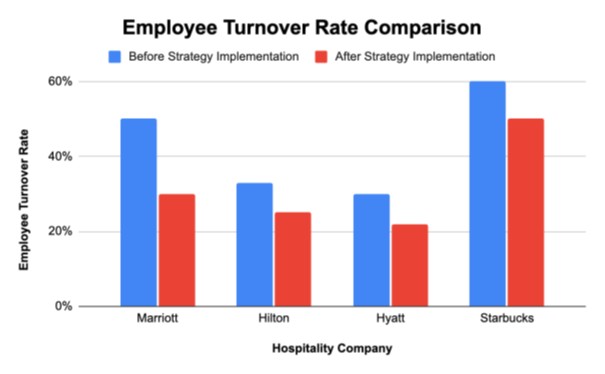
This graph illustrates a noticeable decline in employee turnover rates among employees who participated in the varied employee programs implemented in each business. The largest decline is noticed through the “Voyage Global Leadership Development Program” by Marriott, a program geared to train employees and prepare them for success in future management roles. This program allows for employees to have more career opportunities as well as more sufficient training to do their best in whatever they choose to do. Marriott has learned that there is much more to an individual besides their work performance, and in order to ensure employee satisfaction and minimize turnover rates, they broadened their perspective and “started talking about the whole person, their physical, mental, financial well-being, and making very salient efforts to help our associates with each of those elements” (McGlauflin, p. 5, 2024). By following a pattern of upward mobility, Marriott has encouraged employees to feel more valued, increase loyalty, and reduce turnover rates (Kanner 2024).
CHART 2: Employee Satisfaction Levels
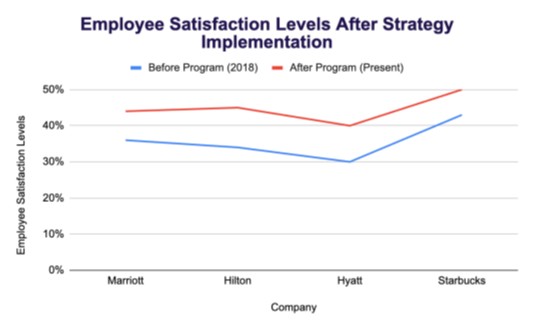
While all companies show a significant increase in employee satisfaction levels post-strategy implementation, the “RiseHY” program, launched in 2018 by Hyatt, has proven to be one of the most effective. This global program was designed to “introduce disconnected youth to hospitality,” establishing a set goal of providing 10,000 youth aged 16-25 with employment opportunities by 2025 (Weber 2018). As of present day, Hyatt has been successful in hiring 5,700 young people over the past 6 years, of which more than 40% are still employed through the company (Newsroom 2024). This program has contributed to a higher level of satisfaction as Hyatt has prioritized the fostering of a healthy, positive, supportive, and fulfilling work environment for these young employees. In addition, the RiseHY program has widened the talent pool, offering a potential solution to the staffing shortage and turnover challenges seen throughout the hospitality industry. Overall, RiseHY has shown Hyatt’s dedication to their employees as they award them priceless opportunities and do everything possible to set the industry up for success in the future.
CHART 3: Employee Retention & Wage Increase Comparison
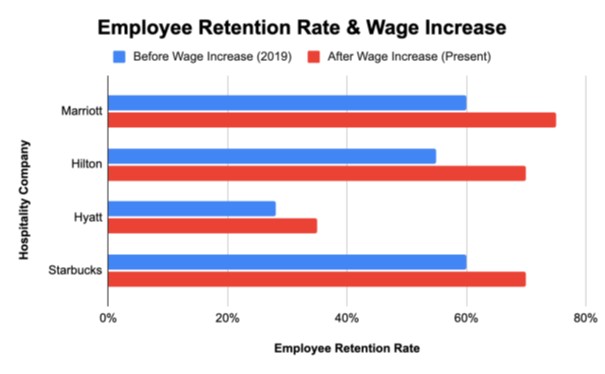
The increase in employee retention rate as a result of wage increase is undeniable across the board. The rising of employee retention rates in these companies, however, can also be attributed to the opportunities that are presented to the employees. Hilton has launched a unique program that offers in-office health clinics, recommendations for babysitters and childcare, and abundant resources for the mental health of team members (Mazumdar 2022). As a result of these benefits, and the use of DailyPay, a financial service that gives users access to their wages daily instead of at the end of the pay period, Hilton has seen an incredible employee engagement rate of 93% (Burleigh 2024). The “Starbucks College Achievement Plan” offers employees a fully covered Bachelor’s degree through Arizona State University where employees are encouraged to explore opportunities for their education that were originally unattainable for them (Starbucks ASU 2023). This program has helped more than 10,000 employees graduate, 20% of which are first-generation college students. This has not only attracted more employees and motivated them to stay with the company, but it also has increased revenue for the company. Starbucks chose to invest 20% of these profits back into the employee experience through increased wages, more extensive training, and new equipment, leading to a notable decline in turnover rates (Starbucks 2023). Both of these companies have provided their associates with opportunities that encourage them to stay loyal and dedicated to the corporation, giving them the resources they need to attain higher degrees, better their mental and physical health, and explore more opportunities for growth.
RECOMMENDATIONS
Starting from the perspective of Danny Meyer, there are many possible solutions to help address the soaring rates of employee turnover in the hospitality industry. Meyer’s idea of developing a sense of purpose beyond the workplace can be applied to addressing turnover in hospitality businesses by creating programs that allow employees to give back to the community. For instance, companies can offer paid time off for employees to volunteer, partner with local organizations, or sponsor community events. This provides employees with an opportunity to connect with their local environment and deepen their relationship with the company, further enhancing job satisfaction and loyalty.
In an effort to strengthen connections between customer and employee, companies can offer and enforce training programs that emphasize emotional intelligence, conflict resolution, and customer care. These types of programs empower employees to handle stress and difficult situations while ensuring that customers continue to receive exceptional service. As employees gain confidence in their ability to handle various customer-facing situations, their stress levels decrease, leading to lower turnover rates. Overall, Meyer places great emphasis on finding solutions that are rooted in employee appreciation and establishing stronger ties with the community.
Many of the comprehensive strategies suggested by Meyer are equally supported by the case studies and independent research conducted for this paper. However, there are other strategies that companies can look to adopt for the betterment of their employees such as the implementation of an employee feedback system to ensure that each employee is heard and that their opinions are valued. There is also the recommendation to invest in extended training and development opportunities like paid certifications, continuing education, and professional development programs like the ones demonstrated by many of the top hotel companies to motivate employees to grow and thrive within their organizations. The chance to offer opportunities for upward mobility goes hand in hand with this recommendation, as employees are likely to stay within a company if there are known opportunities for growth and development (Roosted 2023). Individuals crave job security, and giving them the chance to visualize a long-term future with the company is an extremely effective way to prove they are valued, appreciated, and trusted to contribute to the company’s success.
CONCLUSION
In conclusion, the hospitality industry is facing a critical issue with labor shortages and high turnover rates, which have significant implications for employees, businesses, and customers. As highlighted throughout this paper, factors such as unsatisfactory wages, workplace stress, lack of employee appreciation, and limited career growth opportunities contribute to the challenges of attracting and retaining staff. These issues have a cascading effect on business operations, with negative consequences for employee morale, customer satisfaction, and overall productivity. However, through strategic approaches such as improving wages and benefits, enhancing work culture by encouraging community involvement and bonding activities, investing in proper training, and providing more opportunities for advancement, companies can begin to mitigate these challenges.
The significance of the survey conducted for this paper further underscores the real-world impact of these challenges. By collecting insights from current and former employees in the hospitality industry, the survey offers valuable, firsthand perspectives on the root causes of turnover and labor shortages. The findings confirm the widespread dissatisfaction with working conditions and highlight areas where companies can improve to better support their workforce.
Additionally, lessons drawn from case studies of successful companies like Marriott, Hilton, Starbucks, and Hyatt, and insights from industry leaders like Danny Meyer emphasize the importance of employee appreciation, community involvement, and a strong feedback loop to foster long-term retention. By implementing these solutions, a more supportive, appreciative and sustainable work environment can be created to ensure both employee well-being and satisfaction. With the right approach, the hospitality industry has the opportunity to make great strides in reducing turnover, enhancing employee retention, and ultimately improving both business operations and customer experience.
REFERENCES
American Hotel and Lodging Association (AHLA). (2023). 76% of surveyed hotels report staffing shortages. Retrieved from https://www.ahla.com/news/76-surveyed-hotels-report-staffing-shortages
Arizona State University. (n.d.). Starbucks College Achievement Plan. Starbucks College Achievement Plan | Starbucks ASU Partnership. https://starbucks.corporate.asu.edu/starbucks-college-achievement-plan
Burleigh, E. (2024, April 24). Hilton credits their 93% engagement rate to a strong ERG culture and a “virtuous cycle” of benefits. Yahoo! Finance. https://finance.yahoo.com/news/hilton-credits-93-engagement-rate-105500899.html
DailyPay. (n.d.). Staff turnover rates in the hotel and hospitality industry. Retrieved from https://www.dailypay.com/resource-center/blog/staff-turnover-rates-hotel-motel-hospitality-industry/
Harver. (n.d.). Causes of employee turnover in hospitality. Retrieved from https://harver.com/blog/causes-of-employee-turnover-in-hospitality/
HiltonCareers Team. (2022, June 22). What is Thrive at Hilton? Q&A with Hilton Benefits leader. Thrive at Hilton. https://jobs.hilton.com/us/en/blogarticle/what-is-thrive-at-hilton-qa-with-benefits-leader
HospitalityNet. (2023). Labor shortages in the hospitality industry. Retrieved from https://www.hospitalitynet.org/opinion/4118580.html
Hyatt. (2024, March 20). More than 5,700 careers created: Hyatt’s Opportunity Youth Advancement Program marks a major milestone. Hyatt Newsroom. https://newsroom.hyatt.com/news-releases?item=124476
Kanner, M. G. (2024, October 10). The Marriott Voyage Program Overview: Salary, details & more. Life at Marriott Blog. https://life.marriott.com/blog/voyage/
Luther, D. (2024, June 24). 13 hospitality industry challenges. NetSuite. https://www.netsuite.com/portal/resource/articles/erp/hospitality-industry-challenges.shtml
Magee, T. (2024, November 8). Industry commentary survey. Industry Commentary Survey. https://docs.google.com/forms/d/e/1FAIpQLSe0SoDx86D1kzExhkaIaP0pjH3zY4ySzna_zFG5ip6h1BKNMw/viewform?usp=sf_link
McGlauflin, P. (2024b, June 21). How Marriott solved its record-high turnover crisis by rolling out flexible schedules and blending job roles. Yahoo! Finance. https://finance.yahoo.com/news/marriott-solved-record-high-turnover-120139994.
Meyer, D. (2006). Setting the table: The transforming power of hospitality in business. HarperAudio.
Roosted. (2023, March 13). 8 reasons for employee turnover in Hospitality. Roosted HR. https://www.roostedhr.com/8-reasons-for-employee-turnover-in-hospitality/
Seymour, A. (2022, August 29). Hospitality sector named the most stressful to work in. Catering Insight. https://www.cateringinsight.com/work-related-stress-guide-released-for-hospitality-sector/
Starbucks Corporation. (2023, November 6). Starbucks raises the bar with industry-leading employee benefits, outperforming competitors. Starbucks Press. https://about.starbucks.com/press/2023/starbucks-raises-the-bar-with-industry-leading-employee-benefits-outperform-competitors/
APPENDIX
Survey Questions Created by Author, Distributed through Google Forms.
- Are you currently employed?
- What is your age range?
- Are you currently employed within the hospitality industry?
- If so, what is your role in the industry?
- What is your current employment status? (full-time, part-time, seasonal, freelance)
- How would you rate your job satisfaction on a scale of 1-5?
- Which factors most impact your job satisfaction? (e.g. pay, work-life balance, benefits, management support)
- What is the most challenging part of working in hospitality today?
- How often do you experience stress or burnout related to your job?
- How frequently does your workplace experience staff shortages?
- In your opinion, what are the primary reasons for labor shortages in the hospitality industry? (e.g., low wages, lack of benefits, high turnover, demanding work hours)
- Has your company had to adjust its services, hours, or offerings due to staffing challenges? If so, how?
- Are you aware of any employees who left the industry? If so, what were their main reasons?
- How would you rate the difficulty of hiring qualified staff on a scale of 1-5?
- Which recruitment strategies does your company use?
- What retention efforts has your company implemented to retain staff? (e.g., increased wages, flexible scheduling, career growth opportunities, additional training)
- What do you believe would make the industry more attractive to potential employees?
- Do you feel that employees receive adequate training and support in their roles? Why or why not?
- How important do you think training and development programs are for employee retention?
- In what areas do you think the hospitality workforce could benefit most from additional training? (customer service, technical skills conflict resolution, management, other)
- What long term solutions do you think could help alleviate the labor shortage in the hospitality industry? (e.g. increased wages, better benefits, improving workplace culture, etc.)
- On a scale of 1-5, how optimistic are you about the future of labor stability in the hospitality industry? (1 being very pessimistic, 5 being very optimistic)
- What policy changes (if any) would you recommend to address workforce issues in the hospitality industry?
- Is there anything else you would like to share about labor shortages or working conditions in the hospitality industry?