Artificial Intelligence Technology Used Within the Hospitality Industry, Enhancement or Hindering Tool?

ABSTRACT
The purpose of this paper is to highlight the advantages and disadvantages of Artificial Intelligence (AI) within the hospitality industry as it is quickly advancing and expanding to all parts of our lives, creating a more convenient way of life. When it comes to the hospitality industry, this convenience can be viewed as enhancing the experience or hindering it. As businesses within the industry strive to create that convenience for guests, they also must consider the balance that needs to exist in order to remain viable and competitive. The hospitality industry has always run on face-to-face interaction and touch, which AI is now creating a new path of receiving that interaction. Sectors must work together to incorporate this technology instead of allowing AI to take over the full experience.
Keywords
Artificial Intelligence, Hospitality Industry, Technology, Hotels, Restaurants
INTRODUCTION
Artificial intelligence (AI) is increasingly becoming an integral part of the everyday norm. Whether through simple activities, such as streaming services analyzing user watch preferences, or complex activities, such as content creation or self-driving cars, AI serves as an influence in both our personal and professional lives (University of York, n.d.). When it comes to the hospitality industry, AI technology is not just a technological trend, but a representation of the fundamental shift in how organizations like hotels and restaurants can operate, and serve guests, while offering opportunities for efficiency, personalization, and innovation (Morch, 2024). There is no escaping AI, as its functionality is present in the palm of your hand through social media, applications, and emails, freeing up time by creating an easier, convenient way of life. The power of convenience paves the way for growth within the hospitality industry, optimizing the guest experience. With the increasing use of AI, those who fail to embrace this technology trend miss out on the benefits, leaving themselves at a disadvantage (Hollander, 2024). However, while AI proves to be beneficial to the industry, this new advancement comes with a set of challenges and complexities that can be harmful to not only guests, but to employees as well (Krzak, 2023). It’s important for these businesses to have a balanced approach when it comes to AI technology to ensure that human interaction remains a constant in the hospitality industry.
INDUSTRY CONTEXT
The idea and concept of artificial intelligence (AI) refers to the simulation of human intelligence possessed by machines and software (Iberdrola, n.d.). While the concept of AI has existed for quite some time, the idea was first presented as a model of artificial neurons in 1943 by Warren McCulloch and Walter Pitts, which laid down the foundation and development of artificial networks. In 1950, the question of “Can machines think?” arose, resulting in an experiment to determine whether machines could possess human behaviors and skills, such as problem solving, pattern recognition, and decision making. AI technology also focuses on collecting and processing data, based on an algorithm made up of logic and deep learning. This technological trend spans multiple industries, from cybersecurity to finance services to retail, and even healthcare. The biggest sector is now being found within the hospitality industry.
The hospitality industry has a lot of person-to-person contact, be it in hotels, restaurants, attractions, or event services. With the focus being on personal interaction, it begs the question of whether AI technology will enhance that experience or interfere with it. Based off a PwC survey in 2021, 86% of CEOs agree that AI will become a mainstream technology that will be used by their own companies within the next five years (Roelen-Blasberg, 2024). In another survey provided by the Hotel Tech Report, 40% of jobs around the world are expected to be impacted by AI, while 56% of those jobs are believed to be partially or fully replaced by AI technology within the next few years (Hollander, 2024). With any new advancement, there will be positive and negative implications, but it’s critical to remember that there must be a balanced approach where this technology is used as a supportive measure rather than a tool that dominates the true guest experience.
DISCUSSION
The hospitality industry has always been about human interaction and touch, a cornerstone of customer service (Karagiannis, 2024). Now, more and more sectors are beginning to see how integral artificial intelligence is becoming and what it can do for them. The traditional hospitality approach has now been shifted to a tech-driven one, focused on operational efficiency and personal preferences. AI can be used in a multitude of ways, and within all sectors of the industry. Some businesses in the restaurant and hotel sector are weary about incorporating AI, as they are still facing the aftermath of COVID-19. While some businesses were able to bounce back, others are being forced to close as they struggle to make a profit based on a variety of factors, such as increased food costs and rent, employee retention, and supply shortages. AI might not be able to fix certain factors, but it can be an aide in the process. For these reasons, it would make sense that some sectors are wary to incorporate and invest time in this technological trend, but the effects of not incorporating AI could be more damaging. The focus should be on ways to enhance the customer experience, versus replacing it.
As previously mentioned, AI exists in numerous different functions. Based on capabilities, there are three different types of AI (IBM, 2023). Narrow artificial intelligence, or Narrow AI, can perform only one single or narrow task within a limited scope (Interaction Design Foundation, 2023). This would consist of tasks using image and voice recognition, chatbot systems, and language translation services. Some well-known platforms of this type of AI include assistants such as Alexa or Google, Spotify, and Netflix. Even social media feeds are considered a type of Narrow AI. Artificial general intelligence is theoretical and consists of learning skills much like a human has, without having the human to train the model (IBM, 2023). This type of AI relates closely to the Theory of Mind AI, in that it will understand and process the cognitive abilities and emotions that a human being would possess. This tool is meant to assist with operations instead of fully taking over. Examples of this type of AI include ChatGPT and self-driving cars. The last type of AI, Super AI, or artificial superintelligence, is strictly theoretical and would surpass the cognitive abilities and emotions of a human being (2023). This version would be able to create and feel emotions, along with beliefs, desires, and reasonings. While Super AI remains theoretical, most sectors within the industry are using narrow AI and general AI. However, both are constantly evolving and update frequently.
Chart 1: Generative AI in the Hospitality Market
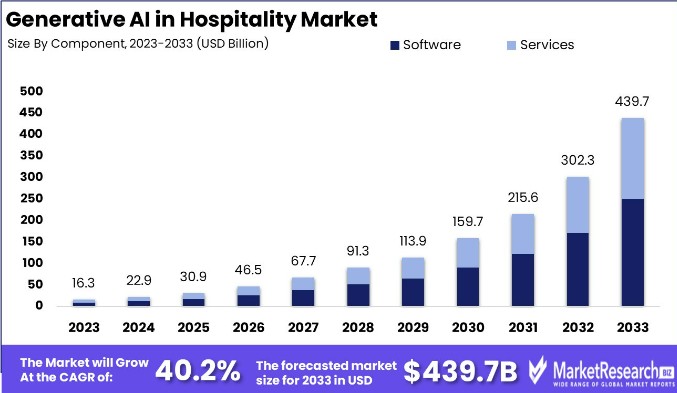
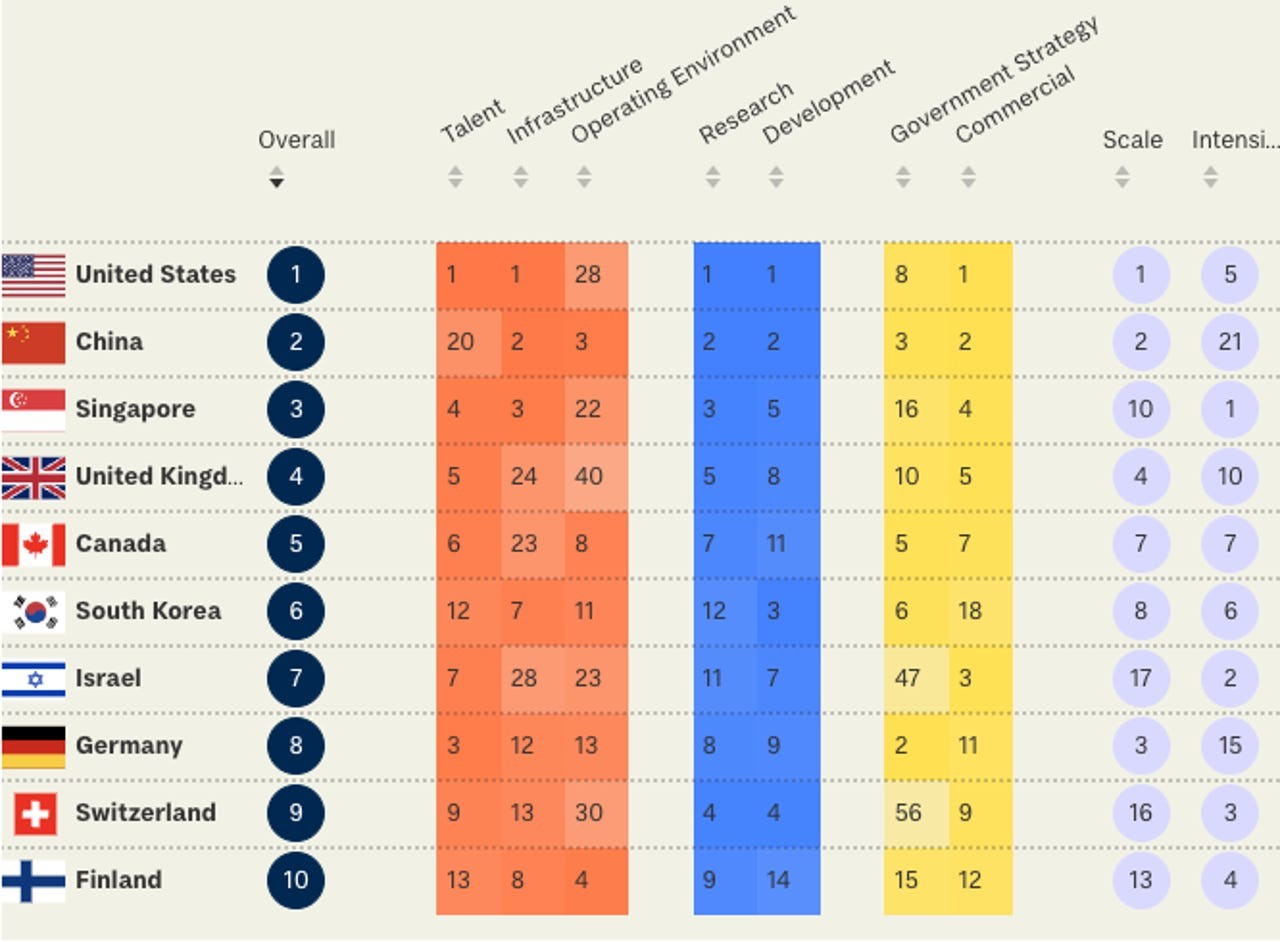
As depicted in the chart above by MarketResearch.Biz, generative AI is expected to reach $439 billion by 2033, with a 40.2% compound annual growth rate (Pharmiweb, 2024). It’s important to point out that both software and services are increasing as well for each year. When it comes to analyzing AI usage, Chart 2 below indicates that the United States is currently the leading country, as it is the highest ranked in terms of investment, innovation, and implementation (Ortiz, 2023).
Chart 2: Global Index of AI Development
What Does This Mean for the Hospitality Industry?
From the results of Charts 1 and 2, AI development and usage is in no way slowing down. AI has the opportunity to offer immense benefits, if used correctly and used to address ongoing concerns. In terms of the hospitality industry, this advancing tool can assist with operational efficiency, personalization, service, and so much more. AI is not a trend that will go out of style, but a force that is setting new standards. When guest demands are changing and evolving, so must the process. For hotels that have incorporated AI, it has been a game changer and helped to streamline and relieve burdens, allowing more focus on other parts of the business. Restaurants incorporating this technology have also had their fair share of success in terms of increased revenue.
AI Tools to Support Hotel Operations
Live chatbots are equipped and available 24/7 to handle guest inquiries, reservations, checkout, and payments (Cook, 2024). This is not only convenient for the guest, but it also allows employees to focus on other areas of the hotel. Going along with chatbots, group messaging is another important convenience for guests. This type of messaging can be over email or text and generally interacts with guests before, during, and after their stay. Very similar to a front-desk employee, the messenger will respond to any inquiries, make necessary reservations, and assist with requests, say for example if a guest needs more toiletries or towels. More and more consumers are choosing to stay where a personalized experience is provided. Services are being tailored by consumer preferences and behaviors to enhance room settings and customized dining (Karagiannis, 2024). Smart room technologies are enhancing the experience via smart thermostats, automated lighting controls, and in-room entertainment (Pharmiweb, 2024). Understanding and personalizing guests’ needs has also been linked to upselling, further increasing revenue.
To coincide with revenue, AI technology has also played a crucial role when it comes to revenue management. By analyzing data, hotels can set prices based on demand and occupancy during low and peak seasons based on accurate forecasting (Triendl, 2023). What is considered a time-consuming and complicated process can be done instantly and effortlessly, analyzing the market and strategizing opportunities. This type of forecasting also goes hand in hand with scheduling, making sure that resources are allocated to the right places at the right times. Using AI technology also assists in minimizing human error that would consist of more time fixing and analyzing, taking employees and staff away from other duties. This also further helps to reduce costs, allocate resources, and diminish waste and unnecessary expenses (Karagiannis, 2024). It’s surprising how many businesses are unaware of exactly how much they spend, along with where those costs are going. Using these tools also helps improve staff productivity, allowing them to provide the personalized customer service AI cannot.
AI is not meant to replace in-person jobs, but it does aid with the labor shortages that some areas are experiencing. Some of the most used or known platforms that exist when it comes to hotels are Visito, Aiosell, EasyWay, and Ivy the Direct Messenger (SiteMinder, 2024). Some large hotels, like Hilton, have even invested time into creating their own unique platform, a robo-concierge named Connie, that can welcome guests along with addressing their needs and wants (Johnson, 2019). Connie is also used as a marketing tool, drawing in guests who want to see this advanced development in action. Marketing and content creation serve as another important tool when it comes to AI technology. Content can be created in an instant, in a variety of ways, in a multitude of languages (Triendl, 2023). The technology can pull out identifying keywords, write out elaborate and unique descriptions, as well as target a certain audience.
AI Tools to Support Restaurant Operations
While AI has shown advancements when it comes to hotels, the technology has also become integral to restaurants. Like hotels, more and more restaurants are using booking platforms when it comes to reservations. Through these services, restaurantgoers can update their party size, dates, times, and even add on services directly through the application. Emails and texts can also be sent directly to the customer, equipped with a calendar option they can share with their party. Ordering food directly through an application or kiosk has also existed for quite some time, creating convenience and personalization, but the newest trend is AI voice ordering (2023). Through the power of voice commands, guests quickly place their orders, without having to worry about managing through an app. Facial recognition software is even being tested to provide more convenient ways to order, pick up and deliver. Restaurants have even gone a step further by adding in AI technologies that have the ability to pick up phone calls, detecting certain words or phrases to answer customers’ questions. For one restaurant in the Colorado area, this was a big help, as it saved employees from the large volume of calls that would come in (Popmenu, 2024).
Selecting data tools involving AI also makes inventory management ordering more accurate, as data can be tracked based on trends, market, and season (Triendl, 2023). These tools can also assist when it comes to scheduling, allowing the general managers and back of house to focus on more important aspects of the operation. Robotics have also become the new “chefs” in the kitchen. One popular food chain in California is set to open the first fully autonomous artificial intelligence restaurant, with the latest kitchen technology featuring an advanced grill and fry station that will handle food preparation along with providing integrated ordering technology and order fulfillment through facial recognition (Kanesa, 2024). This chain will also hire human employees, but on a smaller scale than regular fast-food chains. Yum Brands, a fast-food corporation that oversees chains such as KFC, Taco Bell, and Pizza Hut, is constantly pushing the use of AI technologies and is looking toward its next phase. The company believes itself to be at a competitive advantage, as its technologies are working on labor scheduling, inventory management, quality control monitoring, and marketing (Maze, 2024).
Taco Bell has experienced the most use of AI, adding a voice activation ordering system, launching a loyalty and membership drive-thru and a kiosk based on facial recognition. Wendy’s locations in Ohio and Florida have also launched their latest advancement, partnering with Google Cloud to provide their version of FreshAI, a voice ordering system in English and Spanish (Kell, 2024). They also hope to one day incorporate a chatbot that will be able to translate items on the menu, along with detailing the ingredients. One of the main reasons these fast-food chains are testing and investing in this technology is to keep up with the competition. While other chains are fighting to incorporate these trends, it begs the question as to why other larger chains, like McDonald’s, have decided to opt out.
Negatives to Incorporating AI in Hotels and Restaurants
While AI would seem to be most beneficial to these sectors, there are also some concerns that need to be addressed before they are incorporated. The main concern regarding AI is losing the hospitable factor. Does automation make things less personal? What experience do guests receive by booking everything online right through their phones? Check-ins and check-outs have now been made convenient for hotel guests as procedures are done through phone applications or through the in-room television, bypassing the front desk experience. Even in restaurants, ordering through an application can be viewed as taking away from the experience. Despite this, Oliver, from AI Hospitality Insights, believes AI will become the secret weapon of the hospitality industry, if used correctly (AI Hospitality Insights. 2024).
With applications and technologies doing the jobs of those working in hotels and restaurants, will people begin to lose their jobs? As more tasks become automated, traditional skills may decrease as tech-savvy skills increase (Karagiannis, 2024).
Becoming dependent on AI can create a risk that could impact business. Like with any other piece of technology, what happens if it fails? Platforms for both hotels and restaurants could malfunction, creating double booking or canceling reservations. A system could even charge or overcharge guests. Anything could happen. This type of concern could also become associated with data privacy and security concerns involving personal information. All technology would need to be constantly maintained and regularly updated to ensure everything is running smoothly. It’s important to note that not all businesses operate the same, so the AI platforms must be able to integrate with the existing technology to align with certain goals (2024). Another concern with adopting AI is the cost. Not only would there be a fee to invest in the technology, but what if it breaks? It could end up costing more than it took to install. At that point, it would be entirely up to the business to decide whether it is worth fixing.
AI and Additional Research
The question remains, can AI technology exist within the hospitality industry?
Abraham Terrah, a Spears School of Business Ph.D. student, was able to witness firsthand the major impact AI had on the industry as he worked on completing his master’s degree in hospitality management when the pandemic hit in 2020 (Hart, 2024). He struggled to study and work in the industry, quickly realizing that AI would shape its future. Driving factors for hotel guests to use AI technologies ultimately became his master’s thesis, focusing on why people are drawn to using AI, whether they were prone to curiosity and the latest trends, or whether they were drawn to the convenience and usefulness. As stated by Dr. Cortney Norris, Abraham’s advisor, “The HTM program focuses on preparing students for the evolving needs of the hospitality industry, emphasizing technology and innovative practices shaping the future. Abraham's expertise in the intersection of technology and hospitality positions him as a valuable researcher for analyzing and predicting consumer behavior and preferences with these emerging technologies” (2024).
Not only is Abraham currently working on a project involving personalization-privacy, but he is also conducting research with robots designed to work in the hospitality field. He describes these beings as a “complement” versus a substitute for human beings, as the industry is now becoming tech-based and encourages people to embrace the change (2024). Another case study on AI, robots, and their impact on the hospitality industry performed by Suneel Kumar, Varinder Kumar, and Kamlesh Attri also found that AI and robotics are not meant to take away jobs but could in fact add to the industry (Kumar, 2021). AI has ingrained itself into lifestyles, but the “cornerstone of customer service” will never go away and will never be replaced but will be enhanced so these sectors remain agile and competitive (Karagiannis, 2024).
CONCLUSION
This powerful technological tool can exist within the industry if there is a balance between convenience and human interaction. While humans’ preferences are shifting, there are ways for practitioners to sustain that balance. Select technological advancements that exist within the hotel and restaurant sector have been successful in providing those services, such as digital check-in and check-out procedures and the ability to book, edit, and cancel rooms and reservations directly through a website or application. Even incorporating chatbots to help answer questions has provided a 24-hour, seven-days-a-week “assistant” that eliminates the extra step of making a phone call or tracking someone down. However, despite the assistance, practitioners can ensure human staff are still available to assist with requests that require specific instructions or personalization, encouraging human interaction whether it be in person or over the phone. AI technologies do not have the capability to possess human emotion and connection, so it’s important to encourage that interaction. Some employees fear that AI will take over jobs within the industry, but the technology is not meant to replace, but to augment the experience.
As previously mentioned, AI can assist with collecting data focused on services and preferences, but practitioners should not rely on attaining that information solely through digital means. Therefore, they need to limit the amount of AI usage and focus on exactly where and when this technological advancement fits into their sectors, to ensure that all needs are being met, not just with consumers, but with employees as well. Incorporating too much of this technology, like the “chefs” that have taken over the fast-food chain in California, could potentially hurt that part of the industry. Using AI to assist with scheduling, inventory, and small tasks can be helpful, but there are more disadvantages than advantages. Aside from the lack of human interaction, there’s the cost that goes into implementing the technology and the service that goes into ensuring it is working correctly. What if it breaks down or malfunctions? Is there a team that needs to be hired to maintain, service, and update the technology? Further research would need to be conducted to determine whether adding these advancements is worth it for the operation.
To conclude, AI can enhance hospitality and the experience when it comes to certain aspects of the industry. The idea isn’t for this technology to completely take over and run the business, but it should be able to be used as an assistance tool to allow growth in other parts of the operation. By simply allowing AI to take over, it would remove the very essence of what the hospitality industry is all about. Therefore, there must always be a balance between convenience and human interaction for the industry to remain viable and competitive.
REFERENCES
AI Hospitality Insights. (2024).The AI Revolution in Hospitality: Adapt or Get Left Behind! https://www.youtube.com/watch?v=i1BABSarWWg apt or Get Left Behind!
Cook, Lana. (2024). Cloudbeds. AI in hospitality: 12 ways artificial intelligence is impacting hotels.https://www.cloudbeds.com/articles/ai-in-hospitality/ y: 12 ways artificial intelligence is impacting hotels.
D, Kanesa. (2024). Trendhunter. CaliExpress Offers Burgers and Fries Prepared by AI Technology.https://www.trendhunter.com/trends/caliexpress.
Hart, Hallie. (2024). OSU. High-tech hospitality: Ph.D. student Abraham Terrah offers insight into AI’s growing role in hotel service. https://news.okstate.edu/articles/business/2024/abraham-terrah-research.html.
Hollander, Jordan. (2024). HotelTechReport. AI in the Hospitality Industry: Here's What You Need to Know. https://hoteltechreport.com/news/ai-in-hospitality.
Iberdrola. (n.d.). Deep learning: a key concept to take artificial intelligence to the next level. https://www.iberdrola.com/innovation/deep-learning.
Iberdrola. (n.d.). Artificial intelligence: birth, applications and future trends. https://www.iberdrola.com/innovation/history-artificial-intelligence#:~:text=John%20McCarthy%20coined%20the%20term,with%20a%20boost%20in%20funding.
IBM. (2023). Understanding the different types of artificial intelligence. https://stampede.ai/blog/3-clever-ai-tools-to-support-your-hotel-operations IBM.
Interaction Design Foundation. (n.d.). Narrow AI. https://www.interaction-design.org/literature/topics/narrow-ai#:~:text=Narrow%20AI%2C%20sometimes%20called%20Weak,when%20compared%20to%20human%20intelligence.
Johnson, Dan. (2019). SmartMeetings. Tiny Robot Concierge Stands Tall.https://www.smartmeetings.com/tips-tools/technology/85518/hilton-ibm-robot-concierge-stands-tall.
Karagiannis, Manos. (2024). Medium. AI in Hotels: Unveiling the Pros and Cons for Modern Hoteliers. https://medium.com/hotel-tech/ai-in-hotels-unveiling-the-pros-and-cons-for-moderhoteliers e309261bc405#:~:text=Risks%20of%20System%20Failure%20and,service%20disruptions%20and%20guest%20dissatisfaction.
Kell, John. (2024). Fortune. Inside Wendy’s drive-thru AI that makes ordering fast food even faster. https://fortune.com/2024/10/15/wendy-google-ai-drive-thru-expansion/ dy’s drive- thru AI that makes ordering fast food even faster | Fortune.
Kumar, S., Kumar, V., & Attri, K. (2021). Impact of Artificial Intelligence and Service Robots in Tourism and Hospitality Sector: Current Use & Future Trends. Administrative Development: A Journal of HIPA Shimla, 8(SI-1), 59–83. https://doi.org/10.53338/ADHIPA2021.V08.Si01.04.
Krzak, Robert. (2023). Gecko Hospitality. The Downside of AI Technology in the Hospitality Industry. https://www.geckohospitality.com/2023/04/13/the-downside-of-ai-technology-in-the-hospitality-industry/.
Maze, Jonathan. (2024). Restaurant Business. For Taco Bell parent Yum Brands, the future is AI.https://www.restaurantbusinessonline.com/technology/taco-bell-parent-yum-brands-future-ai rands, the future is AI.
Morch, Are. (2024). HospitalityNet. The AI Revolution in Hospitality: Transforming the Hotel Industry through Innovation and Employee Empowerment. https://www.hospitalitynet.org/opinion/4123075.html.
Ortiz, Sabrina. (2023). ZDNet. AI arms race: This global index ranks which nations dominate AI development. https://www.zdnet.com/article/ai-arms-race-this-global-index-ranks-which-nations-are-dominating-ai-development/.
Pharmiweb. (2024). Overview of the Generative AI in Hospitality Market. https://www.pharmiweb.com/press-release/2024-03-20/generative-ai-in-hospitality-market-projected-to-grow-at-402-cagr-crossing-us-439-billion-by-203 rket Projected To Grow At 40.2% CAGR, Crossing US$ 439 Billion By 2033, Reports Marketresearch.Biz - PharmiWeb.com.
PopMenu. (2024). AI in restaurants: 9 ways artificial intelligence is shaping the food industry. https://get.popmenu.com/post/ai-in-restaurants artificial intelligence is shaping the food industry.
Roelen-Blasberg, Tobis. (2024). Mara. AI Statistics in Hospitality: A Glimpse into the Future. https://www.mara-solutions.com/post/ai-statistics-in-hospitality#:~:text=Looking%20ahead%2C%20half%20of%20all,within%20the%20next%20five%20years.
SiteMinder. (2024). AI in the hospitality industry: Artificial intelligence for hotels. https://www.siteminder.com/r/artificial-intelligence-ai-hospitality-industry/#:~:text=AI%20helps%20you%20implement%20dynamic,bookings%20and%20increased%20overall%20revenue Artificial intelligence for hotels.
Triendl, Cate. (2023). Stampede. 3 Clever AI Tools To Support Your Hotel Operations. https://stampede.ai/blog/3-clever-ai-tools-to-support-your-hotel-operations To Support Your Hotel Operations - Stampede.
Triendl, Cate. (2023). Stampede. 3 Restaurant-Specific AI Tools That Drive Sales. https://stampede.ai/blog/3-restaurant-specific-ai-tools-that-drive-sales ools That Drive Sales - Stampede.
Triendl, Cate. (2023). Stampede. The Pros and Cons of Using AI in Hospitality. https://stampede.ai/blog/the-pros-and-cons-of-using-ai-in-hospitality itality - Stampede.
University of York. (n.d.). Artificial intelligence and its impact on everyday life. https://online.york.ac.uk/artificial-intelligence-and-its-impact-on-everyday-life/.