Frequently Asked Questions
What is BCWEP?
BCWEP is a collaborative effort by the New Jersey Department of Children and Families and a consortium of accredited baccalaureate social work programs in New Jersey. The intent of the program is to enhance the public child welfare workforce by encouraging students with generalist social work education and additional coursework in child welfare to enter professional positions in New Jersey public child welfare agencies.
If awarded a child welfare traineeship through BCWEP, students' tuition and fees will be paid for one academic year. In return, students accepting a traineeship must sign a legally binding commitment to work for the New Jersey Division of Child Protection and Permanencyfor a minimum of two years following graduation.
What do I get if I'm accepted?
If accepted, your senior year of tuition and fees are paid for, minus any grants and scholarships. BCWEP does not provide for housing, meals, or books.
Here is an example of how a tuition payment is calculated. Using simple math, assume it costs $10,000 for tuition and fees and you have a $3,000 grant, $2,000 scholarship, and $5,000 loan. BCWEP will deduct the $5,000 in grants and scholarship and pay the remaining $5,000 balance. We will ignore the loan so then you can either decline that loan and incur less debt or keep it so you get money to support you in other ways. That decision is ultimately yours and we cannot advise you what to do with it.
In addition to your tuition and fees being covered, after successfully completing your practicum, you will be hired by the NJ Division of Child Protection and Permanency after graduation.
Who may apply?
Any social work major in good standing enrolled at one of the participating colleges or universities may apply. Students must be ready to enter their direct service practicum placement, have a satisfactory grade point average, and be recommended by the faculty of their social work program.
If you are a student in your junior year, preparing to enter the senior practicum in the upcoming fall semester, and are taking/have taken the child welfare course, then you are able to apply.
PARTICIPATING INSTITUTIONS AND CONTACTS
- Centenary University - Tara Veerman, Campus Academic Coordinator, (Tara.Veerman@CentenaryUniversity.edu)
- Georgian Court University - Erica Hansen, Campus Academic Coordinator, (ehansen@georgian.edu)
- Monmouth University - Sarah Brown, Campus Academic Coordinator, (sabrown@monmouth.edu)
- Kean University - Jennifer Pax, Campus Academic Coordinator, ( jennifer.pax@kean.edu)
- Ramapo College - Cardacia Davis, Campus Academic Coordinator, (cdavis3@ramapo.edu)
- Rider University - Timmesha Davis(tdavis@rider.edu), Campus Academic Coordinator
- Rowan University - Anne Rosenfeld (rosenfeldas@rowan.edu), Campus Academic Coordinator
- Rutgers University - Camden/Mays Landing - Natalie Bembry, Campus Academic Coordinator, (nmbembry@ssw.rutgers.edu)
- Rutgers University - New Brunswick - DuWayne Battle, Campus Academic Coordinator, (dbattle@ssw.rutgers.edu)
- Rutgers University - Newark - Lana Church, Campus Academic Coordinator, (lana.church@rutgers.edu)
- Saint Elizabeth University - Lauren Busfield, Campus Academic Coordinator, (lbusfield@steu.edu)
- Seton Hall University - Mary Landriau, Campus Academic Coordinator, (mary.landriau@shu.edu)
- Stockton University - Dawn Konrady Fanslau, Campus Academic Coordinator, (dawn.konrady@stockton.edu)
- William Paterson University - Jessica Lake (Lakej4@wpunj.edu) and Sharon Bale-Peña (balepenas@wpunj.edu), Campus Academic Coordinators
What happens if I have full tuition coverage?
BCWEP covers tuition and fees, minus grants and scholarships. It does not cover housing, meal plans, or books. If you have dedicated housing scholarships, BCWEP will exclude them from the calculation.
If you are fully supported by grants and scholarships, then there would be no financial payment made by BCWEP. While you would still have an employment committment of two years, if you left before that committment was met, you would not have a financial obligation.
Are there additional program requirements?
Yes, students must take at least one course in child welfare and request DCP&P for their practicum placement. Students are also required to attend an orientation, mid-year meeting, and specialized Work Readiness Training program that occurs virutally and in-person throughout the year.
Below is a list of the child welfare courses across the consortium:
- Centenary University: SWS-3075 Child Welfare
- Georgian Court University: SW265 Child Welfare
- Monmouth University: SW-461 Diverse Child Welfare
- Kean University: SOCI 364 Strengthening and Protecting Families in Child Welfare Social Work Practice
- Ramapo College: SWRK 227 Child Welfare
- Rider University: SOWK 281 Introduction to Child Welfare
- Rutgers University Camden/Mays Landing:
- Rutgers University Newark: 21:910:343 Children and Families
- Rutgers University New Brunswick: 910:476 Child Welfare Services and Practices
- Saint Elizabeth University:
- Seton Hall University: SOWK- 1311 Children Youth and Society
- Stockton University: SOWK 3650 Topics in Child Welfare
- William Patterson University:
What is the application process?
Students need to inform their program faculty of their interest in a child welfare career and BCWEP. Each social work program has a BCWEP Campus Academic coordinator who can offer assistance, advice, and information about the program.
Students meeting the eligibility requirements must complete the BCWEP application , an updated resume that includes employment history, education, relevant volunteer experiences, and specialized skills (such as ability to speak a second language), and a personal statement. The Social Work Faculty will then prepare a letter of recommendation and submit the materials to the lead institution, Stockton University.
BCWEP applications must be received no later than March 1st. The selection of students for a traineeship is based upon criteria which include available funding, geographic distribution, availability of practicum placements and qualified supervisors, grade point average, demonstrated interest in a child welfare career, and social work faculty recommendations. Acceptance into BCWEP is also contingent upon approval of the internship by DCP&P, which requires a background check and valid driver's license.
Successful applicants must undergo additional screening by the NJ Division of Child Protection and Permanency. All students interning at DCP&P must undergo a criminal background check, a CARI (Child Abuse Registry Index) check to verify that the student has no history of maltreatment of children, and a check of the applicant's driving record. A valid, non-provisional, driver's license is required. Because driving of state vehicles with clients is an essential function of this position, the following may disqualify you from consideration: driving record with five points or more within the past five years; any driving under the influence conviction within the past five years; or any combination of three motor vehicle violations/license suspensions within the last five years). Once cleared by DCP&P, students are matched with a qualified social work practicum instructor at a local or area office.
Do I need a driver's license?
Yes, a valid, non-provisional, driver's license is required. Driver's abstracts are reviewed to determine eligibility. Because driving of state vehicles with clients is an essential function of this position once fully employed, the following may disqualify you from consideration: driving record with five points or more within the past five years; any driving under the influence conviction within the past five years; or any combination of three motor vehicle violations/license suspensions within the last five years).
BCWEP participants must have a horizontal, non-provisional license in order to begin employment. For example, if a student is under 21 years old, and has a verticial provisional license, it must be updated to a horizontal standard license prior to the student being hired so there are no driving restrictions.
How far do I have to drive?
BCWEP strives to establish meaningful practicum experiences which means that you may have to drive up to an hour to get to your practicum location or training location. The commute will vary based on your proximity to the local offices within the counties you submitted in your application. It is best that your famliarize yourself with the DCPP local office map, so you can explore locations and select the counties that would work best for you.
Do I need a Social Security Number?
Yes, you need a social security number or ITIN and be fully eligible to be employed in the United States. If your Social Security card has "Valid for Work Only with DHS Authorization", you will need to provide additional documents to verify you are authorized to work in the United States. You will have to complete an I-9 Form for employment verification purposes.
DCF's AUTHORIZATION TO WORK: Selected candidates must be authorized to work in the United States according to the Department of Homeland Security, United States Citizenship and Immigration Services Regulations. This position does not offer visa sponsorship now or in the future.
I am an international student, am I eligible to apply?
Yes! You can certainly apply as long as you are aware of the employment requirements for DCF and are able to meet them.
DCF'S AUTHORIZATION TO WORK states: Selected candidates must be authorized to work in the United States according to the Department of Homeland Security, United States Citizenship and Immigration Services Regulations. This position does not offer visa sponsorship now or in the future.
Where can I do my practicum placement?
You can complete your practicum in any of the DCPP local offices, pending supervisor availability.
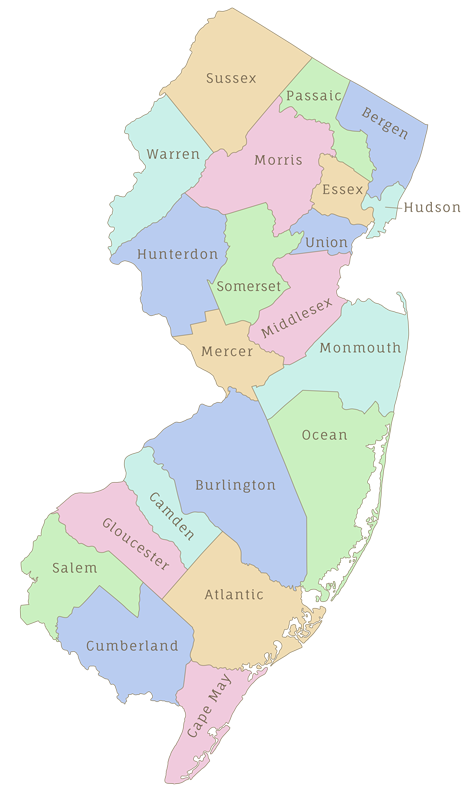
Every county has at least one local office. It is strongly encouraged that you view this map of DCPP local offices so you know which counties you'd like to include on your application.
Where is the funding coming from?
Traineeships are funded by the New Jersey Department of Children and Families.
What are the job requirements after graduation?
The responsibilities of the Family Services Specialist Trainee (FSST) fluctuate to meet the needs of the children and families we serve. For clarity and transparency, please review the below information pertinent to the requirements of this position.
- While the stated hours of work are 9am-5pm, your schedule will fluctuate based on caseload and you may be required to work outside of those hours, starting your day earlier or ending later as needed.
- Frequent driving of various state vehicles of all sizes is a requirement of this title.
- Transportation of clients may include travel across county, state, and/or international borderlines.
- As a trainee, there will be rigorous training within the first eighteen (18) months of hire. Such training may require attendance at a location different from your hiring office, including the Office of Training and Professional Development located in New Brunswick.
- The ability to perform heavy lifting (up to 100lbs) of children and their belongings is a requirement of this position.
- The requirements of this role may not be conducive to continuing education as educational accommodations cannot be guaranteed.
Should I apply?
You should apply only if you have a serious interest in working within the public child welfare system after graduation. Should you receive a traineeship, you will be required to make a commitment to work in child welfare for at least two years upon completion of your undergraduate social work degree. Should you be unable to fulfill this commitment, you will be required to repay the funds you received.
Can I still get my MSW if I'm in BCWEP?
Yes, you are still eligible to pursue a MSW degree. While it is recommended that you wait at least a year after you start working at DCP&P so you can get acclimated to the work and complete your training, it is possible to still attend an MSW program.
View our Program brochure for a summary of this information.
For further information:
Contact the local coordinator at your school or: Dawn Konrady Fanslau, Director (Dawn.Konrady@Stockton.edu) or Luz Pestritto, Program Coordinator (Luz.Pestritto@stockton.edu).